


The cup that looks like the obvious choice may not suit your service. Choosing biopak coffee cups wholesale means weighing up your menu, takeaway workflow, customer experience and the product information behind any environmental claims. Single-wall cups, double-wall options and BioPak Art Series designs each offer a different format to consider for your café’s counter.
Compostability claims need to match the exact cup and its documentation, and the disposal pathway matters too. This guide compares cup options, explains what to look for in certification information such as AS 4736, and sets out practical ways to plan stock around your service. Goodies Distribution is an authorised BioPak wholesale distributor, with a Sydney-local warehouse and Sydney-wide delivery. Use the guidance below to shortlist cups that suit your venue and present your brand clearly.
Key Takeaways
- Match single-wall, double-wall or Art Series cups to your drinks menu, service routine and preferred presentation.
- When buying biopak coffee cups wholesale, compare the format and documented details of each product before choosing a regular supply option.
- Check compostability and paper claims against documentation for the exact cup, including the relevant certification and disposal pathway.
- Use your venue’s service records to estimate cup use, select formats and plan replenishment around busy periods.
- Goodies Distribution supports Sydney hospitality businesses as an authorised BioPak wholesale distributor, with a local warehouse, Sydney-wide delivery and over 40 years of industry experience.
Why Sydney cafés choose BioPak coffee cups wholesale
For a Sydney café, takeaway cups are part of the daily service setup, not a one-size-fits-all purchase. Choose for the drinks on your menu, how orders move from the counter to customers, the impression you want the cup to make and the product claims you can support. Your regular ordering routine matters too: a suitable cup needs to fit the way your venue manages stock.
Wholesale BioPak coffee cups are supplied in quantities suited to a hospitality venue’s regular service, with the format selected to fit its menu, customer experience and purchasing needs. If your café serves takeaway coffee throughout the week, wholesale purchasing lets you plan repeat orders around your actual service pattern. Start with the way your venue operates rather than assuming every café needs the same cup setup.
What café operators need from a takeaway coffee cup
Consider the trip from the barista’s bench to the customer’s hand. Someone collecting one coffee has different practical needs from a customer carrying several drinks back to an office. Use these familiar service moments to decide which format fits your hand-off routine, whether accessories are needed and how staff can identify the right option during a rush.
Separate the cup’s function from optional presentation. The cup holds the drink for takeaway service, while branding is a separate choice that can express your café’s identity. Lids and stirrers are also separate items to plan for, based on how you serve drinks. Don’t infer heat retention, leak resistance or another performance feature from a cup’s name or appearance. Use product information to assess those details against your menu and workflow.
Why wholesale supply needs a venue-led plan
Wholesale decisions work best when they reflect the way your café trades. A busy morning takeaway counter may have different priorities from a venue where takeaway orders make up a smaller share of service. Note which drinks are commonly ordered to go, how customers collect them and whether your team needs one consistent setup or different options for parts of the menu.
Use your sales and service records to guide repeat purchasing. They can help you separate everyday requirements from items used mainly during particular service periods, without relying on generic consumption averages. A venue-led plan also gives staff a consistent basis for explaining cup choices and product information.
For Sydney cafés, the decision is a balance: choose a cup setup that suits the work at your counter, the experience you want customers to have and the supply routine your business can manage. This makes wholesale part of practical service planning, rather than simply a larger version of a one-off order.
BioPak coffee cup materials, formats and certification claims
Check material and certification details at product level. A familiar brand name or a general range description doesn’t establish what a particular cup is made from or which environmental claims apply. Keeping those details specific helps your team make clearer purchasing decisions and prevents one product’s claims being applied to another.
BioPak offers single-wall and double-wall cups, as well as Art Series cups. These describe format and presentation choices, but don’t establish which paper sourcing or compostability claims apply. For each option on your shortlist, use its product information as the reference point. Review cup construction, material description and certification as separate details.
How to read BioPak cup material and certification information
FSC-certified paper is a claim about paper sourcing. Check the documentation for the exact cup to establish whether the claim applies to the product you’re ordering. Don’t assume it covers every component or confirms compostability. This distinction is useful when preparing purchasing records or deciding what information to share with customers.
Certification claims belong to the exact product, not the whole range. Read the product documentation for the named standard and the scope of the claim. Refer to AS 4736 or EN 13432 in connection with a cup only where its documentation supports that statement. A seedling logo is a certification mark, not a guarantee that a local service accepts the cup. Keep the relevant product information with your ordering records so staff can refer to the same evidence.
What compostable means for a café’s disposal pathway
Certification and collection are separate parts of disposal planning. A product may carry a compostability claim, but that alone doesn’t establish that your café, building or local service has a suitable collection pathway. Confirm which waste stream your business can use and make sure signs and staff instructions match that arrangement.
Home compostability is a separate product claim. Look for documentation that specifically supports it and the relevant home compostable logos. Don’t infer home compostability from an industrial compostability claim. This helps staff answer customer questions accurately and keeps environmental messaging tied to evidence for the specific cup.
For wider context, the BioPak sustainable packaging guide can help cafés consider product claims alongside purchasing decisions and end-of-life arrangements. Goodies Distribution supplies BioPak cup options for wholesale buyers. Explore BioPak cups from Goodies Distribution as you compare product details and documentation for your venue.
Single-wall, double-wall and Art Series: compare BioPak coffee cups
Use this comparison to narrow your shortlist by construction and customer-facing presentation. It describes the formats, not their relative performance. Product details can vary, so refer to the relevant BioPak documentation before making a selection.
| Format | Confirmed description | Useful comparison question |
|---|---|---|
| Single-wall | A paper cup with a single-wall construction. | Does this format suit the way your team serves takeaway drinks and the presentation you want at hand-off? |
| Double-wall | A paper cup with a double-wall construction. | Does this construction fit the customer-facing format you want to use for your menu? |
| Art Series | A BioPak cup option featuring artwork, available in single-wall and double-wall versions. | Would an artwork-led cup complement your venue’s presentation, and which construction fits your service? |
Shortlist single-wall, double-wall and Art Series cups by service context and presentation, then compare the documented details of each product. A format that suits one café’s hand-off routine or visual identity may not suit another venue.
When a single-wall cup may suit the service
Consider a single-wall cup for your takeaway setup, then assess it against your menu and the way drinks move from preparation to collection. For example, note whether staff use the same format for several menu items or keep different options for distinct service needs. Check product information rather than inferring heat or handling performance from the construction name. Compare capacity separately using the BioPak 8oz versus 12oz cup guide.
When to compare double-wall and Art Series options
Double-wall describes a construction; Art Series describes a design option available in both single-wall and double-wall versions. Keep those attributes separate as you compare products. Artwork can contribute to how a takeaway order looks in a customer’s hand, while construction describes the cup format. Consider whether a design-led presentation fits your existing brand identity.
For a practical team discussion, compare one single-wall option and one double-wall option against the same service scenario. Consider how each fits your counter routine and the visual impression you want, then review the product-specific documentation. If you’re considering Art Series, treat its artwork as a presentation choice, not as evidence of a particular specification or performance level.
Keep cup size separate from this format decision. A size guide can help you assess capacity against your menu, while this comparison focuses on construction and design. Once you have a shortlist, record the exact product references your team is considering. This makes the next review more specific and ties purchasing decisions to the cups themselves, rather than broad assumptions about a format.
Plan BioPak coffee cups wholesale for Sydney service and stock
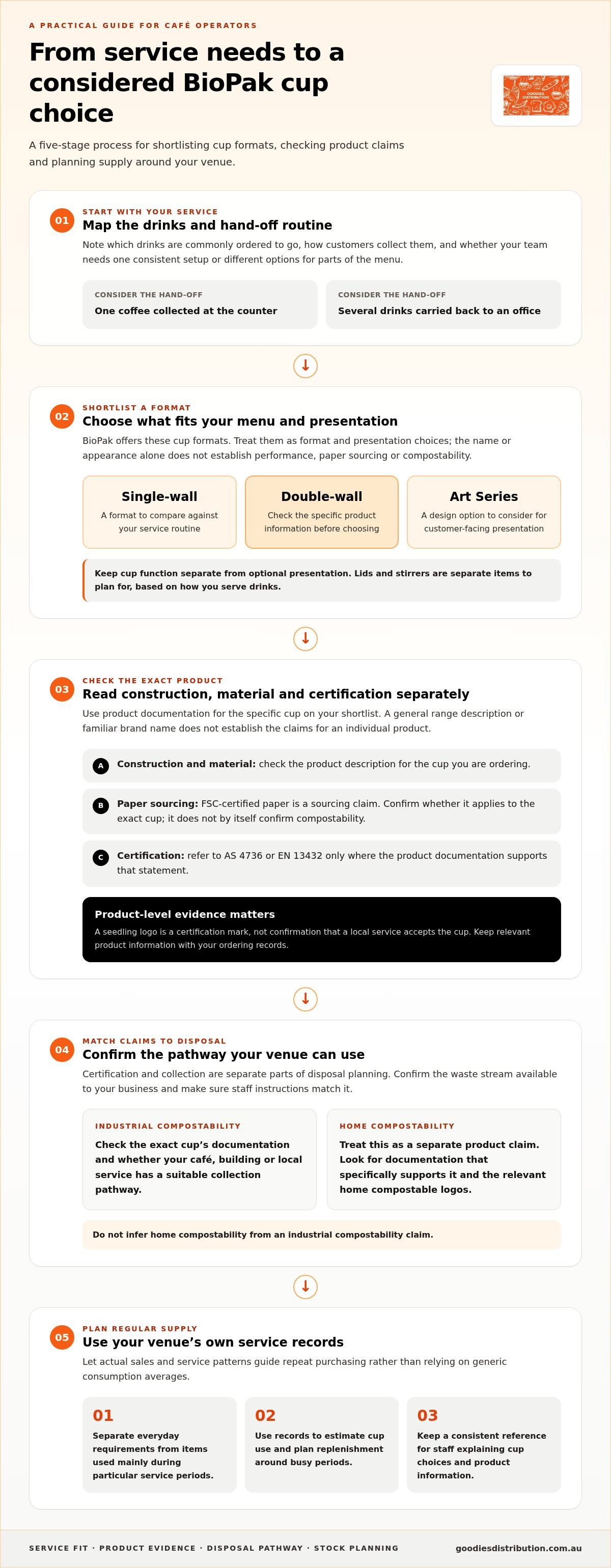
A reliable cup plan starts with your venue, not a standard carton mix. For Sydney cafés, match orders to your menu, service patterns and storage capacity, then set a replenishment routine around your records. Use this sequence to make each ordering decision clear and repeatable.
- Map your service needs. Review your menu and note which takeaway drinks need cups, including seasonal or event-related changes that affect your usual pattern.
- Select formats. Choose the single-wall, double-wall or Art Series options that fit your service and presentation priorities. Keep regular cup requirements separate from optional lids and stirrers.
- Check product documentation. Record exact product details and any claims you plan to communicate. This gives staff a clear reference when ordering and describing packaging.
- Plan replenishment. Use your sales and service records to estimate usage, then set a time to review stock and arrange the next order.
A practical wholesale ordering checklist for cafés
Keep a simple ordering sheet that separates core cup requirements from add-ons. Track the formats you use, how quickly each moves through service and any menu changes. List lids and stirrers separately so a change in accessory use doesn’t distort your estimate of cup demand.
Compare records across relevant service periods instead of relying on generic averages. A café with strong weekday takeaway trade may order differently from one that is busiest at weekends or during local events. Review the sheet regularly and update it when your menu or service routine changes. Leave detailed storage planning to a dedicated paper cup storage guide.
Connect cup selection with branding and customer experience
A takeaway cup travels beyond the counter, so its appearance can shape the customer’s experience of your café. Decide whether you want a simple, consistent look or packaging that carries your venue’s identity. Goodies Distribution offers in-house custom branding services to help align packaging presentation with your business. The custom branded packaging guide can also help you consider branding as part of a wider packaging approach.
Connect branding decisions to the cup formats you actually order. If your venue uses more than one format, plan how each will fit the same visual identity. Keep customer-facing statements about compostability or materials consistent with documentation for the exact product. Accurate, clear wording supports trust without extending claims beyond the available evidence.
For replenishment, just-in-time inventory means scheduling orders closer to when stock is needed. It can provide a structure for stock reviews, but it doesn’t guarantee uninterrupted availability. Set review points using recorded usage and the supply arrangements relevant to your venue. Goodies Distribution supports Sydney cafés with a Sydney-local warehouse and Sydney-wide delivery, so you can plan supply around your own records rather than a one-size-fits-all schedule.
Plan your BioPak wholesale cup supply with Goodies Distribution around your venue’s service records, preferred formats and presentation needs.
Source BioPak coffee cups wholesale with Goodies Distribution
For Sydney cafés and takeaway venues, a wholesale partner should help connect cup choices with day-to-day service needs. Goodies Distribution is an authorised BioPak wholesale distributor, with a Sydney-local warehouse and Sydney-wide delivery. The team brings over 40 years of hospitality industry experience, with an understanding of the practical demands of food-service packaging.
What Sydney hospitality businesses can expect from a local wholesale partner
A local warehouse gives your purchasing plan a Sydney-based point of support, while Sydney-wide delivery serves hospitality businesses across the city. Plan orders around your usage records and your venue’s supply arrangements.
Hospitality experience is useful because packaging decisions sit alongside menu planning, busy service and customer expectations. When choosing biopak coffee cups wholesale, compare single-wall and double-wall formats, Art Series designs, and relevant cup lids and stirrers as part of one purchasing plan. Select for your menu and workflow, rather than applying a standard setup to every venue.
Give product claims the same attention as format choices. Keep descriptions tied to the exact cup’s documentation, especially when communicating certification or material information to customers. This helps your team keep ordering records and customer-facing language aligned, without implying a claim applies to every BioPak cup.
Take the next step with BioPak wholesale cups
Start with the cups your menu relies on, then identify which accessories support the way you serve drinks. A clear list of preferred formats and related items gives your team a practical basis for wholesale ordering and future stock reviews. It also keeps optional accessories separate from regular cup requirements.
Presentation can be part of the decision too. Customers see a takeaway cup as they leave your venue, so its appearance can contribute to their experience of your café. Goodies Distribution provides in-house custom branding services for businesses seeking packaging that reflects their identity. Consider branding alongside your choice of cup format, so it supports your venue’s presentation and the practical needs of service.
For Sydney hospitality operators, a local BioPak wholesale distributor brings cup selection and supply planning into a conversation grounded in local support and hospitality experience. Explore the cup options and relevant accessories, then build an order plan around your service records and brand priorities.
Explore BioPak coffee cups wholesale
Make your next cup decision work for your café
Your next packaging decision can be a practical step towards a more considered takeaway service. Set a clear standard for the cups your team orders, the product information you retain and the claims you share with customers. Review that standard when your menu or service pattern changes, so your packaging choices remain relevant to your café.
For biopak coffee cups wholesale, shortlist formats that suit your menu, then compare their documented details and presentation. Keep the decision grounded in your venue’s needs rather than choosing a cup simply because it’s familiar. This gives your team a consistent reference for future orders and connects packaging choices with the experience you want customers to take away.
Ready to explore options for your venue? Explore BioPak coffee cups wholesale with Goodies Distribution and plan a cup setup around your service. Thoughtful choices add up, one takeaway order at a time.
Frequently Asked Questions
Are all BioPak coffee cups certified for home composting?
No. Home compostability is a product-specific claim, so don’t assume every BioPak coffee cup is suitable for a backyard compost system. Look for documentation that names the exact cup and supports home composting, along with the relevant home compostable logos. An industrial compostability claim doesn’t establish home compostability. Base disposal guidance for customers on the cup’s documentation.
Can BioPak coffee cups go in Sydney kerbside recycling?
No. Compostable cups shouldn’t go in kerbside recycling, as they can contaminate paper and plastic recycling streams. In a Sydney café, keep used cups separate from recycling and make disposal instructions clear for staff and customers. A cup’s paper content or compostability certification doesn’t make it suitable for the recycling bin. Follow your local waste service’s instructions for the remaining disposal options.
How should a café dispose of compostable cups without access to industrial composting?
If your café has no industrial composting pathway, don’t put certified cups in kerbside recycling or assume a council Food Organics and Garden Organics (FOGO) bin accepts them. Acceptance varies between services. Follow the instructions published by your council or commercial waste service; if no suitable composting stream is accepted, use the residual waste option they specify. Put cups in home compost only when they are documented as home compostable.
Do BioPak coffee cups use the same material and coating across every product?
Don’t assume so. Cup construction, materials and coatings can differ between products, so read the product documentation for the specific cup you’re ordering. This matters if your café needs to explain material content or compostability to customers, or match a cup to a particular service. For biopak coffee cups wholesale, keep product references with your ordering records so staff can distinguish one option’s claims from another’s.
Can BioPak coffee cups be used for cold drinks as well as hot drinks?
Suitability depends on the exact cup, so don’t assume a coffee cup is intended for cold drinks as well as hot ones. Read the product description and documentation for its stated beverage use before adding it to your cold-drinks service. For example, if your café serves iced coffee, choose a cup whose product information identifies it for that use, rather than relying on appearance or the BioPak name alone.
What does an FSC certification claim mean on a BioPak paper cup?
An FSC certification claim relates to the paper’s sourcing, not automatically to the cup’s compostability, coating or suitability for a particular drink. Read the exact product documentation to see which cup the claim covers and how it is described. This distinction helps café staff explain that a paper-sourcing claim and an end-of-life certification answer different questions and aren’t interchangeable.