


The right biopaper bowls and lids should suit your menu, service style and customer experience. Choosing a practical format can help keep takeaway orders cohesive and make packing and handover easier for staff. Start by identifying what each container needs to do in your daily service.
For cafés, restaurants and catering teams, packaging connects food presentation with workflow. Choose a bowl that suits the dish, and consider how the packaging fits your ordering routine and storage space. Comparing these details against your venue’s needs helps narrow the options.
This guide explores the details that can shape that decision, from material and finish to lid compatibility and pack formats. It also considers how packaging choices sit alongside your broader brand presentation. Use the guidance to narrow the options and build a food-service setup that feels considered, practical and right for your business.
Key Takeaways
- Compare bowl materials and coatings to find options that suit your menu and service style.
- Match bowl and lid dimensions so takeaway orders are practical to pack and serve.
- Use carton quantities to plan ordering around your menu and storage capacity.
- Learn which details to compare when reviewing product listings and making a packaging choice.
Hot and cold food and liquid suitability
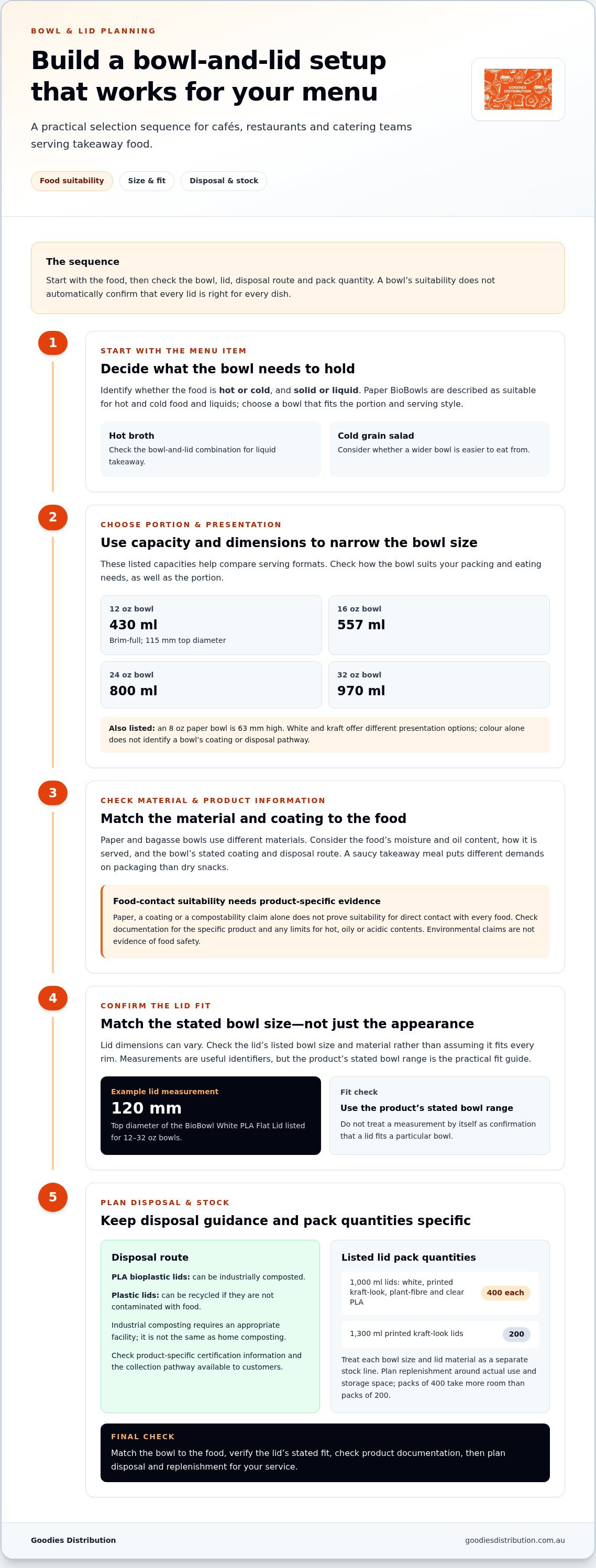
Paper BioBowls are suitable for hot and cold food and liquids, making them a versatile option for Sydney takeaway menus, from hot soups to chilled salads. Choose a bowl that fits the portion and serving style. For example, hot broth needs a bowl-and-lid combination suited to liquid takeaway, while a cold grain salad may be easier to eat from a wider bowl.
Choose the lid by matching its listed bowl size and material, rather than assuming every lid fits every rim. Lid dimensions can vary, so check the listed size when choosing a lid for a bowl. For 12-32 oz bowls, the BioBowl White PLA Flat Lid has a 120 mm top diameter. These measurements help distinguish lid sizes, but the product’s intended bowl range remains the practical fit guide.
Lid material affects disposal. PLA bioplastic lids can be industrially composted, while plastic lids can be recycled if they are not contaminated with food. These are different disposal pathways. Industrial composting requires an appropriate facility and is not the same as home composting.
For hot-food service, assess the bowl and lid separately. A bowl’s suitability for hot food does not automatically mean every lid material is suitable for every hot dish. Before choosing a combination, follow three steps:
- Identify whether the menu item is hot or cold, solid or liquid.
- Match the lid’s stated bowl size, using measurements such as 93 mm or 120 mm as useful identifiers.
- Plan disposal around the lid material and the facilities available to your customers.
This approach helps cafés and takeaway venues select biopaper bowls and lids based on food, fit and disposal, rather than assuming one combination suits every menu item.
Paper bowl materials and coatings
Material, coating, colour and capacity all affect how a bowl works in food service. Compare these features with your menu and disposal arrangements.
Alternative material comparisons
Paper and bagasse bowls use different materials, so compare their intended uses and product details, not just their appearance. Consider the food’s moisture and oil content and how it is served, then check the bowl’s stated coating and disposal route. A saucy takeaway meal places different demands on packaging than dry snacks. These checks help you match the material to your menu.
Food-contact safety requirements
The available material descriptions do not establish that every bowl and lid meets Australian food-contact requirements. Paper, a coating or a compostability claim alone does not prove suitability for direct contact with every food. For each menu item, use product-specific documentation that identifies food-contact suitability and any limits for hot, oily or acidic contents. Environmental claims are not evidence of food safety.
White and kraft paper bowls offer different presentation options. White gives meals a clean, simple look, while kraft has a natural paper appearance. Colour does not identify the coating or disposal pathway, so compare those details separately when choosing a finish for your brand.
Capacity and dimensions help match portions to service. Standard 12 oz white and kraft bowls hold 430 ml brim-full, with a 115 mm top diameter. The 16 oz, 24 oz and 32 oz sizes hold 557 ml, 800 ml and 970 ml respectively. An 8 oz paper bowl is 63 mm high. Use capacity to compare serving formats, then consider how the bowl fits your packing and eating needs.
Compostability and recyclability depend on the specific material and available collection pathway. PLA lids can be industrially composted, but that does not mean every bowl or lid follows the same route. Check product-specific certification information and distinguish industrial composting from home compostability before giving customers disposal guidance.
Compare biopaper bowls and lids by material, size and intended use at Goodies Distribution.
Pack quantities
Pack size affects storage, replenishment and how you coordinate bowls with lids. Available lid quantities vary by bowl capacity and material: the listed options include packs of 400 for several 1,000 ml lids, and packs of 200 for printed kraft-look lids for 1,300 ml bowls. Compare each pack with your menu and ordering cycle.
For 1,000 ml large bowls, white lids and printed kraft-look lids are offered in packs of 400. Plant-fibre lids for 1,000 ml bowls also come in packs of 400. Clear PLA lids for 1,000 ml bowls are listed in the same quantity. This makes it easier to compare lid materials while keeping the pack count consistent.
Printed kraft-look lids for 1,300 ml extra-large bowls are supplied in packs of 200. That smaller pack quantity may suit a venue with fewer extra-large portions than standard bowl orders. Treat each size and lid material as a separate stock line, so the quantities you buy reflect actual use rather than an assumed one-to-one match.
- 1,000 ml white lids: packs of 400.
- 1,000 ml printed kraft-look lids: packs of 400.
- 1,000 ml plant-fibre lids: packs of 400.
- 1,000 ml clear PLA lids: packs of 400.
- 1,300 ml printed kraft-look lids: packs of 200.
Before ordering, map each bowl size to its matching lid, then estimate how quickly each pairing moves through service. Keep high-use 1,000 ml options distinct from the 1,300 ml format. This simple stock check helps prevent a surplus of one lid type while another runs short. Also consider available storage space: packs of 400 take more room than packs of 200.
Use pack quantity as a planning detail, not a substitute for checking fit. Match the listed capacity and lid type to the bowl, then plan replenishment around your sales pattern. For a mixed menu, grouping stock by bowl size and lid material can make ordering and daily packing clearer.
Product prices including GST
For useful purchasing records, note each product’s identity and service role, not just its catalogue label. A Sydney café might record the bowl used for takeaway soup separately from the one used for cold lunches. Include the matching lid description and intended menu use in each stock line. Clear records help staff choose the right packaging during busy service and organise repeat orders.
Keep product details consistent across ordering, storage and staff instructions. Use the same name for each packaging format in your stock sheet and kitchen notes, and update both if a product description changes. This reduces mix-ups between similar-looking items and helps new team members find the right packaging without relying on memory.
- Record the product name and its role in your menu.
- Keep each bowl and lid as a distinct stock line.
- Note the food-service use, such as soup takeaway or cold lunch packing.
- Use consistent wording across stock records and staff instructions.
When cartons arrive, compare their labels with your order records before storing them. Separate formats clearly and rotate stock so older cartons are used first. Shelf labels showing the product description and service purpose help staff avoid picking a similar but unsuitable item during a rush.
When seasonal menus change, review the packaging assigned to each dish before updating your ordering routine. A new serving format may need a different stock line, storage location or staff note. Keeping these details aligned helps your team manage packaging from delivery through daily service.
Goodies Distribution: Custom Branding Services
Goodies Distribution’s Custom Branding Services can help bring your packaging and brand presentation together once you have chosen products that suit your menu and service. For cafés, restaurants and takeaway businesses, branded packaging can carry your identity beyond the counter. Consider how bowls work alongside takeaway containers, paper bags and biodegradable cutlery to create a consistent presentation.
Goodies Distribution supports businesses that want to bring their packaging choices and brand presentation together. Whether you are refreshing your takeaway setup or developing a new look, consider how each item works in daily service and appears to customers. Practical choices should suit the food, portions and way orders are handed over.
To explore custom branding for your packaging, contact Goodies Distribution or visit goodiesdistribution.com.au.
Put your packaging plan into action
Make your packaging choice part of a wider service plan. Review the takeaway experience, from first impression to handover, and identify where consistent branding could make it feel more considered. The right biopaper bowls and lids are one part of that plan, alongside packaging that suits how customers order and carry meals.
Goodies Distribution offers Custom Branding Services, Takeaway Containers and BioPak Compostable Cups to help food-service businesses bring their packaging choices together. Choose a direction that reflects your brand and suits how your team serves customers. Thoughtful packaging can make everyday orders feel connected to your business.
Ready to take the next step? Explore paper bowls and lids and keep building a packaging approach that feels right for your business.
Frequently Asked Questions
What sizes and capacities are available for BioPaper bowls in Australia?
BioPak BioBowls are available in 8 oz, 12 oz, 16 oz, 24 oz and 32 oz sizes. The 12 oz bowl has a brim-full capacity of 430 ml; 16 oz holds 557 ml, 24 oz holds 800 ml, and 32 oz holds 970 ml. For portion planning, compare capacity with your actual serving size, not just the bowl’s outer dimensions.
Which lids fit BioPaper bowls, and are they sold separately?
Choose a lid by its stated bowl size and format, as the lid options are listed in separate packs. For example, white, printed kraft-look, plant-fibre and clear PLA lids are offered for 1,000 ml bowls. Printed kraft-look lids are also offered for 1,300 ml bowls. Match the lid listing to your bowl before ordering, particularly when stocking multiple formats.
How much do BioPaper bowls and lids cost in Australia?
Compare each bowl and lid as separate line items, and note whether the displayed amount includes GST. Pack quantity, bowl capacity and lid material affect which listings are comparable. For instance, a 1,000 ml lid pack and a 1,300 ml lid pack contain different quantities, so compare the required units as well as the displayed GST treatment when planning your purchasing budget.
Can BioPaper bowls be used for hot, cold, oily, or microwave-heated food?
Paper BioBowls are suitable for hot and cold food and liquids, so they can work for menu items such as soup or chilled salad. This does not establish microwave suitability or performance with oily foods. For takeaway curry, match the bowl and coating to the food’s moisture and oil content, and follow the product’s specific use instructions before reheating.
Where can businesses buy BioPaper bowls and lids in Australia?
Businesses can buy BioPaper bowls and lids from Goodies Distribution, with local Sydney delivery and tracking available for local orders.