


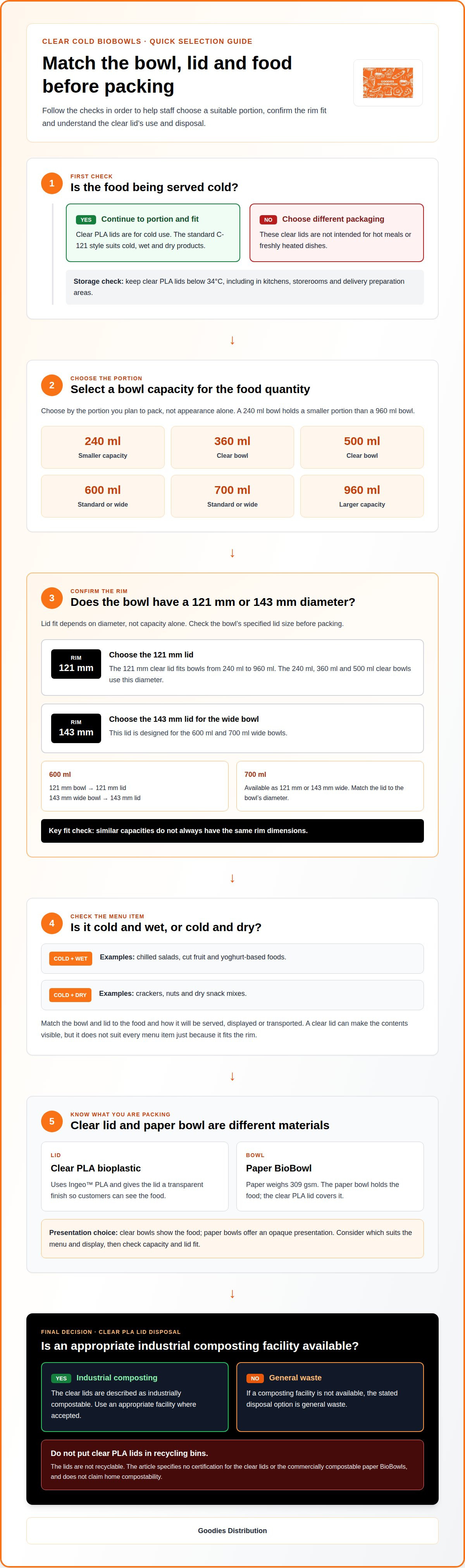
A lid that fits well helps cold takeaway food travel neatly and arrive ready to enjoy. Clear cold BioBowls and lids come in several capacities: clear bowls are available in 240 ml, 360 ml, 500 ml, 600 ml, 700 ml and 960 ml sizes. The 121 mm clear lid fits bowls from 240 ml to 960 ml, while the 143 mm lid is designed for the 600 ml and 700 ml wide bowls.
Choosing clear cold biobowls and lids for a café, restaurant or takeaway service means balancing fit, presentation and disposal. This guide covers bowl capacity, lid compatibility, what clear PLA lids are made from, and their recycling and composting status. Use it to match packaging to your cold-food menu and help your Sydney business make an informed choice.
Key Takeaways
- Match bowl capacity and lid diameter to the portion and presentation you need, so takeaway orders are easier to pack consistently.
- Choose these clear bowls for suitable cold menu items, and consider how moisture and food texture affect the customer experience.
- Understand the difference between compostability and recyclability before deciding how used lids should be disposed of.
- For Sydney food-service operations, local packaging support can help align product choices with your day-to-day service and brand presentation.
Clear bowl capacities
Clear bowl capacities range across six sizes: 240 ml, 360 ml, 500 ml, 600 ml, 700 ml and 960 ml. These options suit different serving portions. Choose by the food quantity you plan to pack, not appearance alone. A 240 ml bowl holds a smaller portion than a 960 ml bowl. The right capacity helps present servings consistently across takeaway orders.
Lid fit depends on diameter, not capacity alone. The clear PLA bowl lid with a 121 mm diameter fits bowls from 240 ml to 960 ml. A 143 mm lid fits the 600 ml and 700 ml wide bowls. The 700 ml size is available with both diameter options. Match the bowl’s specified lid size before packing. Similar capacities don’t always mean the same rim dimensions.
- 240 ml, 360 ml and 500 ml: these clear bowls have a 121 mm diameter and pair with the 121 mm lid.
- 600 ml: the clear 121 mm bowl uses the smaller lid; the 143 mm wide bowl uses the larger lid.
- 700 ml: choose between a 121 mm bowl and a 143 mm wide bowl, then select its matching lid.
- 960 ml: the clear bowl has a 121 mm diameter and fits the 121 mm lid.
How do Clear Cold BioBowls compare with paper takeaway bowls? Clear bowls show the food, while paper bowls offer an opaque presentation. Consider which suits your menu and display, then check the portion capacity and lid fit.
Use this simple selection sequence: decide the portion, select the bowl capacity, then match the diameter and lid. For example, a 700 ml serving may suit either diameter, so confirm whether the bowl is the 121 mm or 143 mm version. The 600 ml wide bowl also needs the 143 mm lid, not the 121 mm one. Keeping these distinctions clear helps staff pack orders accurately and gives customers a neat view of the food inside.
The ounce-labelled BioBowls have brim-full capacities of 270 ml for the 8oz BioBowl, 430 ml for the 12oz BioBowl, and 557 ml for the 16oz BioBowl. The 24oz BioBowl has a brim-full capacity of 800 ml, while the 32oz BioBowl has a brim-full capacity of 970 ml.
The 8oz BioBowl White PLA Flat Lid has a top diameter of 93 mm.
Suitable food types
Clear PLA bowl lids are for cold use only. The standard C-121 style lid suits cold, wet and dry products. That gives food-service teams options across chilled menu items, from salads to dry snacks. It isn’t intended for hot dishes. Keep the food’s serving temperature in mind when planning takeaway packaging.
For wet foods, consider chilled fruit, dressed salads or yoghurt, which fit the stated cold, wet product category. For dry foods, think crackers, nuts or bakery snacks served cold. A clear lid lets customers see the contents, which can help identify pre-packed meals in a display. Choose a bowl that suits the portion and menu item.
- Cold and wet: chilled salads, cut fruit and yoghurt-based foods.
- Cold and dry: crackers, nuts and dry snack mixes.
- Not suited to: hot meals or freshly heated dishes.
Menu temperature matters as much as texture. A cold pasta salad may be wet, while a dry biscuit remains crisp. Both are cold foods, but they place different demands on packaging during handling. Match the food to the bowl and lid combination. Don’t assume a clear lid suits every menu item just because it fits the rim.
Storage conditions matter, too. Clear PLA lids should be stored below 34°C. Keep this limit in mind in kitchens, storerooms and delivery preparation areas. For a chilled display, a clear lid offers visibility while keeping the food covered. Follow the cold-use purpose when planning how food is packed and presented.
For takeaway service, group menu items by temperature and moisture. A café could pack a chilled salad separately from a hot toasted item. A catering team might use a clear-lidded bowl for cold fruit portions, then choose different packaging for heated foods. This helps staff select packaging for each food instead of relying on one container for every order.
Before adding a packaging item to your routine, identify whether the food is cold, wet or dry. Then consider how it will be served, displayed or transported. Cold dressed greens, for example, need a different packing approach from dry snack portions. Clear lids are useful when customers benefit from seeing the food, but their cold-use purpose remains the key limit.
What are Clear Cold BioBowls and lids made from?
The clear BioPak bowl lid is made from PLA bioplastic. These lids use Ingeo™ PLA, a plant-based bioplastic that gives them a transparent finish. Customers can see a salad or dessert inside. The lid material differs from the paper bowl beneath it.
PLA is plant-based, but that doesn’t mean it belongs in household recycling. Clear PLA lids aren’t recyclable. They’re described as industrially compostable, but no certification is specified here. They need an appropriate disposal pathway. If a composting facility isn’t available, the stated disposal option is general waste. Don’t put these lids in recycling bins.
BioPak Paper BioBowls are made from paper and are described as commercially compostable, but no certification is specified here. The paper used in BioBowls weighs 309 gsm. That figure describes paper weight, not bowl capacity. Paper and PLA serve different roles: the bowl holds the food, while the clear PLA lid covers it and displays its contents. Distinguish the paper bowl from its lid when explaining disposal.
- Clear bowl lid: PLA bioplastic, including Ingeo™ PLA.
- Paper BioBowl: paper weighing 309 gsm.
- Clear lid disposal: industrial composting where accepted, or general waste.
- Recycling: clear PLA lids aren’t recyclable.
Compostable doesn’t mean home compostable. The clear lids are described as industrially compostable, while BioPak Paper BioBowls are described as commercially compostable. No certification is specified here. These terms refer to composting facilities, not automatic breakdown in every backyard. Don’t imply a home-composting claim or promise that every local collection service accepts these items.
A separate product detail helps prevent confusion: the 8oz BioBowl White PLA Flat Lid is made from 100% renewable resources. That specification describes the white flat lid, not the clear bowl lid. Keep product names and material claims together when labelling packaging or writing customer-facing disposal guidance. Clear lids are also for cold use only, so their PLA material should be considered alongside the food’s serving temperature.
Goodies Distribution
Goodies Distribution helps Sydney food-service businesses connect packaging choices with day-to-day needs. As an official BioPak distributor, it supports businesses considering BioPak packaging alongside practical needs such as bowl-and-lid fit, cold-food presentation and disposal pathways. Its role is to help make packaging decisions easier to align with menu service and customer experience, without treating one container as suitable for every food.
A dedicated Sydney-local warehouse and Sydney-wide delivery support local hospitality operations. Cafés, restaurants, caterers and takeaway venues can plan packaging supply around their service requirements. Local warehousing provides a Sydney base for distribution, while delivery across Sydney supports businesses operating in different parts of the city. Goodies Distribution also brings 40+ years of industry experience, offering an informed perspective on packaging for food-service settings.
Packaging decisions often extend beyond a single bowl. Goodies Distribution supplies takeaway containers, paper bags and cutlery, and offers custom branding services. These options help businesses plan how packaging works together across an order, from the food container to the bag and utensils. Custom branding can connect packaging presentation with a venue’s identity and create a consistent customer experience.
- For local operations: a Sydney-local warehouse and Sydney-wide delivery support packaging planning.
- For BioPak packaging: official distributor status offers a relevant route for food-service businesses exploring BioPak options.
- For broader takeaway needs: containers, paper bags and cutlery cover several packaging categories.
- For presentation: Custom Branding Services can help carry a business’s identity across its packaging.
Goodies Distribution is a practical next step when your venue is weighing packaging fit, service requirements and presentation. Its hospitality experience and Sydney presence relate directly to the decisions local operators make when planning packaging for customers. The right mix depends on your menu, how orders are served and how you want packaging to represent your business.
Contact Goodies Distribution to discuss packaging choices for your food-service business.
Frequently Asked Questions
What sizes and capacities do Clear Cold BioBowls come in?
Choose a bowl based on the portion your menu serves, then use that choice consistently across orders. This helps staff pack familiar menu items predictably and manage portion presentation. Bowl capacity and rim size are separate considerations, so account for both when selecting packaging rather than using one measurement as a guide to the other.
Which lids fit Clear Cold BioBowls, and are they sold separately?
Yes, the clear lids are sold separately from the bowls. For smoother service, store each lid type beside its matching bowl stock and label them clearly for staff. This reduces mix-ups during busy packing periods. A stock list that records bowl and lid product names together can also make replenishment and ordering easier to coordinate.
Are Clear Cold BioBowls and lids compostable or recyclable in Australia?
Give disposal guidance for each component rather than using one instruction for the complete pack. In a Sydney café, clear signage near sorting bins can help staff and customers separate items according to the relevant disposal route. Keep product claims precise in menu or packaging communications, and don’t suggest that every local waste collection accepts the same materials.
What food and temperature types are Clear Cold BioBowls suitable for?
Use the bowls as part of a menu-specific packaging plan. A takeaway venue, for example, can group cold menu items by presentation needs, then assign a bowl format to each category. This gives staff a repeatable packing routine and helps keep orders visually consistent. Keep instructions clear for everyone assembling meals during a busy service.
How can I order Clear Cold BioBowls and lids?
Goodies Distribution serves business customers through a registered account. Orders require an Australian Business Number, and purchases are prepaid. Sydney cafés and takeaway operators can plan their orders by listing the bowl and lid products their menu needs, along with the quantities required for service.