


A takeaway bag earns its place when it fits the order, works at the pass and makes your brand easy to recognise. For cafes, restaurants and takeaway venues, choosing custom printed takeaway bags Sydney customers carry through their day means balancing practical fit with clear, considered branding.
It can be difficult to choose a bag format without first considering your menu and handover routine. Artwork needs to remain legible on the chosen material, and sustainability claims need to match the product and its certification. The right setup supports service as well as presentation.
This guide explains how to match a bag to your food and workflow, prepare artwork for clear printing, and assess environmental claims using product-specific information. Goodies Distribution supplies paper bags and provides in-house custom branding for food-service businesses. With a Sydney-local warehouse, Sydney-wide delivery support and directors with more than 40 years of combined hospitality industry experience, Goodies Distribution understands the practical demands behind packaging decisions. Use the steps below to prepare a brief for your business.
Key Takeaways
- Define what your takeaway bag needs to carry and how it fits your team’s handover routine.
- Plan artwork around your brand assets, with clear contrast and an uncluttered layout that customers can recognise quickly.
- Match bags to order formats, and remember that carry bags and food containers have different jobs.
- Assess environmental claims using information and certification for the specific product, rather than assuming every bag is compostable.
- Prepare a practical brief for custom printed takeaway bags Sydney businesses can tailor to their menu, branding and workflow.
Custom takeaway bags in Sydney: what should your bag do?
A custom printed takeaway bag carries a food-service order and represents the business that prepared it. Its first job is practical: bringing packaged items together for collection or delivery. Printed branding adds another function, helping customers identify the business at handover and giving the order a considered presentation.
A bag and a food container aren’t interchangeable. Containers hold and protect food; the carry bag supports transport and handover. A café order with drinks and pastries, for example, may need a different packing arrangement from a restaurant meal or a catering order. Choose a bag to suit the food, order format and service workflow, then let containers do the job of holding the food.
Packaging also contributes to presentation and can carry information, alongside its practical roles in containment and transport. The overview of the role of packaging provides useful context. For food-service businesses, the key question is how each item fits into the real path from packing bench to customer.
How takeaway bags shape the customer handover
A clear, legible brand mark helps customers identify an order without slowing down collection. At a café counter, bags need to be easy to distinguish among orders waiting for pickup. For delivery, packaging should make the business clear at the point of transfer. Catering orders have a different focus: bags may be one part of a group of items organised for a client or event. In each case, considered presentation supports a coherent handover without promising a particular business result.
Which Sydney food businesses benefit from custom carry bags?
Cafes can plan for takeaway coffee and food orders; restaurants and takeaway venues can consider meals packed for collection or delivery. Caterers may need to group items for an event or client, while food manufacturers can consider how bags support the handover of prepared products. Across Sydney, the best starting point is the order mix: what customers buy, how staff pack it and where the order is collected or delivered.
If you’re considering custom printed takeaway bags Sydney customers will carry, observe the handover before choosing artwork. What must staff keep together? What should a customer recognise quickly? Which containers go inside the bag, and how will the order be passed on? Answering these questions defines the bag’s purpose before you settle on print design and material choices.
Plan custom bag printing around your brand and food-service workflow
Strong bag artwork starts with a clear brief, not a crowded design. Before preparing files, decide who will see the bag, how it will be used and what you want customers to notice first. A café may prioritise its name and logo for quick recognition, while a caterer may want the business identity to remain clear across grouped orders.
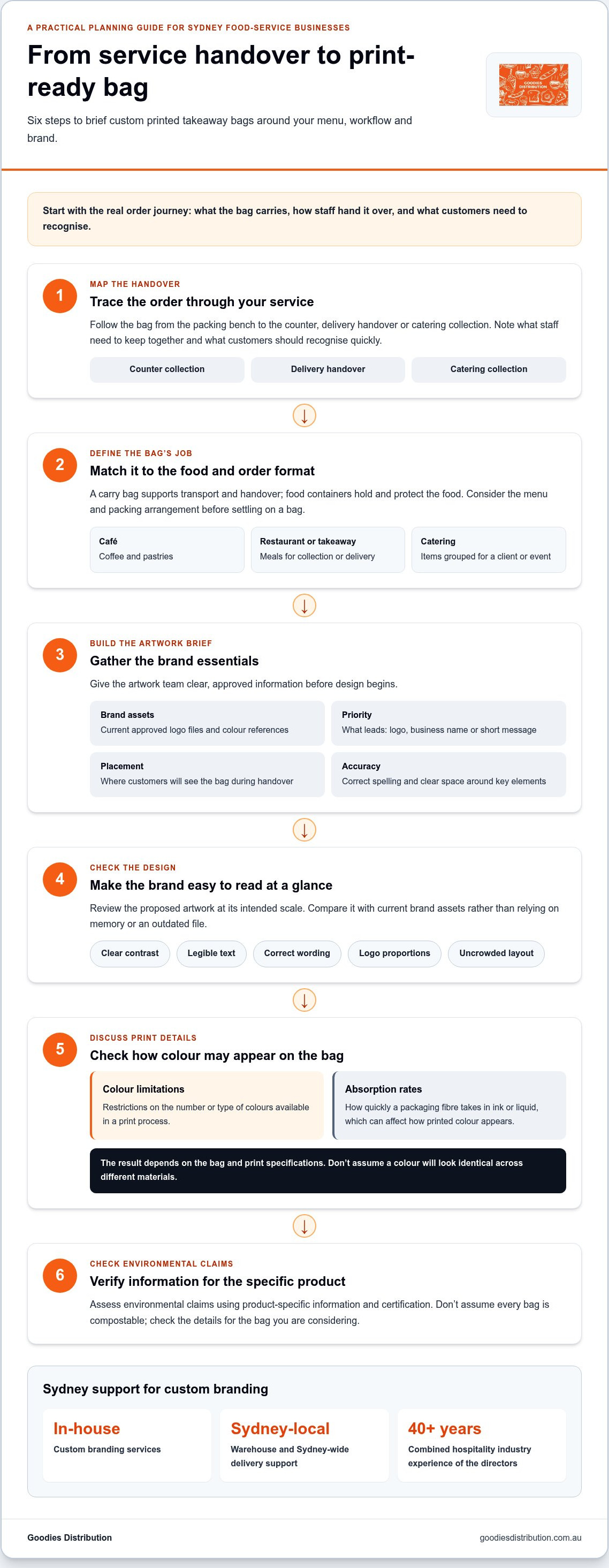
Trace how the bag moves through your service, from packing bench to counter, delivery handover or catering collection. This reveals which brand elements matter most and where customers will see them. Goodies Distribution provides in-house custom branding services to help food-service businesses bring their chosen brand assets to printed bags.
What should a takeaway-bag artwork brief include?
Gather the essentials before artwork begins. Include approved logo files, brand colours, your business name and any short message that must appear. Identify where customers will see the bag and which information should read first. Keep the layout focused: a simple design is easier to recognise at its final printed scale than one crowded with small details.
- Brand assets: Provide current, approved files and colour references.
- Priority: State whether the logo, business name or a short message should lead.
- Placement: Describe the usual handover so the design suits how customers encounter the bag.
- Accuracy: Check spelling and leave clear space around key elements so they don’t compete visually.
Use the brief to review the proposed design before it is prepared for print. Check names, wording, logo proportions and the order in which information appears. Reviewing these details early helps catch avoidable artwork errors before they become part of a production file.
How to keep printed branding clear and consistent
Contrast matters. If the print colour is too close to the bag surface in tone, the logo or wording may be harder to read at a glance. Clear spacing and legible text help the main brand mark stand out. Compare the proposed artwork with your current brand assets instead of relying on memory or an outdated file.
Discuss colour limitations and absorption rates during artwork planning. Colour limitations are restrictions on the number or type of colours available in a print process. Absorption rates describe how quickly a packaging fibre takes in ink or liquid, which can affect how printed colour appears on the surface. The result depends on the bag and print specifications, so don’t assume a colour will look identical across different materials. Reviewing artwork at its intended scale helps you judge readability.
For broader context on material choices and brand presentation, Goodies Distribution’s guide to eco-friendly packaging for Australian businesses can inform your planning. A focused brief is a practical starting point for custom printed takeaway bags Sydney businesses can make their own. Explore in-house custom branding support to shape your bag design around your business identity.
Choose takeaway bags for Sydney menus, order formats and sustainability goals
Choose a carry bag around the order it needs to support, not as a substitute for food packaging. Containers hold and protect food; the bag brings packed items together for transport and handover. Consider your menu, how staff group each order and what customers need to carry. Assigning each item a clear role can make service more organised without asking one packaging product to do every job.
| Order type | Bag purpose | Print needs | Material documentation |
|---|---|---|---|
| Café order with food and drinks | Group separate packaged items for collection | Keep the business name clear and easy to spot | Check evidence for the specific bag material and any environmental claim |
| Restaurant or takeaway meal | Carry one or more food containers during collection or delivery handover | Prioritise a legible brand mark on the chosen bag | Keep bag documentation distinct from container documentation |
| Catering order | Help organise packaged items for a client or event handover | Use a clear, uncluttered design that identifies the business | Review claims for each packaging component separately |
| Delivery order with add-ons | Bring containers and additional items together for transfer | Make the brand recognisable in a quick handover | Match any compostability or sourcing statement to evidence for that item |
Use these examples as planning prompts, not bag-size specifications. Several containers or drinks may need to be grouped and handled differently from a single packaged meal. Consider how items sit together and whether moisture from food could affect packaging inside the bag. Soggy bottom syndrome describes food packaging losing crispness or strength when moisture accumulates. It concerns the food packaging, not a reason to assume a carry bag provides a moisture barrier.
Check environmental claims and certification carefully
Compostability depends on the exact product and the conditions it is certified for. Home compostability refers to breakdown in a domestic composting environment; industrial compostability relates to processing in a commercial composting facility. These pathways aren’t interchangeable. A compostability claim should match the exact product and its certification.
Seedling logos are certification marks for products that meet specified compostability requirements. They don’t make a claim for every item in an order. Check documentation for the particular bag, container or other component. AS 4736 relates to industrial compostability, while AS 5810 relates to home compostability. EN 13432 is also referenced for industrial compostability. Use a standards or certification claim only when product-specific evidence supports it.
For Sydney food-service businesses, environmental decisions also sit alongside local requirements. NSW rules can apply to particular items and materials, so refer to current NSW EPA guidance before making a regulatory claim or choosing packaging on that basis. Businesses using custom printed takeaway bags Sydney can keep the bag’s function, print brief and material documentation connected, while assessing each packaging component using its own evidence.
Prepare a clear custom printed bag brief before placing an order
A useful brief turns your day-to-day needs into clear decisions about bag use, artwork and materials. Separate what your business already knows, such as its usual order mix and brand colours, from product-specific details tied to the bag selected. This gives the design process a practical starting point without assuming a particular material, size or print specification.
Build a useful order and artwork brief
Work through the details in order. A café handling mostly counter collections may have different priorities from a caterer preparing grouped orders for an event. Capture those differences before settling on the design.
- Define the use case. Note your business type, where customers receive orders and how bags move through packing, collection, delivery or catering handover.
- Describe typical contents. Record the food containers, drinks and add-on items your team commonly groups together. This clarifies what the bag needs to carry as part of your workflow.
- Set brand priorities. Gather current logo files, approved colour references, your business name and the exact wording that needs to appear. Identify which element should be easiest to recognise.
- State sustainability priorities. Note whether you’re considering a particular material or compostability pathway. Treat claims as product-specific and tie supporting documentation to the exact packaging item.
- Record delivery details and open specifications. Include the Sydney delivery location and distinguish firm business requirements from details tied to the selected bag, such as its material, dimensions or print specifications.
Use this checklist to prepare the brief before design work begins:
- Business type and typical menu items
- Order formats and handover points
- Approved logo, colours and required wording
- Environmental priorities and relevant documentation
- Sydney delivery location and product-specific details to resolve
Review the proposed design before production
Give the proposed artwork a deliberate review. Check that the logo is clear, names and other wording are spelt correctly, and contrast makes essential information readable on the chosen bag. Consider its intended use: an order handed across a café counter may be seen differently from a grouped catering order. Compare the artwork with current brand guidelines, including approved colours and logo proportions.
Keep the review focused on two kinds of decisions. Your business can set requirements for the message, identity and intended use. Product-specific material, certification and print details should be assessed against the selected bag and its documentation. For broader material context, sustainable packaging for Australian wholesale buyers can help inform your thinking.
Once your brief is ready, explore custom branding support to shape the project around your food-service operation and brand.
Get custom printed takeaway bags for your Sydney business with Goodies Distribution
Once you’ve mapped out what your bags need to do, bring the functional and brand requirements together. Goodies Distribution provides in-house custom branding services for food-service businesses, helping you shape a brief around your identity and the way your team handles orders. Have your menu, typical order format and brand assets ready so the project starts with the needs of your operation.
Why work with a Sydney-based packaging partner?
Local support matters to busy hospitality teams. Goodies Distribution’s Sydney-local warehouse and Sydney-wide delivery support food businesses across the city with their packaging needs. A local warehouse provides a practical supply point for Sydney operators, while delivery support connects that supply with businesses throughout the stated service area. It doesn’t replace planning your stock requirements, but it gives your packaging decisions a local context.
The directors bring more than 40 years of combined hospitality industry experience. That background informs practical conversations about how packaging fits into food-service work, from the order mix to the handover routine. It’s useful perspective when you’re balancing clear brand presentation with the everyday demands of packing and carrying takeaway orders. Product choices and material or certification claims should still be grounded in documentation for the specific item.
Bring your printed-bag project together
A focused brief connects the details you’ve considered with how the packaging will be used. Before moving ahead, bring together:
- Bag use: the order types it needs to support and how your team hands them over.
- Brand assets: current logo files, approved colours and any essential wording.
- Functional needs: how the bag will work alongside food containers and other items in a typical order.
- Sustainability priorities: your material preferences and documentation for any product-specific environmental claim.
These points give custom branding a clear place within your broader food packaging decisions. A considered project brings together practical bag use, recognisable artwork and responsible claims without assuming that every bag has the same material or certification. For businesses seeking custom printed takeaway bags Sydney, a clear brief can turn a general idea into a project shaped around the venue, its customers and its service routine.
Bring your requirements together and explore custom branding with Goodies Distribution as the next step for your printed-bag project.
Take the next step towards packaging that feels like your brand
Your takeaway packaging is part of the experience customers carry beyond your venue. During your next packaging review, check whether the bag, food containers and printed identity work together from packing through to handover. A considered approach to custom printed takeaway bags Sydney food businesses use can help create a distinctive presentation while keeping practical service needs in view.
As you move from planning to artwork, keep approved brand files and product-specific environmental documentation together. This gives your team a reference when designs or packaging choices are reviewed later, and helps keep environmental statements aligned with evidence for the exact product.
Goodies Distribution combines in-house custom branding with local warehousing and Sydney-wide delivery support. Ready to plan printed bags around your business? Explore custom branding with Goodies Distribution.
Frequently Asked Questions
Can takeaway bags be compostable?
Some takeaway bags may be certified compostable, but the claim applies only to the specific product supported by evidence. Check whether its certification is for industrial or home composting, as the two pathways involve different conditions. Also consider whether the relevant composting service accepts that item. For a Sydney venue, keep product documentation with your packaging records and give staff clear disposal guidance rather than relying on a compostable label alone.
What should I include on a custom printed takeaway bag?
Include the details customers need to identify your business, such as your business name or logo, and any short brand message that earns its place. A café might feature its name prominently, while a caterer may need a clear business identity across orders prepared for an event. Keep the design focused. Avoid claims about materials or environmental benefits unless you have product-specific evidence to support the wording.
How do I prepare artwork for custom printed bags?
Start with current logo files and approved colour references, then supply the exact wording you want printed. Check spelling, logo proportions and small text before the artwork is prepared. Review the design at its intended printed scale, since fine details that look clear on a screen may be harder to read on a bag. Keep a final approved version of the artwork for future reference.
Are paper takeaway bags suitable for hot or greasy food?
Suitability depends on the specific bag’s construction and the order, so don’t assume every paper bag will handle heat, oil or moisture in the same way. Use food containers selected for the menu item to hold and protect the food, then use a carry bag to group the packed order. For a hot, oily meal, consider how steam or leakage could affect the packaging during the expected handover.
Can custom printed takeaway bags be recycled?
Some paper bags may be recyclable, but acceptance depends on their material, any coatings or other components, their condition and local collection guidance. A bag contaminated with food or liquid may not be suitable for paper recycling. Check the product information and follow advice from your local council or waste service in Sydney. Don’t assume that printing alone determines whether a bag can be recycled.
What is the difference between a printed and a plain takeaway bag?
A plain bag has no custom business artwork, while a printed bag carries chosen branding or other approved design elements. Both can serve as carry bags; the difference is how much brand information travels with the order. For example, a venue may choose a printed design to make its name visible during collection, while a plain bag keeps the presentation neutral. The right option depends on your brand priorities and packaging requirements.
How can Sydney businesses make environmental claims about takeaway bags responsibly?
Keep each claim specific to the item it describes, and retain supporting product documentation. If a bag is certified compostable, state the relevant certification and whether it relates to home or industrial composting; don’t extend that claim to containers or other parts of an order. Avoid broad terms such as “eco-friendly” without clear evidence. Sydney businesses should also refer to current NSW EPA guidance when considering local disposal advice or regulatory requirements.