


Choosing takeaway cups means balancing service needs, customer comfort and the packaging message your business wants to convey. Double-wall PLA BioCups are one option for cafes and food-service venues comparing cup formats, but the right choice depends on more than the product name. It should suit the drinks you serve and the way your team works.
When weighing options, separate a cup’s construction from its environmental claims. Product descriptions, certification details and disposal guidance answer different questions. Considering each separately makes it easier to assess what the cup offers and how it fits your venue’s packaging approach.
This guide covers decisions that matter to Australian hospitality businesses: comparing double-wall and single-wall formats, checking sizes and carton quantities, and interpreting compostability information. It also offers practical ways to match cup dimensions to your service routine and consider the customer experience. Use these points to choose more confidently for your cafe, restaurant or takeaway operation.
Key Takeaways
- Compare cup construction against the drinks you serve and the customer experience you want, rather than choosing on appearance alone.
- A plant-based PLA lining doesn’t automatically make a cup home compostable; disposal options depend on the cup’s specific material and certification.
- Match capacity, rim diameter and lid fit to your serving sizes, as cups with similar ounce labels may differ in dimensions.
- Compare carton quantities with your storage space and usage patterns to make ordering easier to plan.
- Consider how cup design and custom branding work alongside your other takeaway packaging to create a consistent customer experience.
What Are Double Wall BioCups Made Of?
Double-wall BioCups combine two paper layers with a plant-based PLA lining. The space between the walls slows heat transfer from a hot drink to the cup’s outer surface. For takeaway coffee, this construction can make the cup more comfortable to hold than a single-wall cup, without requiring a separate sleeve for insulation.
Material specifications show how a particular cup is built. One listed double-wall format uses 285 gsm paper with a 35 gsm PLA lining. PLA is a plant-based bioplastic commonly made from renewable starch sources such as corn or sugarcane. The lining helps make the paper cup suitable for beverages, while the paper provides its structure.
A separate description for a double-wall 16 oz paper cup specifies 100% virgin paper fibreboard with a bioplastic waterproof layer. These figures relate to individual product descriptions, not a universal formula for every double-wall cup. For a cafe comparing formats, read the material details alongside the stated capacity and intended use.
Insulation comes from the layered construction, not the PLA lining alone. The two paper walls separate the hot drink from the outer surface, slowing direct heat transfer. This can help make cups more comfortable to hold during takeaway service. The result also depends on the cup’s dimensions and how the drink is served.
Textured paperboard changes the surface customers see and touch. A textured exterior may feel or look different, but insulation comes from the double-wall structure. Don’t treat texture as proof of better heat retention or assume every double-wall cup has a textured finish. Assess surface and construction as separate features.
Do double-wall PLA BioCups need separate lids, and which lids fit? For a closed takeaway drink, use a separate lid sized to the cup rim. An 80 mm rim takes a lid designed for an 80 mm diameter; a 90 mm rim needs a 90 mm lid. Match the diameter, not only the ounce label.
Capacity adds useful context. A listed 8 oz, 80 mm PLA double-wall cup has a brim-full capacity of 260 ml, an 80 mm top diameter and a height of 95 mm. Brim-full volume reaches the cup’s top edge, rather than indicating the usual serving pour. Leave practical room for the drink and any additions on your menu.
- Read the material and lining details for the exact cup format.
- Match the rim diameter with the lid size, such as 80 mm or 90 mm.
- Assess surface texture separately from the cup’s insulation.
PLA describes the lining material, not the finished cup’s end-of-life outcome. Make compostability claims only when supported by the relevant certification and disposal pathway. For Sydney takeaway operators, checking these details helps align material choices, customer instructions and waste handling.
Environmental impact of double-wall cups
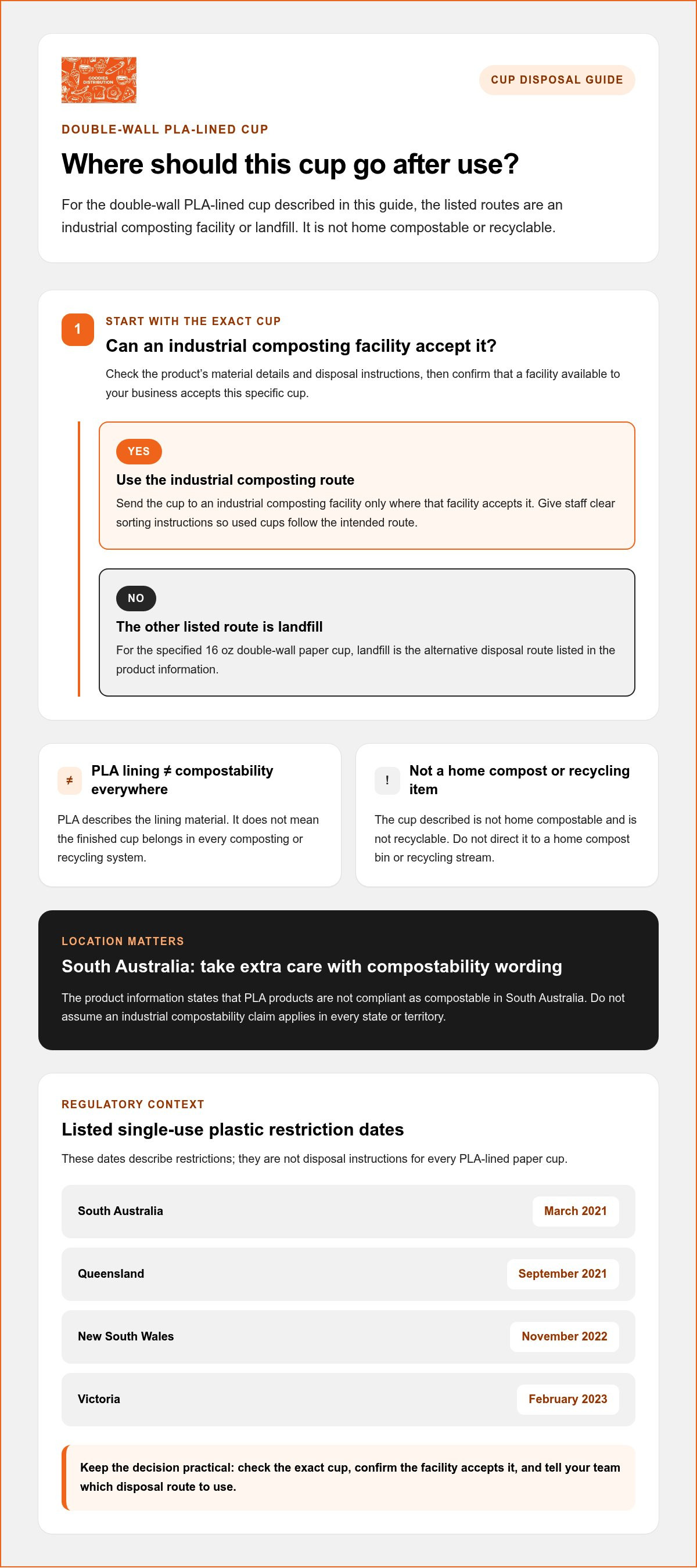
For the double-wall PLA-lined cup described here, the listed disposal routes are an industrial composting facility or landfill. The cup is not home compostable or recyclable. A plant-based lining does not make the complete paper cup suitable for every composting or recycling system.
These cups are intended for hot and cold drinks, including takeaway coffee. No maximum temperature is specified, so the supported use is beverage service, not a particular temperature range. For cafes, insulation can help with hot-drink handover, while material and disposal route remain separate considerations.
PLA products also have different local considerations. Listed single-use plastic restrictions have applied in New South Wales since November 2022, Queensland since September 2021, South Australia since March 2021, and Victoria since February 2023. These dates describe restrictions, not a universal disposal instruction for every PLA-lined paper cup.
South Australia requires particular care with compostability wording: product information states that PLA products are not compliant as compostable there. Don’t assume an industrial compostability claim applies in every state or territory. In Sydney, distinguish a product’s stated certification and disposal instructions from broader claims about PLA.
Use a practical disposal check when selecting cups for your venue:
- Identify the material and compostability certification for the exact cup.
- Separate industrial composting claims from home compostability.
- Confirm the listed disposal route matches the waste process used by your business.
- Give staff clear sorting instructions so used cups follow that route.
Industrial composting is only a practical option where an industrial facility accepts the cup. For the specified 16 oz double-wall paper cup, landfill is the other listed route. Don’t label this cup recyclable or suitable for a home compost bin. Clear instructions help prevent customers and staff from placing it in an unsuitable stream.
Production claims need similar care. A product description says producing Ingeo bioplastic uses 75% less carbon emissions than regular plastic. That comparison applies to bioplastic production, not the complete lifecycle of a finished cup. Paperboard, cup manufacture, transport and disposal also form part of its wider environmental impact.
For hot takeaway drinks, double-wall construction affects handling and insulation, not compostability. PLA lining is one part of the material profile; certification and an available disposal route inform end-of-life choices. Customer-facing messages should name the route your venue uses, rather than imply that every cup labelled compostable belongs in any compost bin.
Assess the cup’s end-of-life route alongside its material and intended use. Explore double-wall PLA cup options in the context of your venue’s waste arrangements.
Cup sizes and carton quantities
Compare the labelled drink size with the carton count before choosing cups for an Australian cafe. Goodies Distribution double wall pla biocups include a 255 ml / 8 oz option, listed in cartons of 1,000, and a 460 ml / 16 oz option, listed in cartons of 600. The 595 ml / 20 oz Leaf double wall pla biocup is also listed in cartons of 600. These examples show why size and pack quantity need separate consideration.
A sleeve count isn’t always the same as the total carton quantity. Each sleeve of the 8 oz, 80 mm PLA double wall pla biocup contains 50 pieces. That format is listed at 1,000 cups per carton, so the sleeve quantity helps staff handle stock while the carton figure supports ordering and storage planning.
Pack formats can also differ across listings. A double-wall cup is listed in a pack of 40, while a carton of double wall 16 oz paper cups contains 600 cups. These figures relate to distinct product listings. Don’t assume that every cup labelled 16 oz, or every cup range, arrives in the same carton quantity.
Before ordering, use a simple planning sequence:
- Match each menu drink to a labelled cup capacity, such as 255 ml / 8 oz or 460 ml / 16 oz.
- Record the carton count for that exact cup format, rather than relying on another size’s pack details.
- Estimate how quickly your venue uses each size, using sales and service records.
- Compare the resulting stock requirement with available storage space and replenishment routines.
For example, a venue serving mostly smaller coffees may assess the 1,000-cup carton of 255 ml / 8 oz cups differently from the 600-cup carton of 460 ml / 16 oz cups. A menu with larger drinks may also consider the 595 ml / 20 oz Leaf format, which has a 600-cup carton listing. The best comparison starts with the venue’s actual drink mix, not the largest carton.
Keep product names and material details together in purchasing records. One listing may describe a PLA lining, while another identifies a different cup format. Recording the product name, labelled capacity, carton count and lining helps staff reorder the intended item and maintain consistent service.
Carton quantity affects storage and stock rotation as well as ordering. Consider the shelf space cartons need and how stock will be rotated during busy service. Protect cartons from unsuitable storage conditions, and make the pack count visible to staff replenishing the coffee station. Clear records make stock checks easier, especially when several sizes are stored together.
For Sydney takeaway operators, compare cup sizes and carton quantities with menu demand, storage space and service workflow. Choose the format that fits, rather than relying on “double-wall” or “bioplastic lining” as sufficient information.
Cup capacity and dimensions
Capacity, rim diameter and height describe different features of a takeaway cup. A 255 ml / 8 oz BioPak aqueous double-wall cup has an 80 mm diameter, while the 390 ml / 12 oz format has a 90 mm diameter. The 460 ml / 16 oz format also has a 90 mm diameter. Compare all three measurements with your menu and service setup.
Ounce labels don’t always map neatly to millilitres across listings. One double-wall cup is labelled 8 oz and holds 295 ml, with a 90 mm rim. Another is labelled 16 oz and holds 460 ml, also with a 90 mm rim. These examples show why the label alone cannot identify the cup’s full dimensions or fit.
Brim-full capacity is another useful detail. The BioPak 8oz, 80 mm PLA Double Wall Art Series BioCup has a brim-full capacity of 260 ml, an 80 mm top diameter and a height of 95 mm. Brim-full capacity measures to the top edge. It differs from the volume a barista pours during normal service, which needs room for the drink’s surface and any additions.
A separate BioPak BioCup listing gives a 460 ml capacity, 90 mm top diameter, 60 mm base diameter and 136 mm depth. Those measurements describe its profile from rim to base. For a busy coffee station, the base diameter can help assess how cups sit on trays or counters; the top diameter helps identify the matching lid size.
Use a consistent comparison process before selecting a format:
- Match the listed millilitre capacity to the drink size on your menu.
- Compare rim diameter with the lid specification, such as 80 mm or 90 mm.
- Review height and base diameter against storage, cup holders and service equipment.
- Distinguish brim-full capacity from the intended serving volume.
For example, an 80 mm rim and 95 mm height describe the 8 oz Art Series cup, while a 90 mm rim appears on listed 12 oz and 16 oz formats. Shared rim diameter doesn’t mean shared capacity or height. Keep the complete specification with each product name in ordering records to reduce mix-ups during restocking.
Cup size does not establish whether a product is certified compostable. Certification relates to the product’s materials and applicable standard, not its millilitre capacity or rim width. Check capacity, dimensions, lid fit and environmental certification separately. This gives Sydney cafes a clearer basis for matching cups to menu portions and front-of-house routines.
When comparing double-wall cup specifications, check the exact product listing rather than assuming size conventions are consistent across ranges. Record capacity in millilitres alongside the ounce label, then check diameter and height. This helps staff choose the intended cup, serve consistent portions and pair it with the correct lid.
Single-wall versus double-wall cup construction
A single-wall cup has one paperboard layer between the drink and the customer’s hand. A double-wall cup adds another paper layer, creating a different construction for takeaway coffee service. The choice affects handling, insulation, storage and how your venue presents each drink.
For hot drinks, the main practical difference is the extra layer. Double-wall construction helps reduce heat transfer to the outside surface; a single-wall cup has no second paper layer. A sleeve can add insulation to a single-wall cup, but it also means another item for staff to store and serve.
How do double-wall PLA BioCups compare with paper cups and other insulated compostable cups? They combine paper walls with a PLA lining, while a single-wall paper cup has one wall and other insulated compostable formats may use different coatings. Compare the specific material, construction, certification and disposal route rather than assuming all compostable cups perform or break down alike.
Compostability is not determined by wall count. A double-wall cup with PLA lining is not home compostable and is not recyclable; the listed disposal options are an industrial compost facility or landfill. AS4736 is relevant to industrial compostability claims, but a certification mark must relate to the specific product, not simply its paper construction.
Construction also affects service routines. A Sydney cafe serving mostly hot takeaway coffee may value the extra hand comfort of a second wall. A venue serving drinks at different temperatures may weigh insulation against storage needs and presentation. Consider how each format works at the counter, during handover and in customers’ hands.
Use these checks to compare options for your menu:
- Drink and handling: Decide whether the extra wall suits your hot-drink service and customer experience.
- Material: Identify the paperboard, lining or coating used in the finished cup.
- Compostability: Look for a product-specific certification, such as AS4736 for industrial composting.
- End of life: Match the cup’s disposal instructions to the waste pathway available to your business.
- Operations: Compare how each cup format fits your storage, lid matching and staff workflow.
Some home-compostable takeaway cups use aqueous coatings rather than PLA linings. This difference may matter to businesses prioritising a home-compostability claim, while PLA-lined cups have a different disposal profile. Neither “paper” nor “compostable” tells the whole story. Check the product’s construction and certification together.
The practical takeaway: choose single wall cups when their construction suits your service routine; consider double-wall formats when an added paper layer better fits hot-drink handling. Then align the cup’s certified end-of-life claim with the disposal route your venue can use. Shop double-wall PLA cups with those comparisons in mind.
Goodies Distribution: Custom Branding Services
Goodies Distribution offers custom branding services for hospitality businesses looking to create a consistent customer experience. When reviewing takeaway cups and other packaging, consider how your visual identity carries from the counter to collection and delivery. A clear, recognisable presentation can help customers associate an order with your venue.
Goodies Distribution also supplies takeaway containers, paper bags and biodegradable cutlery. These products support different parts of takeaway service, from packing food to handing over orders. When planning a packaging update, consider how the items work together, what customers see first and how each choice aligns with your venue’s packaging goals. Keep environmental claims accurate and specific to each product.
To explore branding for your packaging, contact Goodies Distribution to discuss your business needs.
Make your next packaging choice count
Use your next packaging review to connect cup selection with the wider takeaway experience. Consider how drinks are presented at collection, how packaging carries your brand and whether disposal information is clear to customers. A considered selection supports consistent service, from the coffee order to the final handover.
Goodies Distribution supplies BioPak compostable cups, custom branding services and takeaway containers for hospitality businesses. When refining a cup range, assess double-wall PLA BioCups against your serving requirements and desired brand experience. Custom branding can carry your identity across packaging, while practical container choices support takeaway orders.
Choose the next step that suits your venue: explore the cup range and consider which format fits your service. Explore double-wall PLA cups and keep building a thoughtful packaging experience for your customers.
Frequently Asked Questions
What About ‘Eco-Friendly Cups’?
“Eco-friendly” alone doesn’t explain how a cup is made, certified or managed after use. For a Sydney venue, look for clear, product-specific claims and communicate them accurately on menus, bin signs or in staff guidance. Avoid broad wording that suggests all cups have the same environmental outcome. A useful customer message explains the relevant product attribute and gives practical instructions for handling the cup after use.
What sizes and quantities can I order?
Formats and carton quantities vary by cup design. To plan orders, match each format to a menu item, then record its full product name and storage location in your stock system. This helps staff select the right cup during busy service and makes replenishment easier to track. Keep products with similar labels distinct rather than grouping them under a generic “coffee cups” entry.
What are double-wall PLA BioCups made from?
These cups combine two paper layers with a PLA lining. In purchasing records and customer communications, distinguish the lining from the paper structure: “plant-based” describes the PLA material, not every part of the finished cup. Keep the product description with your internal packaging notes, especially when making environmental claims. This helps staff describe the packaging accurately without implying that its material alone determines its overall environmental performance.
What sizes and designs of double-wall PLA BioCups are available in Australia?
Australian listings include multiple capacities and design treatments, giving hospitality businesses formats to compare for different menu uses. Consider how a cup looks at handover, whether its design suits your brand and how easily staff can distinguish formats at the service station. If you use more than one design, label storage areas with the full product description. This reduces selection errors during busy periods.
Are PLA BioCups compostable in Australian commercial composting facilities or at home?
Compostability depends on the specific cup and the processing route for which it is certified. For the PLA-lined model discussed here, home composting is not an appropriate route; industrial processing applies only where the facility accepts that product. Set bin signage to match your venue’s collection arrangements, brief staff on sorting and don’t direct customers to a compost stream your business cannot access.
What are the environmental benefits and limitations of PLA BioCups?
PLA is plant-based, so its material origin differs from that of conventional oil-based plastics. That alone does not establish the finished cup’s overall environmental performance. Make communication more trustworthy by separating material-origin claims from certification and disposal instructions. Consider the collection and processing systems customers can actually use, and avoid describing a cup as universally sustainable when its end-of-life route depends on local facilities.
How much do double-wall PLA BioCups cost per cup or carton in Australia?
Pricing for double wall pla biocups fluctuates based on supplier rates, delivery locations across Australia, and order volumes. Wholesale purchasers through distributors like Goodies Distribution typically secure lower per-unit costs when buying by the carton rather than smaller pack sizes, making bulk purchasing the most economical choice for busy hospitality venues.
Which Australian suppliers sell double-wall PLA BioCups, and what are their minimum order quantities?
BioPak is the supplier identified in the listings, with distribution also supported by commercial partners such as Goodies Distribution. Listed order units include a pack of 40 for one double-wall BioCup, cartons of 1,000 for the 255 ml / 8 oz Art Series cup, and cartons of 600 for the 460 ml / 16 oz and 595 ml / 20 oz cups; these are pack sizes, not stated minimum order quantities.