


Could the right takeaway format make service smoother and give your food a more considered presentation? For Sydney cafés, restaurants and takeaway venues, choosing fsc bioboard corrugated boxes and trays starts with the menu: portion size, how food travels and how customers receive it. A burger box, dinner box, family format or open tray each has a different role, so compare dimensions with your actual portions rather than choosing by format name alone.
Packaging claims also need to be clear. FSC certification relates to responsible sourcing of forest-based materials; it is not a compostability certification. Any compostability statement needs to be supported by the relevant product-specific certification, so don’t use one claim as shorthand for another. This guide explains how to shortlist formats by menu and service style, compare box and tray options, and describe material credentials accurately. It also covers how kraft and white options affect presentation, plus practical points for food service. Goodies Distribution’s Sydney-based warehouse and Sydney-wide delivery support local hospitality operators with their packaging needs.
Key Takeaways
- Compare the dimensions of fsc bioboard corrugated boxes and trays with the food you serve, not just the format name.
- Use examples such as 105 x 105 x 85mm burger boxes and 290 x 170 x 85mm family boxes to assess fit with representative portions.
- Consider colour choices alongside carton quantities so presentation suits your venue and ordering fits your storage and usage.
- Before ordering, review menu fit, measurements, carton use and product-specific claims to avoid common selection mistakes.
- Compare snack boxes, hot dog boxes and trays by their format and dimensions to build a practical shortlist for your menu.
What are FSC BioBoard corrugated boxes and trays?
For a takeaway venue, the name describes the packaging construction and a sourcing claim. Corrugated board is made from layers of paperboard, with a shaped, fluted layer between flat sheets. This construction gives the material its ridged structure. For food-service businesses, fsc bioboard corrugated boxes and trays include formats such as meal and snack boxes, hot dog boxes and open serving trays.
In brief: FSC identifies the sourcing certification attached to a product’s forest-based material. It does not, by itself, say whether the finished packaging is compostable or how it should be disposed of. Keeping these claims separate helps you choose packaging carefully and explain it accurately to customers.
What does FSC tell a food-service buyer?
FSC certification relates to responsible sourcing of forest-based materials. For buyers, it provides a way to identify paper and board products carrying a recognised sourcing claim. It does not certify compostability, determine which waste stream accepts the packaging, or explain how it breaks down after use.
Use the wording attached to the specific box or tray you’re selecting. For example, you can describe a product as carrying an FSC sourcing claim, but avoid adding a compostability or disposal statement unless product-specific information supports it.
What does corrugated packaging mean in food service?
Corrugated packaging is paperboard formed with a wavy inner layer between flat outer layers. For a broader explanation of the material and its construction, see Corrugated fiberboard. In food service, the category includes different shapes for packing and serving, so the format matters as much as the material.
An enclosed box surrounds a portion, making it a familiar option for packing meals and snacks for takeaway. An open tray leaves food visible and accessible, which can suit serving or presentation. These formats have different uses, and the name alone does not establish how a particular product will perform with every menu item.
When choosing packaging or describing it to customers, keep three questions separate: what the packaging is made from, what its FSC wording certifies, and what end-of-life claims apply to that specific product. FSC relates to sourcing; compostability and disposal require their own product-specific information. This distinction helps you make considered packaging choices without overstating a certification.
How to match corrugated boxes and trays to your menu
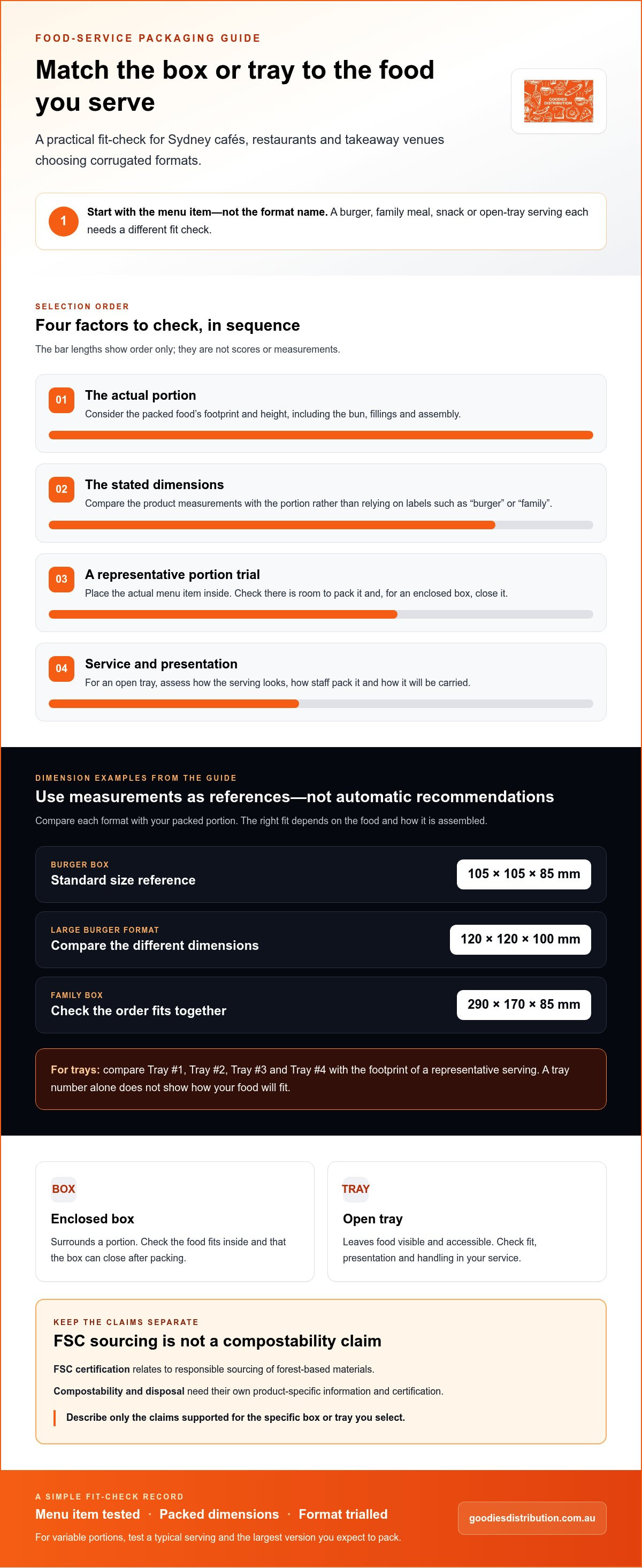
Start with the food, not the product label. A burger box may sound like an obvious match, but bun size, fillings and assembly all affect the space required. Measure the portion’s footprint and height, then compare those measurements with the packaging dimensions. This gives your team a more useful shortlist than choosing by name alone.
Fit-check rule: compare the packed food’s dimensions with the product’s stated dimensions, then test the fit with a representative portion. Leave practical room to place the food inside and close an enclosed box. A close measurement on paper may not reflect how the food sits once packed, so trial the actual menu item before settling on a format.
Choosing between burger, dinner, family and snack boxes
Use the 105 x 105 x 85mm burger box as a size reference, not a recommendation for every burger. Compare it with the packed footprint and height of your menu item. The 120 x 120 x 100mm large burger format has different stated dimensions, but the right fit depends on the food you serve and how it is assembled.
For a larger order, compare a single-meal format with the 290 x 170 x 85mm family box. Consider how many items the order contains and how they will sit together, rather than assuming a family label automatically suits your meal. Dinner and snack formats also need a portion-by-portion fit check.
When an open corrugated tray may suit the service
An open tray can suit food presented or served without an enclosed box. Compare the listed dimensions for Tray #1, Tray #2, Tray #3 and Tray #4 with the footprint of a representative portion. The tray number alone does not tell you how the food will fit.
Place a typical serving in the tray and assess its presentation, how staff pack it, and how it will be carried as part of your service. This practical trial helps you assess handling and appearance without assuming one tray suits every menu item.
Make the fit check part of your ordering routine
Keep a simple record of the menu item tested, its packed dimensions and the format trialled. If portion sizes vary, test a typical serving and the largest version you expect to pack. Your team can then compare options consistently instead of relying on memory or product names.
Packaging choices also form part of a broader conversation about materials and responsible design. The Sustainable Packaging Coalition shares resources on sustainable packaging, providing wider context as you weigh menu requirements alongside your packaging priorities.
Once you have a shortlist, browse the corrugated box and tray formats and compare their stated dimensions with your fit-check notes. For Sydney venues, checking actual portions against service workflows helps you choose fsc bioboard corrugated boxes and trays that suit how your menu reaches customers.
Compare the collection’s sizes, colours and carton quantities
A side-by-side comparison helps you weigh menu fit, presentation and stock planning together. The table summarises stated product details. Use the individual product information to compare dimensions, colour options and carton quantities for the formats you’re considering.
| Format | Listed dimensions | Colour option | Carton quantity |
|---|---|---|---|
| Burger box | 105 x 105 x 85mm | Kraft or white examples | Product details |
| Large burger box | 120 x 120 x 100mm | Product details | Product details |
| Family box | 290 x 170 x 85mm | Product details | Product details |
| Hot dog box | Product details | White | 400 per carton |
How to read product dimensions and carton quantities
Dimensions are shown in millimetres and should be read in the order presented. For example, 105 x 105 x 85mm is the stated sequence for the burger box; keep that order when comparing formats. Carton quantity answers a different question: how many units are supplied in a carton. It does not indicate how much food a box holds.
Compare dimensions and carton quantity together: dimensions help you assess the format, while carton count supports stock planning. Estimate how quickly your venue uses each format and compare that with its carton quantity. This gives you a practical basis for just-in-time inventory planning without treating carton size as an indicator of portion capacity.
White or kraft: choose the presentation that fits your venue
White and kraft are visual choices. A kraft burger box and a white burger box can create different impressions alongside your menu and branding, but colour alone does not establish a difference in performance or environmental outcome. Consider how each option looks at your counter, in takeaway presentation and alongside your existing brand colours.
For more context on packaging decisions in Australian wholesale settings, the eco-friendly packaging wholesale guide can complement this format comparison. Keep sourcing and end-of-life claims tied to the specific product information instead of inferring them from its colour.
Use the table as a starting point, then compare product details with your menu needs and expected usage. This makes it easier to shortlist fsc bioboard corrugated boxes and trays based on practical details as well as presentation, while keeping dimensions and carton quantities clear for your ordering plan.
Avoid common buying mistakes when ordering corrugated packaging
A product name or appealing colour can make a box seem like an easy choice, but neither tells you whether it suits your menu or ordering routine. Use a consistent review before choosing a format. For fsc bioboard corrugated boxes and trays, work through these steps:
- Confirm menu fit: choose a representative portion and consider how it will be packed and served.
- Check dimensions: compare the packed food’s footprint and height with the product’s stated measurements.
- Plan carton use: consider expected usage alongside storage capacity and the carton quantity.
- Review product claims: use only the sourcing or environmental wording attached to that specific product.
Check fit before settling on a carton format
Measure a representative packed portion, including its height and any accompanying food. Then test it in the proposed format. A box that seems suitable by name or colour may not fit the actual portion, while a tray needs to accommodate the food and suit the way your team serves it.
Trial the packing and serving workflow before adopting one format across the menu. In Sydney, factor in storage space, busy service periods and how quickly your venue is likely to use a carton. Planning around realistic usage helps you avoid choosing a quantity that does not suit your stockroom or routine.
Keep environmental claims accurate and product-specific
FSC sourcing and home compostability address different questions. FSC relates to the sourcing claim for forest-based material; it does not, by itself, establish compostability or tell customers which local disposal options accept a product. Use only the certification and environmental wording stated for the particular box or tray, and don’t extend one product’s claim across the range.
For broader context on packaging orders, the Australian wholesale guide to food packaging can sit alongside your product-by-product review. Keep customer-facing descriptions clear: identify the stated sourcing claim separately from any compostability information, and avoid suggesting a disposal route unless it is supported by product information and relevant local arrangements.
Good stock planning covers the journey from ordering to storage as well as the customer’s service experience. Consider when cartons are needed around busy periods and how much room your venue can set aside, then plan orders with Goodies Distribution’s Sydney-wide delivery support.
Ready to compare formats against your checklist? Explore corrugated boxes and trays and use the product details to guide your shortlist.
Explore standout FSC BioBoard boxes and trays for your venue
Format examples can help turn your menu and stock notes into a practical shortlist. Compare stated measurements and carton details with your venue’s requirements, then use the product information to assess each option. These examples are starting points, not guarantees of fit for a particular portion.
Standout formats to shortlist
- Regular snack box: the kraft format measures 175 x 90 x 84mm and is supplied in cartons of 200. Compare these dimensions with the packed footprint and height of the snack you serve.
- Large snack box: the 204 x 107 x 84mm format is available in white and kraft. Consider which colour suits your brand presentation, then assess the stated size against a representative serving.
- Tray #3: at 180 x 134 x 45mm, this open format gives you a stated size to compare with your menu and serving workflow.
- Tray #4: measuring 228 x 152 x 45mm, it offers another footprint to consider alongside Tray #3.
The hot dog box is another distinct format in the collection. The white option is identified as FSC Recycled and supplied in cartons of 400. Keep that product-specific wording attached to this item rather than assuming other boxes share the same certification or carton quantity.
For each option, trial a representative portion and consider how staff will pack or present it during service. Stated measurements help narrow your shortlist, while a practical test lets your team assess the format in its own workflow. White and kraft provide different visual treatments; colour alone does not indicate a difference in performance or environmental outcome.
Browse the range and plan your next order
Before ordering, match your shortlisted formats with expected use and available storage space. Include product dimensions and carton quantities in your stock plan so the selection reflects your menu and routine, not appearance alone.
For a wider view of how material choices fit into packaging decisions, the Goodies Distribution sustainable packaging wholesale guide offers related context. Then browse FSC BioBoard corrugated boxes and trays to compare formats and product information. With dimensions, presentation and carton planning in view, you can build a shortlist around your menu and the way customers receive it.
Make your next packaging choice with confidence
Your packaging can adapt as your menu changes. When dishes, portions or service routines shift, review the format to keep the customer experience considered and your product claims clear. A focused shortlist can also help your team make consistent choices during service.
Goodies Distribution brings more than 40 years of combined hospitality industry experience to its work with food-service businesses, alongside an FSC-certified paper packaging range. That experience supports practical decisions grounded in venue needs, while product-specific details help you communicate material claims accurately.
Ready to take the next step? Shop FSC BioBoard corrugated boxes and trays and compare the options with your menu and service plans. With a thoughtful approach to fsc bioboard corrugated boxes and trays, you can choose packaging that suits your food, your customers and the way your venue operates.
Frequently Asked Questions
Is FSC-certified packaging the same as compostable packaging?
No. FSC relates to the sourcing of forest-based materials, while compostability concerns what happens to a product after use under particular conditions. For fsc bioboard corrugated boxes and trays, describe FSC sourcing only when the specific product carries that claim. Make a separate compostability statement only when supported by product-specific certification, and don’t imply that FSC certification identifies a disposal method.
Can I use corrugated boxes and trays for hot takeaway food?
Suitability depends on the specific product and the food you plan to pack. Heat, steam, moisture and oily ingredients can affect food presentation and the packaging experience, so consider these conditions before choosing a format. Trial a representative serving in the intended box or tray, then assess it through your usual packing and handover routine. Use the product’s stated information to guide your selection.
How many corrugated boxes should a café or takeaway order?
Base the order on your venue’s actual usage rather than a general estimate. Review how many boxes you use across a normal service period, note changes during busy periods, and compare your forecast with the carton quantity for the format you’re considering. Also factor in available storage space and how often you want to replenish stock. This gives you a practical ordering plan without taking up space with slow-moving formats.
Are kraft and white BioBoard boxes different in performance?
Kraft and white are colour options, and the available product information does not establish a performance difference between them. Choose based on how the packaging fits your menu presentation and brand palette, rather than assuming colour changes how a box performs. To create a consistent look across takeaway items, compare the options with your existing packaging and customer-facing materials.
What does corrugated mean on a food packaging product?
Corrugated describes paperboard with a shaped, fluted layer between flat layers. This structure is used to make packaging formats such as takeaway boxes and serving trays. For food-service buyers, the term identifies a material construction, not a promise that a particular item suits every menu. Choose a format by considering its stated dimensions and how your team packs or presents the food.
Can I recycle a food box after it has been used?
That depends on the box’s condition and your local recycling guidance. Food residue or grease may affect whether paper packaging is accepted, so separate a clean, dry box from one with substantial food contamination. FSC certification does not mean a box is recyclable. Only place it in a recycling bin when local collection guidance accepts that type of packaging.