

Could packaging labelled “compostable” still be the wrong choice for your customers? Yes, if it is designed for industrial composting but customers expect to put it in a home compost bin. For cafés, restaurants and takeaway businesses, choosing home compostable products means checking more than a front-of-pack claim. The certification, disposal instructions and packaging performance all need to suit how you serve and store food.
Composting terms and certification marks can look similar, so it’s important to check what they mean before ordering wholesale. This guide explains how AS 5810 differs from the industrial composting standard AS 4736, and what to check on product claims, certification details and end-of-life instructions. It also covers how to assess packaging for your menu and service conditions, and how to communicate disposal guidance to customers. These checks can help your Sydney food business make a considered choice and give customers clear information at the point of sale.
Key Takeaways
- Check certification and instructions for the exact product before describing its compostability to customers.
- Understand how home compostable products differ from items intended for industrial composting, and why the disposal route matters.
- Assess packaging against your food, service and storage needs before ordering wholesale.
- For Sydney venues, check whether local council or composting services accept the packaging rather than assuming it can go in a collection.
- Goodies Distribution supplies wholesale packaging, including home compostable products, and offers custom branding services.
What does home compostable mean for food-service packaging?
After a takeaway meal, what can your customers actually do with the packaging? A home compostable claim may point to one option, but it doesn’t mean every household compost will accept or process the item. For cafés, restaurants and takeaway venues, the practical value comes from matching the claim to clear instructions and a disposal route customers can use.
Home compostability is the ability of a product to decompose safely in a domestic or backyard composting environment under specified conditions. That differs from a general “biodegradable” claim, which doesn’t say where a product will break down, under what conditions or within what timeframe. Home composting methods and suitable materials vary. An overview of home composting can help explain the process, but product-specific instructions still matter.
Moisture, airflow and temperature can vary between household compost systems. Certification relates to the conditions and requirements set by the relevant standard, not a promise that every backyard system will produce the same result. Check the product’s directions before telling customers how to dispose of it.
How is home compostability different from industrial compostability?
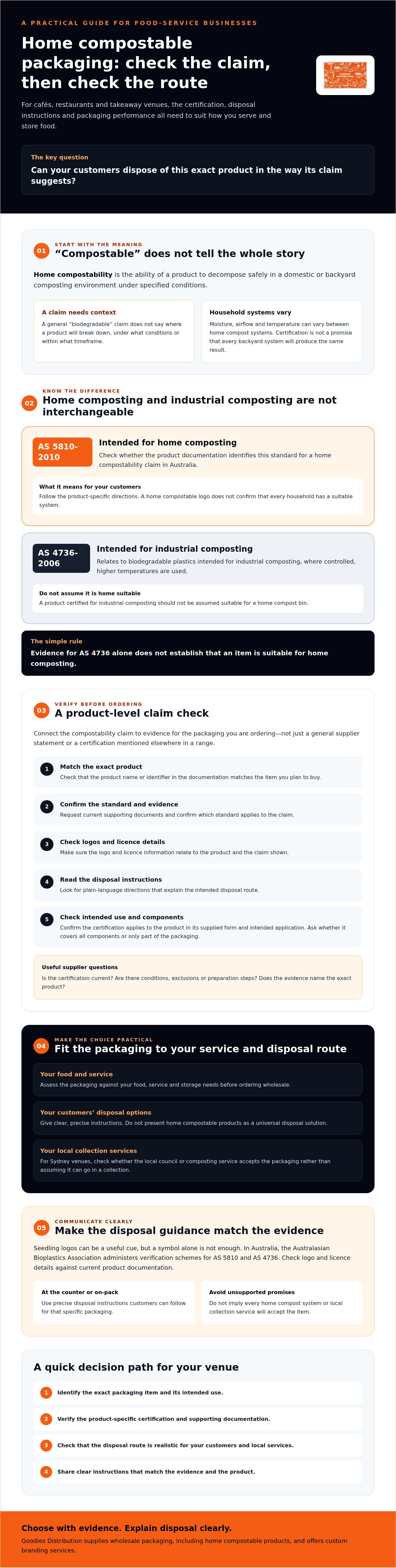
Home and industrial composting refer to different processing environments. In Australia, AS 5810-2010 covers materials intended for home composting, while AS 4736-2006 relates to biodegradable plastics intended for industrial composting, where controlled, higher temperatures are used. A product certified for industrial composting shouldn’t be assumed suitable for a home compost bin. Check certification for the exact item: a claim for one product doesn’t automatically apply to every item in a range.
What do home compostable logos and instructions tell customers?
Home compostable logos can help customers identify a certified claim, while disposal instructions explain what to do with specific packaging. Look for supporting certification details, such as the relevant standard and evidence linked to the product. In Australia, the Australasian Bioplastics Association administers verification schemes for AS 5810 and AS 4736. Check the logo and licence details against current product documentation rather than relying on a symbol alone.
For your business, the distinction affects what you print on packaging, display at the counter or tell customers. A logo doesn’t confirm that a household has a suitable composting system or that a local collection service accepts the item. Keep instructions precise, and don’t present home compostable products as a universal disposal solution.
How can you verify a home compostable packaging claim?
A compostability claim is useful to your business only if you can connect it to evidence for the packaging you’re ordering. Check the item itself, not just a supplier’s general sustainability statement or a certification mentioned elsewhere in its range.
Verify compostability certification at the individual product level before you make or repeat a claim. Use this checklist for each item:
- Exact product: Match the product name or identifier in the documentation to the item you plan to buy.
- Certification evidence: Confirm the applicable standard and request current supporting documents.
- Logo and licence details: Check that any logo and licence information relates to the product and claim shown.
- Disposal instructions: Look for plain-language directions that explain the intended disposal route.
- Intended use: Confirm the certification applies to the product in its supplied form and intended application.
Which certification and product evidence should you check?
For a home compostability claim in Australia, check whether the product documentation identifies AS 5810-2010. AS 4736-2006 relates to industrial compostability, so evidence for that standard alone doesn’t establish that an item is suitable for home composting. Ask the supplier for documentation naming the exact product, its certification and any relevant licence details. Certification for one product in a range isn’t proof that every item in that range carries the same claim.
Ask practical follow-up questions: Is the certification current? Are there conditions, exclusions or preparation steps customers need to know about? Does the claim apply to all components, or only part of the packaging? Clear answers help you avoid giving customers disposal advice the evidence doesn’t support.
How should you assess logos and environmental wording?
In Australia, seedling logos can be a useful cue when checking compostability claims, but the symbol is only a starting point. Verify which standard and product scope it represents, then compare those details with the supplier’s documentation. The National Compostable Packaging Strategy provides broader context on appropriate use and recovery systems for compostable packaging.
Read the on-pack instructions as a customer would. They should make the intended disposal pathway easy to understand and shouldn’t imply that every home compost or local collection service accepts the item. Avoid broad wording such as “suitable for every home compost” unless product evidence supports that precise claim. For help discussing product options before a wholesale order, contact Goodies Distribution’s packaging team with the exact product details.
Home compostable vs industrially compostable: which packaging suits your business?
The right choice depends on where the packaging is intended to break down and whether customers or your business can access that pathway. A commercial waste collection may take packaging to an industrial composting facility, but that doesn’t make the item suitable for a backyard compost bin. Match the product’s verified certification to a disposal option you can clearly explain and support.
| Check | Home compostable | Industrially compostable |
|---|---|---|
| Setting | Domestic or backyard composting environment, under specified conditions. | Industrial or commercial facility using controlled composting conditions. |
| Relevant Australian standard | AS 5810-2010 | AS 4736-2006 |
| Intended user | A customer with a suitable home composting system. | A business or customer with access to a suitable industrial composting pathway. |
| Disposal route | Follow the product instructions and confirm the household system can accept it. | Use an accepting collection or facility, after checking local requirements. |
These standards describe different processing environments, not a ranking of packaging performance or environmental benefit. Check the certification for the exact item and consider how it fits your food-service operations, customer access and waste-handling arrangements.
When might home compostable packaging fit a food-service business?
Home compostable packaging may be relevant when customers can take it away and the product instructions offer a clear home composting route. Before choosing it, consider whether the people you serve are likely to have a suitable system and understand how to use it. Instructions can support clear communication, but don’t promise that packaging will break down in every backyard composting environment.
When should a business consider an industrial composting pathway?
Consider industrially compostable packaging only alongside a suitable processing pathway. Confirm that your collection provider or relevant council accepts the specific item, and check any sorting or preparation instructions. Don’t assume a commercial collection means composting, or that a collector accepts every certified product. Base your choice on the waste arrangements your venue can actually use, then explain the disposal route clearly to staff and customers.
For Sydney businesses, check current local council or service guidance before selecting packaging for an industrial composting stream. If neither a customer’s home system nor an accessible commercial pathway is confirmed, don’t suggest that either option is available by default. Choose and describe each product in line with its certification and practical end-of-life instructions.
How should Sydney food businesses choose and introduce home compostable products?
Start with the job the packaging needs to do, then check whether its verified composting claim fits a disposal route your customers or business can access. For Sydney cafés, restaurants and takeaway venues, weigh menu requirements and service conditions alongside certification. A compostability claim alone doesn’t confirm that the packaging will suit your food or local waste arrangements.
What should cafés, restaurants and takeaway venues assess first?
Match containers, trays or bowls to the food, portion and service format. A container for a saucy takeaway meal has different practical demands from a tray used for pastries. Review product documentation for intended use and available food-service performance information, then assess the item with your own menu under normal service conditions before making it a regular part of operations.
Plan storage carefully. Keep packaging in the conditions stated by the supplier, and consider whether high humidity or contact with moisture could affect its condition or presentation. Check stock periodically and observe how packaging performs during busy service, transport and storage. If it softens, leaks or changes how food arrives, revisit the product choice rather than treating a compostability claim as evidence of suitability.
Also confirm the end-of-life route. Sydney council guidance and service acceptance can vary, so ask the relevant council or waste service whether it accepts the specific packaging. Don’t assume a collection service is available simply because an item is compostable.
How can you explain compostable packaging to customers?
Keep directions short, visible and specific to the item. Tell customers whether the packaging is intended for a suitable home composting system or an accepted commercial collection pathway. Train staff to explain the difference, so customers don’t mistake industrial composting instructions for permission to put an item in a backyard compost bin.
Before printing branded packaging, compare every customer-facing environmental claim with current evidence for the exact product. Clear, accurate wording can support a better customer experience and protect the trust your brand has built.
Use this rollout checklist before changing packaging:
- Confirm the product suits the menu, portion and service format.
- Review intended use, performance information and storage guidance.
- Check council or service acceptance for the disposal pathway you plan to communicate.
- Brief staff on the correct instructions for each item.
- Prepare customer signage and review printed claims against product evidence.
Goodies Distribution supplies wholesale packaging, including compostable cups, takeaway containers, bagasse containers, trays and bowls, biodegradable cutlery and paper bags. Explore packaging options for your venue as you assess product suitability and customer instructions.
How Goodies Distribution can help you source home compostable products
Choosing packaging involves more than finding a compostability claim. You also need to consider how an item fits your menu, service style, storage conditions and customers’ disposal options. Goodies Distribution is a wholesale supplier of eco-friendly and compostable food packaging for businesses in Australia, including Sydney. Its directors have more than 40 years of industry experience.
The company supplies home compostable products alongside other packaging options and offers custom branding for businesses. When comparing products, consider your operational needs and the information available for each item. Goodies Distribution supplies packaging; it doesn’t operate composting services or act as a certification authority. Treat supplier guidance as support for your checks, not a substitute for confirming product evidence and end-of-life instructions.
What can a wholesale packaging partner help you check?
Before choosing an item, discuss its intended use, food-service requirements and how you plan to order it. Explain the type of food you’ll pack, how it will be served or transported, and what matters for presentation. If you’re considering branded packaging, review proposed customer-facing wording alongside the product documentation before committing to print.
Ask for information that identifies the exact product and its relevant compostability certification. Check whether documentation refers to AS 5810 for home compostability or AS 4736 for industrial compostability, and request the product’s disposal instructions. Certification available elsewhere in a supplier’s range shouldn’t be treated as proof for the item you’re buying. Confirm any conditions or exclusions that could affect how staff explain the claim to customers.
Also discuss whether the packaging suits your ordering and storage needs. A wholesale supplier can help you review the information available for a product, but your team should assess how it performs with your food and service conditions. Confirm local collection acceptance separately with the relevant council or service. Goodies Distribution doesn’t provide composting or waste collection.
How can you take the next step with Goodies Distribution?
Sydney cafés, restaurants and takeaway operators can discuss wholesale packaging options with Goodies Distribution, including custom branding. Bring the product category you’re considering, your food-service requirements and any questions about certification or customer instructions. That gives you a practical starting point for comparing options and planning clear packaging communication.
Confirm certification and suitability for the exact product or SKU before ordering or making a compostability claim. Ready to review packaging options for your business? Explore Goodies Distribution’s wholesale packaging range.
Make your next packaging choice with confidence
Choosing home compostable products starts with checking the claim for the exact item, then matching its certification and disposal instructions to a pathway customers or your business can access. AS 5810 relates to home compostability, while AS 4736 applies to industrial compostability. Neither claim replaces practical checks for food-service performance, storage and customer guidance.
For Sydney cafés, restaurants and takeaway venues, clear instructions help staff and customers understand what to do after use. Check local council or service acceptance before relying on commercial collection, and review environmental wording before it appears on branded packaging.
Goodies Distribution supplies high-quality packaging, including compostable cups, as well as takeaway containers, biodegradable cutlery, paper bags and home compostable products. The company also offers custom branding. Explore Goodies Distribution’s wholesale packaging range and discuss options for your operation. A thoughtful, well-checked choice can support your service and give customers clearer information.
Frequently Asked Questions
What does home compostable mean?
Home compostable means a product is designed to decompose safely in a domestic or backyard composting environment under specified conditions. In Australia, AS 5810-2010 is the standard associated with home compostability. The claim is more specific than “biodegradable”, which doesn’t explain where or under what conditions a product may break down. Follow the product’s instructions, as household composting conditions and accepted materials can vary.
How can I tell if packaging is home compostable?
Check the exact product’s current documentation for certification to AS 5810-2010, then compare the product details with any home compostable logos and disposal instructions on the packaging. Ask the supplier for evidence that applies to the item you plan to order, not just a general claim about its range. For home compostable products, confirm any conditions or exclusions before making a claim to customers.
Is home compostable the same as industrially compostable?
No. Home compostability and industrial compostability refer to different processing environments. AS 5810-2010 relates to home composting, while AS 4736-2006 relates to industrial composting, where controlled conditions include higher temperatures. A product certified for industrial composting shouldn’t automatically be treated as suitable for a backyard compost bin. Check the exact product’s certification and instructions so staff and customers receive the right disposal guidance.
Can home compostable packaging go in a food business’s compost collection?
Only if the relevant collection service or facility accepts that specific packaging. A home compostability claim doesn’t confirm acceptance in a commercial composting stream, and a collection service may have its own requirements. Ask your provider or relevant council before placing packaging in a food business’s compost collection. If acceptance hasn’t been confirmed, don’t tell customers or staff that the item belongs in that collection.
Can all home compostable products break down in a backyard compost?
No product claim guarantees the same result in every backyard compost. Home compost systems differ, and conditions such as moisture, airflow and temperature can affect how composting proceeds. Certification relates to specified conditions, so check the product’s instructions and any limits before use. If a household doesn’t have a suitable composting system, the packaging may not have a home composting pathway available to them.
How should a Sydney café choose home compostable packaging?
Start by matching packaging to the menu, portion and service format, then review its intended use and food-service performance information. Check how it should be stored and assess it during normal service. Verify the exact item’s home compostability certification and instructions, and ask your local council or waste service whether it accepts the packaging if you plan to use a collection pathway. Give staff and customers clear disposal directions.
Are seedling logos enough to prove a product is home compostable?
No. A seedling logo can be a useful certification cue, but check which standard it represents and whether its certification applies to the exact product. Confirm supporting documentation and any associated licence details with the supplier. Also read the disposal instructions: a logo alone doesn’t show whether a household has a suitable composting system or whether a local collection service accepts the item.