

What if the best packaging for Uber Eats isn’t one container for every order, but a system matched to your menu? For Sydney cafes, restaurants and takeaway venues, the right combination can help meals arrive contained and presentable, while supporting a smoother handover from kitchen to delivery bag.
Hot or moist food can lose texture during a delivery journey, and a container is only one part of the order. Lids need to fit, bags need to carry the packed meal, and each choice should suit the food inside. Compostability adds another consideration: a certified claim helps customers make informed disposal choices when its conditions are clear.
This guide compares packaging options by food type, delivery journey and compostability, so you can choose formats that fit your menu and build a reliable packing routine. It also covers how to explain environmental claims accurately and use custom branding to make every order feel like an extension of your business.
Key Takeaways
- Choose the best packaging for Uber Eats by matching each format to the food, portion, moisture and delivery journey.
- Compare bagasse containers, trays and bowls with paper bags to build an order setup that suits your menu.
- Check food-use performance as well as compostability claims, and distinguish industrial compostability from home compostability.
- Use a consistent packing sequence, then test it with your actual menu and order handover routine.
- Consider verified product claims, practical stock needs and custom branding when shaping a packaging system for your Sydney business.
Best packaging for Uber Eats starts with the food and delivery journey
Your goal is to get each order from kitchen to customer with its quality and presentation considered at every step. The best packaging for Uber Eats depends on the menu item, its heat and moisture, portion size, and expected journey. A container that suits a dry burger may not be the right fit for a saucy meal or a bowl with separate components.
Think of the order as a small packing system. The primary container holds the food; the outer bag groups items for handover, while accessories such as cutlery complete the order when needed. Each part has a job, and how they fit together matters. For an overview of food packaging functions, consider how packaging can provide physical and barrier protection as well as contain food.
What delivery can change about a takeaway meal
Moisture can build up inside a closed pack and soften crisp food, a familiar form of soggy bottom syndrome. Food can also shift when bags move or containers are stacked. Sauces and dressings need particular attention: check that the food sits securely, the lid fits as intended, and the filled container can be handled without tipping. Assess the whole packed order, because results depend on the dish and journey.
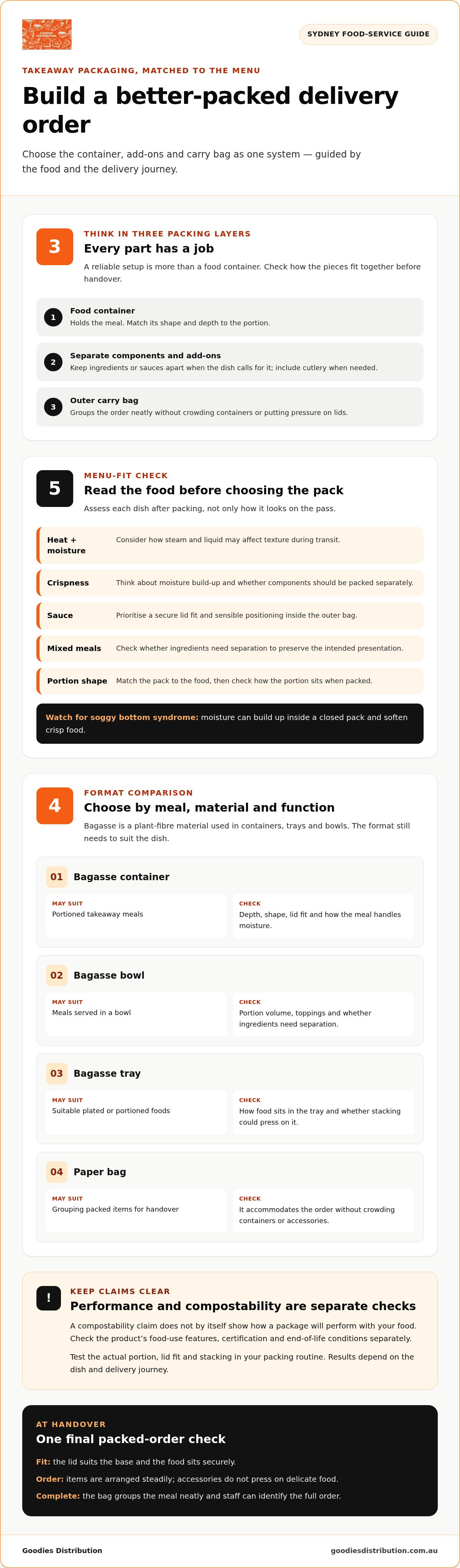
Separate packaging decisions into three layers: the food container, any components packed apart, and the carry bag. The bag should group the order neatly without putting unnecessary pressure on containers or lids. Include cutlery where it’s needed, and arrange items so staff can identify the complete order during handover.
Which menu details should guide packaging choice?
Review each dish by how it behaves after packing, not just how it looks on the pass. Heat, moisture, sauce, crispness and portion shape all influence the choice. A burger needs room to sit without being crushed; a bowl may need enough depth for its contents; and a saucy meal calls for attention to containment and lid fit. Use these as starting points, then check the actual portion in the selected format.
- Hot or moist food: Consider how steam and liquid may affect texture during transit.
- Crisp items: Think about moisture build-up and whether components should be packed separately.
- Saucy dishes: Prioritise a secure fit and sensible positioning inside the outer bag.
- Mixed meals: Check whether ingredients need separation to preserve the intended presentation.
- Unusual portions: Match the container or tray to the food’s shape, then check how it sits when packed.
This item-by-item approach gives your team a clear basis for choosing between takeaway containers, trays and bowls, rather than relying on one format for the whole menu.
Compare takeaway packaging by meal type, material and function
Once you’ve identified what each dish needs, compare the packaging as a set: the food container, any lid or compartments, and the outer bag. Bagasse is a plant-fibre material used in containers, trays and bowls, but the material alone doesn’t determine whether a format suits a particular dish or how it should be disposed of. Check the specific product’s food-use features and any applicable certification.
| Format | May suit | Key consideration |
|---|---|---|
| Bagasse container | Portioned takeaway meals | Match depth and shape to the food; check the lid fit and how the packed meal handles moisture. |
| Bagasse bowl | Meals served in a bowl | Consider portion volume, toppings and whether any ingredients need to be kept separate. |
| Bagasse tray | Suitable plated or portioned foods | Check how the food sits in the tray and whether stacking could press on it. |
| Paper bag | Grouping packed items for handover | Choose a format that accommodates the order without crowding containers or accessories. |
Containers, trays and bowls for different menu formats
Let the menu guide the format rather than assuming one shape works for every meal. A bowl suits food presented in a bowl; a tray may suit foods arranged or portioned across a broader base. Compartments can help keep ingredients or sauces apart when the dish calls for it. Check the lid as well: it should fit the base, and the packed container should stack in a way that suits your kitchen. For further context on takeaway formats, see this Sydney takeaway container guide.
Bags, cutlery and add-ons that complete the order
An outer paper bag brings packed items together for handover, but it doesn’t replace a suitable food container or lid. Arrange the order so containers sit steadily and accessories don’t press against delicate food. Add biodegradable cutlery when it suits the menu and customer’s needs, rather than including it automatically with every meal.
A considered combination of bagasse formats, paper bags and relevant cutlery can make packing more consistent while keeping presentation in view. Goodies Distribution’s takeaway packaging range offers options for Sydney hospitality businesses to compare with their menus.
Can compostable packaging handle delivery? Check performance and certification
Compostable packaging can be considered for delivery, but a compostability claim doesn’t tell you by itself how a package will perform with your food. Before adding a format to your packing routine, consider the meal’s moisture and heat, whether the container holds its contents as intended, and how it handles stacking. Assess the product’s certification and end-of-life conditions separately.
What compostability certification tells a food business
Certification helps make a compostability claim specific. AS 4736 relates to industrial compostability, while AS 5810 relates to home compostability. EN 13432 is another certification reference for compostable packaging. Attribute these standards only to products whose evidence confirms that the certification applies.
Some certified products may carry seedling logos, which indicate that they meet specified compostability requirements. The logo and standard can help you explain a product’s claim, but certification doesn’t mean that local collection or processing is available. Disposal depends on the product’s certified conditions and the facilities accessible to customers.
Industrial compostability means a product is certified for processing in an industrial composting environment; home compostability means it’s certified for breakdown in a domestic composting environment. These claims aren’t interchangeable. Don’t suggest an industrially compostable item can go in a backyard compost bin unless it also has the relevant home compostability certification.
How to balance food performance with environmental claims
Start with practical checks for your menu and packing routine. Certification doesn’t establish whether a container is the right shape, whether its lid fits the base, or how it will handle a moist meal during stacking and transport. Review the specific product information alongside your own food-use testing, and avoid broad descriptions such as “eco-friendly” unless you explain the verified attribute behind the claim.
- For performance: Consider containment, moisture exposure, lid fit and stacking in your order setup.
- For compostability: Check the certification evidence and whether it applies to that product.
- For disposal: Explain the relevant composting conditions without implying a local service is available.
Clear wording helps customers understand what a claim means and what it doesn’t. For broader context on materials and sustainability, read this Australian eco-friendly packaging guide. Goodies Distribution’s compostable packaging options help Sydney food businesses consider certified choices alongside their menu and operational needs.
Build a reliable Uber Eats packing workflow for a Sydney kitchen
A clear pack-out routine helps staff make consistent packaging choices during a busy service. Treat it as a sequence, then test it with your menu and order flow. The best packaging for Uber Eats is only useful in practice if the team can select, assemble and check it reliably.
A step-by-step pack-out check for takeaway teams
Use this sequence as a starting point, then adjust it to suit your kitchen:
- Identify the menu item. Check its portion, shape, moisture and whether any components should be separated.
- Select the package. Choose the container or tray matched to that dish. Check that its lid fits the base and the portion sits as intended.
- Secure the components. Arrange separate items and accessories so they don’t crowd or press on the food.
- Group the order. Place the packed items together in a paper bag, keeping the order organised for handover.
- Check before handover. Confirm the order is complete, containers are closed as intended, and any required cutlery or other accessories are included.
Run the sequence with actual dishes, including meals with different moisture levels or components that need separation. Look for awkward fits, lids that are difficult to close, or packing steps staff find unclear. Use what you observe to refine the routine. Testing one dish won’t establish a result for every menu item or delivery journey.
Keep packaging choices workable during service
Organisation makes the routine easier to follow. Group takeaway containers, bagasse trays and bowls, paper bags and biodegradable cutlery by menu use, with clear cues that help staff reach for the right format. Keep the chosen packaging close to the relevant assembly area where practical, and review usage as menu items and order patterns change. If one format is rarely used, check whether it still has a clear role on the menu.
Just-in-time inventory may suit some kitchens, but it depends on replenishment timing and available storage. Track which formats are used most and plan stock levels around how your venue operates, rather than assuming frequent replenishment will always fit.
For Sydney food businesses, Goodies Distribution’s Sydney-local warehouse and Sydney-wide delivery support provide local context when planning packaging replenishment. Explore takeaway packaging options to compare formats for your menu and packing routine.
Choose a packaging partner and make your Uber Eats orders recognisably yours
The best packaging for Uber Eats should work for your menu and kitchen, not just look good on a shelf. Use a practical checklist when choosing packaging: does each format suit the food, contain it as intended, fit your packing routine, carry clear product-specific environmental claims, meet your stock needs and present your business well?
- Menu fit: Match containers, trays and bowls to the dishes and portions you serve.
- Containment: Consider lid fit, moisture and how packed items will be grouped for handover.
- Practical packing: Choose formats your team can identify and assemble consistently during service.
- Verified claims: Base compostability statements on the certification that applies to each product.
- Stock and presentation: Plan for the formats your menu uses, while considering how packaging represents your brand.
When custom branding can support the delivery experience
Packaging travels beyond the kitchen, so its appearance can help customers recognise an order as yours. Thoughtful branding across suitable packaging can create a more consistent experience, from the food container to the carry bag. Goodies Distribution offers in-house custom branding services and tailored branding consultation to help hospitality businesses plan how their packaging presents their business. Keep environmental wording specific to the material and verified claim for each product.
Next steps for Sydney takeaway operators
Start by grouping menu items according to their packaging needs: meals that need a bowl, foods suited to a tray, and orders that require an outer paper bag or cutlery. Then compare relevant wholesale and bagasse packaging options with your menu and packing workflow. This keeps the choice grounded in what your team serves and how orders move through the kitchen.
Goodies Distribution is an authorised wholesale distributor, with directors bringing more than 40 years of combined hospitality experience. A Sydney-local warehouse and Sydney-wide delivery support local operators as they plan their packaging needs.
Explore Goodies Distribution’s wholesale and bagasse packaging options, and take the next step with wholesale and custom branding solutions for your Sydney takeaway business.
Make your next delivery order a better fit
The best packaging for Uber Eats starts with the meal: match the container, lid and outer bag to the food, then test the full packing routine with your menu. Consider performance and presentation alongside compostability, and describe environmental claims in line with the certification and disposal conditions that apply to each product.
A considered packaging system can make handover clearer for your team and create a more recognisable experience for customers. Goodies Distribution is an authorised BioPak wholesale distributor, supported by a Sydney-local warehouse and Sydney-wide delivery. The directors bring more than 40 years of combined experience in hospitality.
Ready to explore packaging options for your menu and branding? Explore wholesale packaging and custom branding with Goodies Distribution. With the right formats and a well-practised routine, your Sydney business can send out orders with care and confidence.
Frequently Asked Questions
What is the best packaging for Uber Eats orders?
The best packaging for Uber Eats orders matches each dish to a suitable container, lid and outer bag. Consider the food’s heat, moisture, portion and shape, then think about how items will be grouped and stacked for handover. A bowl, tray or takeaway container may suit different menu items. Test your dishes and packing routine, since no single format is right for every meal or delivery journey.
How do I stop food getting soggy in delivery packaging?
Reduce sogginess by considering how steam and moisture affect each dish after it’s packed. Keep crisp components separate from wet ingredients where the meal allows, and avoid packing items so tightly that they’re crushed or difficult to arrange. Choose packaging based on the food’s needs, then test it during your normal pack-out process. Results can vary by dish and journey, so don’t assume one method will suit the whole menu.
Is bagasse packaging suitable for Uber Eats?
Bagasse packaging can be an option for delivery orders, but suitability depends on the specific format and the food it needs to hold. Match containers, trays and bowls to the portion, and consider moisture, lid fit and how the packed order will be stacked. Check product information and test the format with your menu. Bagasse material alone doesn’t establish food-use performance or tell you how the product should be disposed of.
Are compostable containers the same as home compostable packaging?
No. “Compostable” doesn’t automatically mean a product is suitable for home composting. AS 4736 relates to industrial compostability, while AS 5810 relates to home compostability. Check the certification evidence for the specific product and explain its disposal conditions clearly. Certification also doesn’t mean a local collection or processing service is available, so don’t tell customers to compost packaging at home unless the product carries the relevant home compostability certification.
What packaging should I use for burgers, bowls and saucy meals?
Choose packaging according to each meal’s shape, ingredients and moisture. A burger needs room to sit without being crushed; a bowl-style meal calls for a suitable bowl format; and a saucy dish needs careful attention to container shape, lid fit and positioning in the order. Consider separating components if that helps presentation. Test each combination with the actual portion rather than assuming a container will suit every version of a dish.
How can a Sydney restaurant make takeaway packaging more sustainable?
Start by reviewing what each menu item needs, then choose materials and formats that suit the food and packing process. Check product-specific compostability or other environmental claims, and communicate disposal conditions accurately. Compostability is only useful as a customer instruction when the relevant conditions are clear. Paper bags, bagasse formats and cutlery can each play a role where they suit the order. Build your approach around the menu and local disposal options.
Can I customise packaging for Uber Eats orders?
Yes. Goodies Distribution offers in-house custom branding services for hospitality businesses. Branded packaging can carry your restaurant’s identity from the kitchen to the customer, creating a more consistent impression across delivery orders. Consider how branding will appear on the packaging formats you use, and keep any environmental wording tied to verified, product-specific claims. A tailored branding consultation can help you plan an approach that suits your business and chosen packaging.