


The lid matters as much as the bowl when a takeaway meal needs to travel securely. BioCane round bowls come in natural and white, with capacities across the range from 800 ml to 1,420 ml, and natural lids are made for 24 oz, 32 oz and 40 oz bowls.
Choosing BioCane bowls and lids involves more than matching a container size to your menu. Consider the material, the meal and how the lid fits the bowl. BioCane bowls are made from sugarcane pulp and are described as suitable for hot and cold food, offering cafés, restaurants and takeaway businesses a plant-fibre option for varied meals.
This guide covers bowl capacities and colours, what BioCane is made from, and its stated use for hot and cold meals. It also explains how natural lids fit round bowl sizes, helping you choose packaging that suits your service and presentation.
Key Takeaways
- Match bowl capacity to the portions you serve, with round options ranging from 800 ml to 1,420 ml.
- Choose natural or white bowls to suit your meal presentation and service style.
- Use the bowls for hot or cold meals, making them a practical option for varied takeaway menus.
- Pair 24 oz, 32 oz and 40 oz round bowls with the natural BioCane lid designed for those sizes.
Bowl capacity and colour options
BioCane round bowls come in several serving sizes, from smaller portions to substantial takeaway meals. Compare the stated capacity with your menu portion and allow room for toppings.
Bowl size and capacity
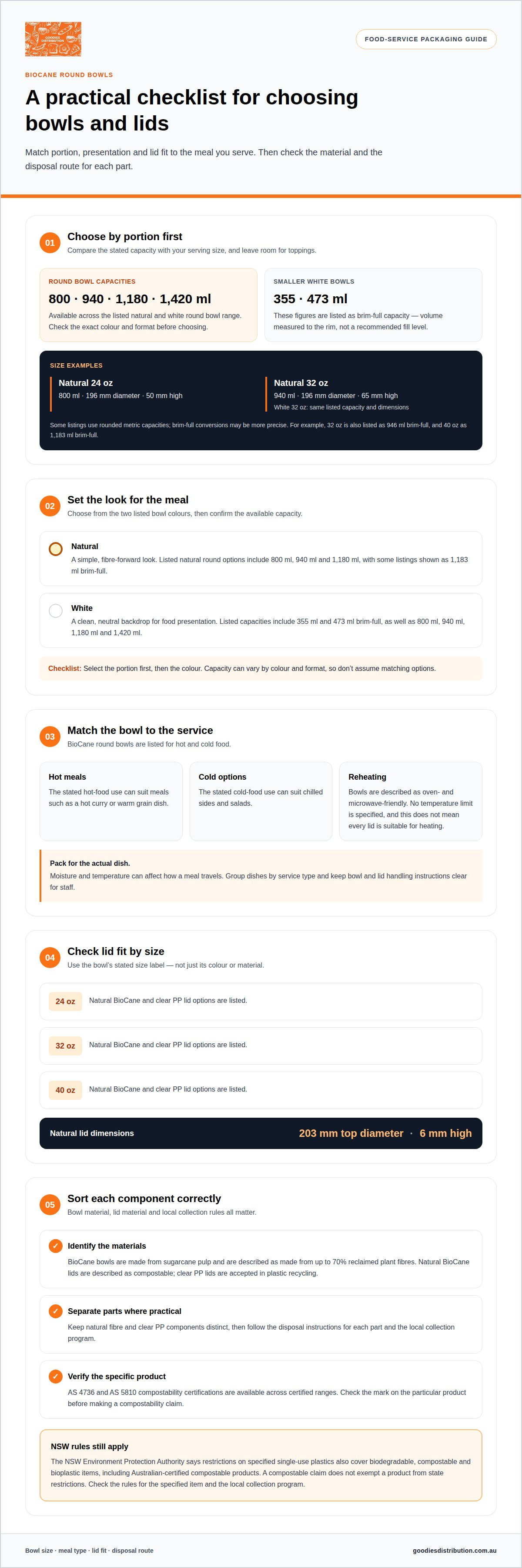
The round range includes 800 ml, 940 ml, 1,180 ml and 1,420 ml options. Smaller white bowls are also listed at 355 ml and 473 ml brim-full capacity. These figures help match a bowl to a dish, but brim-full capacity describes volume to the rim, not a recommended fill level.
For a practical comparison, the natural 24 oz bowl is listed at 800 ml, with a 196 mm diameter and 50 mm height. The natural 32 oz bowl is listed at 940 ml and measures 196 mm across by 65 mm high. The white 32 oz version has the same stated capacity and dimensions.
Some listings give rounded metric capacities, while brim-full measurements use more precise conversions. For example, the 32 oz natural bowl is also listed at 946 ml brim-full, and the 40 oz natural bowl at 1,183 ml. Use the size label consistently when comparing portions and planning service.
Available bowl colours
Natural and white are the two listed colour options for these round bowls. Natural offers a simple, fibre-forward look, while white provides a clean, neutral backdrop. Choose the option that works with the food, menu and takeaway packaging.
Capacity can vary across colours and formats, so compare the exact size rather than assuming every colour has matching options. For example, white bowls are listed at 355 ml and 473 ml brim-full, as well as 800 ml, 940 ml, 1,180 ml and 1,420 ml. Natural options include 800 ml, 940 ml, 1,180 ml and 1,183 ml brim-full listings.
For menu planning, choose a bowl by portion first, then select natural or white to suit the meal’s presentation. This makes serving sizes easier to keep consistent and gives staff a clear packaging choice for each dish.
Round bowls for hot and cold meals
BioCane round bowls are listed for hot and cold food, giving kitchens flexibility across different menu styles. The stated temperature range can suit takeaway service for hot meals as well as chilled sides.
In New South Wales, the NSW Environment Protection Authority says the ban on specified single-use plastics also covers biodegradable, compostable and bioplastic items, including Australian-certified compostable products. AS 4736 and AS 5810 compostability certifications are available across certified ranges, but certification should match the specific product.
That distinction matters for food-service operators. A compostable claim does not exempt a product from state restrictions. NSW rules apply to specified items, so don’t assume a bowl is permitted or prohibited simply because its material is compostable.
When planning service, consider what goes into each bowl. A hot curry, warm grain meal or chilled salad may fit the stated hot-and-cold use, while moisture and temperature can affect how a meal travels. Choose packaging for the actual dish, not just its menu category.
BioCane bowls are also described as oven- and microwave-friendly. This can help with meal preparation and reheating, but it does not specify a temperature limit or mean every lid is suitable for heating. Keep bowl and lid instructions separate in kitchen procedures, especially when meals are packed before reheating.
For a practical menu rollout, group dishes by service type: hot meals for immediate takeaway, chilled options and meals intended for reheating. Select the appropriate bowl for each group and make handling instructions clear to staff. This helps keep packing consistent during busy shifts.
To compare round bowl options for your menu, browse the BioCane bowl range and consider how each format fits your food-service routine.
BioCane bowl materials
BioCane bowls are made from sugarcane pulp, while bagasse bowls are described as certified compostable. Acceptance in Australian food-waste collections depends on the local collection program, so compostability does not automatically mean a bowl belongs in every food-waste bin.
The lid material also affects disposal. Clear PP lids for 24 oz, 32 oz and 40 oz bowls are accepted in plastic recycling, while natural BioCane lids for those sizes are described as compostable. Separate bowls and lids where practical, then follow the disposal instructions for each component.
Sugarcane pulp is a rapidly renewable material used to form the bowls. The BioCane bowls are made from up to 70% reclaimed plant fibres, making the fibre content a useful point to consider when comparing packaging materials. One listed BioBowl is made from plant fibre with no added PFAS.
These details refer to different material attributes, not a single disposal outcome. Fibre content describes part of a bowl’s composition; compostability relates to how a product breaks down under suitable conditions. Neither fact alone establishes acceptance by a council or commercial food-waste service.
For a Sydney venue, set a clear sorting routine for the packaging you use. Identify whether each lid is natural fibre or clear PP, separate the parts after service, and use the relevant local collection stream. This helps staff avoid treating every bowl-and-lid combination as the same material.
Certification marks can help distinguish products designed for composting. The BioPak range includes products with AS 4736 and AS 5810 compostability certifications; these standards relate to industrial and home compostability, respectively. Confirm the mark on the specific product before making a compostability claim to customers.
When choosing menu packaging, consider the bowl’s fibre composition, the lid material and the disposal route available to customers. These factors give a clearer picture than the word “compostable” alone and support accurate waste-sorting instructions at service.
Lid compatibility with round bowls
Match the lid to the bowl’s stated size, not just its material or colour. Natural BioCane lids are listed for 24 oz, 32 oz and 40 oz round bowls, while clear PP lids are also available for those same sizes.
The natural lid has a 203 mm top diameter and is 6 mm high. These measurements help distinguish it from other lid formats, but the size label remains the practical guide for pairing it with a bowl. A lid labelled for a different capacity may not suit the bowl rim.
For a busy Sydney kitchen, label lid and bowl cartons by size. A simple packing sequence helps reduce mix-ups:
- Read the capacity on the bowl and lid packaging.
- Pair matching 24 oz, 32 oz or 40 oz sizes.
- Keep natural fibre and clear PP lids in separate, labelled storage areas.
This distinction also supports accurate waste sorting. Natural BioCane lids are described as compostable, while clear PP lids are accepted in plastic recycling. Don’t treat the materials as interchangeable after service, even when both lid types fit the same bowl size.
Clear PP lids for 24 oz, 32 oz and 40 oz bowls are listed as microwave safe. This property applies to those clear lids, not automatically to every lid type. For meals that need reheating, distinguish the lid from the bowl and follow the product’s stated use instructions.
Check the fit during packing by seating the correctly sized lid evenly around the bowl rim. A consistent match helps staff prepare takeaway orders with fewer packaging errors. For a mixed menu, organise bowls and lids by capacity at the packing bench, rather than relying on colour alone.
Choose matching sizes for your service setup and shop BioCane bowls and lids.
Goodies Distribution: Bagasse containers, trays & bowls
Goodies Distribution supplies bagasse containers, trays and bowls for food-service businesses choosing fibre-based packaging. If your menu includes takeaway meals as well as BioCane bowls, these products can help you plan packaging for different dishes and service needs.
The range includes bagasse bowls described as certified compostable. Custom Branding Services can help coordinate packaging with your business identity. Takeaway Containers and Paper Bags can also support the handover from kitchen to customer.
Consider these options when reviewing packaging beyond round bowls or bringing several packaging choices together for your venue. The right mix depends on the meals you serve and how customers receive them.
For help with your packaging needs, contact Goodies Distribution.
Plan your next packaging step
Make packaging review part of menu planning, not a last-minute purchasing decision. Consider how biocane bowls and lids fit your ordering workflow, storage space and staff routines. A clear process helps keep packaging decisions aligned as your menu and service needs change.
Start by noting which dishes need dedicated packaging and how orders move from preparation to handover. Share those practical requirements with the team responsible for purchasing. This gives your next packaging decision a clear operational focus alongside presentation and customer experience.
Explore the range as you plan your next step. Explore BioCane bowl options, or contact Goodies Distribution to discuss your packaging needs. Thoughtful planning can help your team make choices with confidence.
Frequently Asked Questions
What are BioCane bowls and lids made from?
The bowls are made from sugarcane pulp, while lid material varies by type. Natural fibre and clear PP lids are different materials, so describe them separately on menus or waste-sorting signs. This distinction also helps staff sort packaging after service: identify each part before placing it in a collection stream, rather than treating the bowl and lid as one material.
What sizes and capacities of BioCane bowls are available in Australia?
Available capacities range from smaller portion bowls to larger meal formats, with sizes shown in millilitres or ounces. Listings may use brim-full capacity, meaning the volume measured to the rim, so the figure may not represent a practical fill level. For portion control, match the bowl to the food and leave room for toppings or a lid, rather than relying on the size label alone.
Which lids fit BioCane bowls, and are they sold separately?
Natural and clear PP lids are listed for the 24 oz, 32 oz and 40 oz round bowls, and lids are sold separately. Listed bowl and lid variants are supplied in cartons of 400; natural lids for those three sizes also come in cartons of 400 pieces. For stock planning, keep each lid carton identified by its matching bowl capacity to simplify replenishment.
Are BioCane bowls and lids compostable or biodegradable, and under what conditions?
Some products in the BioPak range carry AS 4736 or AS 5810 compostability certification, so the certification applies to the specific product, not automatically to every bowl-and-lid combination. Use the product’s own certification mark when describing disposal options. For a Sydney venue, align staff instructions with the collection service actually used, since a compostable label alone doesn’t establish local collection acceptance.
Can BioCane bowls and lids go in the microwave, freezer or oven?
BioCane bowls are described as oven- and microwave-friendly, and clear PP lids for 24 oz, 32 oz and 40 oz bowls are listed as microwave safe. Those details don’t establish freezer suitability or apply automatically to natural fibre lids. In kitchen procedures, separate reheating directions for the bowl from instructions for its lid, and don’t infer freezer use from chilled-food service.
Are BioCane bowls and lids safe for hot, oily or acidic foods?
BioCane bowls are described as suitable for hot and cold food, but this does not specify performance with oily or acidic recipes. For dishes such as hot curry or citrus dressing, follow the food-use information for the exact bowl and lid combination. Avoid broader safety claims based on the material name alone, and keep staff guidance tied to the stated product use.