

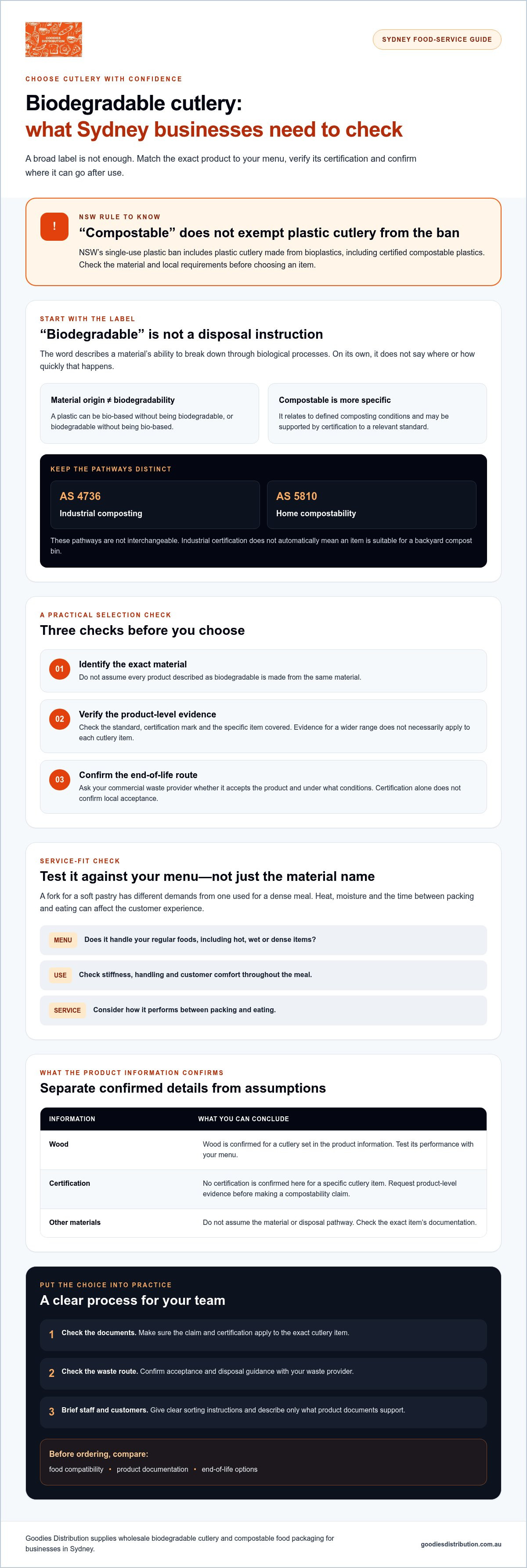
A cutlery item labelled “compostable” may still be the wrong choice for a Sydney food business. NSW’s single-use plastic ban includes plastic cutlery made from bioplastics, including certified compostable plastics, so material and local requirements matter when choosing biodegradable cutlery.
It’s understandable to want cutlery that feels like a responsible choice and holds up with your menu. But “biodegradable” alone doesn’t tell you how or where an item will break down, and a fork that struggles with dense or hot food can disrupt service. The right option needs to suit both your customers and your waste arrangements.
This guide explains how to compare materials, check compostability claims against standards such as AS 4736 for industrial composting and AS 5810 for home composting, and assess performance for different foods and service styles. You’ll also learn what to confirm about a product’s certification and end-of-life pathway before ordering. Goodies Distribution supplies wholesale biodegradable cutlery and compostable food packaging for businesses in Sydney.
Key Takeaways
- Choose biodegradable cutlery by checking documented material and certification details, rather than relying on a broad label alone.
- Match cutlery to your menu and service style by considering how it handles hot, wet or dense foods.
- Confirm your waste provider accepts the product and follow its disposal guidance before updating staff instructions.
- Use a practical shortlist to compare food compatibility, product documentation and end-of-life options before ordering.
- When sourcing biodegradable cutlery wholesale, look for clear product information and relevant hospitality experience. Goodies Distribution supplies cutlery and other food packaging to Sydney businesses.
What does biodegradable cutlery mean for a Sydney food business?
What happens to cutlery after customers finish using it? The answer depends on what the item is made from, the conditions it needs to break down and where it ends up. A label alone can’t tell you whether it will decompose in a backyard compost bin, at an industrial composting facility or in the waste system your business uses.
“Biodegradable” describes a material’s ability to break down through biological processes, but without details it doesn’t specify the environment or timeframe required. It shouldn’t be read as “breaks down quickly” or as proof that an item will safely decompose wherever it’s discarded. Material origin and biodegradability are also different qualities: as the overview of Bioplastics explains, a plastic can be bio-based without being biodegradable, or biodegradable without being bio-based.
Biodegradable and compostable: what is the practical difference?
“Compostable” is a more specific claim. It relates to defined composting conditions and can be supported by certification to a relevant standard. In Australia, AS 4736 relates to industrial composting, while AS 5810 relates to home compostability. These pathways aren’t interchangeable: a product certified for an industrial facility shouldn’t automatically be assumed suitable for a backyard compost bin.
For your team, the distinction affects what you can tell customers and how used cutlery should be sorted. Certification describes the product’s tested composting pathway; it doesn’t confirm that a local waste service accepts it. Check the certification and disposal instructions for the exact item, then confirm acceptance with your waste provider.
What should Sydney operators check before choosing a claim?
Before ordering biodegradable cutlery, check the product description, material information and any certification evidence. Make sure claims on a supplier page, packaging or product documentation apply to the specific cutlery item, not simply to a wider product range. If a claim doesn’t name a standard or explain the required disposal conditions, ask for clarification before repeating it in menus, signage or customer communications.
- Identify the material: Don’t assume all products described as biodegradable are made from the same material.
- Check certification: Confirm the standard, certification mark and item covered by the evidence.
- Confirm the waste pathway: Ask whether your commercial waste provider accepts the product, and under what conditions.
- Keep claims specific: Describe only what product documents support; avoid broad environmental promises.
A considered choice gives staff clearer disposal instructions and helps customers understand what a sustainability claim means in practice. Next, compare verified materials against the foods and service conditions your cutlery needs to handle.
Which biodegradable cutlery materials suit different foods and service styles?
Choose cutlery for the food it needs to handle, not just its material label. A fork used for a soft pastry has different demands from one used for a dense meal, while heat, moisture and time between packing and eating can all affect the customer experience.
Product information provided for this range confirms wood for a cutlery set. It doesn’t establish the material or certification of every cutlery item, so don’t assume all biodegradable cutlery is made from wood or shares the same disposal pathway. Check the specific item’s documentation before comparing options.
| Material | Food-service fit | Verified certification | Disposal considerations |
|---|---|---|---|
| Wood, confirmed for a cutlery set in the product information | Test stiffness and handling with your regular menu. Check how the item performs with hot, moist or dense foods, and whether customers can use it comfortably throughout the meal. | No certification is confirmed here for a specific cutlery item. Request product-level evidence before making a compostability claim. | Follow the item’s documented disposal instructions and check acceptance with your waste provider. Don’t infer a composting pathway from the material alone. |
| Other materials | Confirm the material and assess its performance against your menu rather than assuming it will behave like wood or another option. | Verify the standard, certification mark and product covered by the evidence. | Use the disposal pathway specified for that exact product, then confirm your waste service accepts it. |
How does cutlery performance vary with menu items?
Trial options with your most common dishes. Check stiffness and grip with dense foods, and test whether hot or moist meals affect handling during the time customers typically need the cutlery. Takeaway service deserves a separate check: assess the item after it has been packed and carried, not only straight from the carton. If samples are available, test them before changing a high-volume service item.
What do compostability certifications tell buyers?
AS 4736 covers industrial compostability, while AS 5810 covers home compostability. Neither should be attributed to a cutlery item without product-specific evidence. Check the certification’s scope, marks and documentation; Australian compostable standards can help explain the difference between these pathways. Certification doesn’t by itself confirm local collection or facility acceptance.
In short, match cutlery material to the food and verified disposal pathway. For a practical shortlist, compare item-level documentation with menu performance, and ask your supplier for evidence relevant to each cutlery option.
How can you compare biodegradable cutlery with confidence?
A clear shortlist helps you compare cutlery on what matters during service, not just on a supplier’s headline description. Start with your menu and service style, then check how each option handles the food, what documentation supports its claims and how it should be disposed of. Keep product features, such as shape or pack format, separate from environmental benefits, which need their own evidence.
Compare like with like. Confirm the exact item, material, dimensions and pack configuration shown in the product documentation. If one supplier describes a carton and another describes individual pieces, clarify the specifications before comparing them. This makes it easier to plan ordering and storage, and reduces the chance of selecting an item that doesn’t suit your service needs.
Which questions should you ask a cutlery supplier?
Ask direct questions and request answers that relate to the exact item you’re considering. A broad statement about a product range isn’t evidence for every product in it. Useful questions include:
- What material is this specific cutlery item made from, and which product document confirms it?
- Does this exact item carry AS 4736 or AS 5810 certification? Can you provide documentation showing the standard and its scope?
- What disposal conditions does the supplier recommend, and what evidence supports that guidance?
- Which environmental claims can you make accurately about this item, and what documentation should you keep to support them?
- What are the item’s dimensions and pack format, and do these match your service and storage requirements?
If an answer is unclear, pause before using the claim in customer-facing material. Clear records help your team explain the choice consistently and avoid suggesting a disposal outcome that the product evidence doesn’t support.
How can cutlery support your customer experience?
Environmental positioning matters, but customers also notice whether cutlery feels comfortable, works as expected and suits the meal. Consider appearance and handling alongside your brand presentation. For dine-in, takeaway, catering and delivery, think through how the item will be used, packed or presented. A choice that works at the counter may need testing in a delivery order.
Trial shortlisted options with representative meals and service conditions before adopting one across a high-volume operation. Ask staff to note handling issues and listen to customer feedback. Consistent choices across your cutlery and other packaging can help make your brand message clearer, provided every environmental claim is accurate and supported.
Before ordering, confirm the exact item’s material, food-service fit, specifications, certification evidence, disposal instructions and pack format. That check gives Sydney cafes and restaurants a sound basis for choosing biodegradable cutlery that supports day-to-day service and credible customer communication.
How should Sydney cafes and restaurants plan cutlery use and disposal?
A cutlery change affects more than the item customers use. It can influence ordering, staff routines and how waste is sorted after service. Plan the change from the menu outward, and confirm the disposal pathway before describing an item as locally compostable. Certification doesn’t automatically mean every commercial collection service accepts that product.
A practical cutlery changeover checklist for hospitality teams
Use this process to connect product choice with day-to-day operations:
- Review your menu and service formats. Note which dishes need cutlery, how customers use it, and whether service is dine-in, takeaway, catering or delivery.
- Check the product details. Record the material, specifications and any certification evidence for the exact item. Keep product claims distinct from disposal instructions.
- Trial it during normal service. Ask staff to assess handling with the meals it will accompany and flag issues before you make a wider change.
- Confirm the waste pathway. Contact your commercial waste provider with the product details and ask whether it accepts that specific item.
- Update ordering and staff guidance. Once product claims and disposal instructions are confirmed, document what to order, where used cutlery goes and how staff should answer customer questions.
Keep the product documentation and your provider’s instructions somewhere staff can access during service. A simple reference sheet can help team members give consistent answers without making claims they can’t verify.
How can businesses verify the available disposal pathway?
Ask your provider directly whether it accepts the specific certified cutlery product, not just compostable items in general. Confirm the collection instructions and any contamination requirements, such as what can go in the same bin. Acceptance can vary by service, so don’t assume that a product accepted by one local collection is accepted by another.
If the provider can’t confirm acceptance, avoid telling customers that the cutlery will be composted locally. Explain only what your product documentation supports, and give staff clear disposal guidance based on the information you’ve received. This keeps customer communication helpful and grounded in your venue’s actual waste arrangements.
Goodies Distribution supplies biodegradable cutlery wholesale and compostable food packaging for Sydney businesses. Explore biodegradable cutlery as you review options, then confirm product documentation and waste-provider acceptance before updating your service routine.
Where can Sydney businesses source biodegradable cutlery wholesale?
A wholesale partner should provide clear product documentation, understand hospitality operations and offer relevant local support. These details help you assess whether cutlery suits your menu, ordering process and customer experience, while keeping environmental claims tied to evidence. Ask for product-specific information rather than relying on broad statements about a supplier’s wider range.
Goodies Distribution supplies compostable and biodegradable food packaging wholesale, including biodegradable cutlery, for Sydney businesses. Its directors bring more than 40 years of industry experience. Before ordering, confirm current product availability and request documentation for the specific cutlery item you’re considering.
What should you confirm before placing a wholesale order?
Check the cutlery format, material and specifications against your menu and service needs. Request current certification information for the exact product, including the standard and its scope, and confirm the documented disposal instructions. If you’re reviewing broader packaging choices, ask for relevant product guides and evidence directly rather than assuming general guidance applies to every item. Discuss ordering arrangements with the supplier.
How can wholesale packaging choices support your brand?
Cutlery contributes to the overall meal experience, alongside how takeaway food is packed and presented. Consider whether your choices feel consistent across the order and support a clear, evidence-based message. If you’re ordering several packaging items, ask whether custom branding is relevant to that broader order. Keep environmental statements specific to the documentation for each product.
To discuss product suitability and verified cutlery details for your venue, enquire about wholesale cutlery.
Choose cutlery that works for your menu and waste pathway
Choosing biodegradable cutlery is about more than selecting a material or trusting a label. Check how the item handles your menu, confirm certification for the exact product, and make sure your waste provider accepts it before deciding how it should be disposed of. Clear product evidence and staff guidance help keep customer claims accurate.
A thoughtful choice can support smooth service and a consistent customer experience across dine-in, takeaway and delivery. Goodies Distribution supplies biodegradable cutlery and compostable food packaging wholesale for Sydney businesses. Its directors bring more than 40 years of industry experience and understand food-service operations.
Ready to explore cutlery options for your venue? Enquire about biodegradable cutlery for your business and ask about the material, certification and product details relevant to your needs. With careful checks and local supply support, your next packaging decision can be both practical and considered.
Frequently Asked Questions
Is biodegradable cutlery the same as compostable cutlery?
No. “Biodegradable” doesn’t specify the conditions or timeframe needed for an item to break down. “Compostable” refers to defined composting conditions and can be supported by certification to a relevant standard. For biodegradable cutlery, check the exact product’s material and documentation rather than treating either label as proof of a particular disposal outcome. The product also needs a suitable waste pathway to reach the relevant composting facility.
Can biodegradable cutlery go in a home compost bin?
Only if the exact item is certified for home compostability and its instructions support that disposal method. In Australia, AS 5810 relates to home compostability, while AS 4736 relates to industrial composting. Don’t assume a product will break down in a backyard bin because it’s described as biodegradable or compostable. Check the product documentation and follow its specific instructions before adding it to your home compost.
How long does biodegradable cutlery take to break down?
There isn’t one timeframe that applies to all biodegradable cutlery. The material, product design and breakdown conditions can affect how quickly it decomposes. A broad biodegradable label doesn’t state a timeframe or guarantee that an item will break down in landfill, a home compost bin or a commercial facility. Look for product-specific information about tested conditions and follow the disposal guidance associated with any certification.
Is AS 4736 certification suitable for home composting?
No. AS 4736 relates to industrial compostability, not home compostability. Industrial facilities provide different processing conditions from a backyard compost bin, so certification to this standard shouldn’t be taken as evidence that an item suits home composting. For a home composting claim, check whether the exact product is certified to AS 5810 and read its instructions. Verify the certification scope before making claims to customers.
Can Sydney businesses put compostable cutlery in their food waste collection?
Only if the business’s collection provider confirms it accepts that specific product. Ask about collection rules and contamination requirements, and keep the response with the product documentation. Acceptance can differ between services, so don’t assume certification alone means cutlery can go in your food waste bin. Sydney operators should also check NSW requirements for the particular cutlery material, as compostable plastic cutlery is included in the state’s single-use plastic ban.
What should a cafe look for when buying biodegradable cutlery wholesale?
Check the item’s material, format and specifications against your menu and service style, then request current certification evidence for that exact product. Consider handling and customer comfort, and confirm disposal instructions with your waste provider before making environmental claims. Goodies Distribution supplies biodegradable cutlery and compostable food packaging wholesale for Sydney businesses. Its directors bring more than 40 years of industry experience.