


What if a compostable label doesn’t mean packaging can go in your local food-waste bin? For Sydney cafes, restaurants and takeaway venues considering compostable pla packaging wholesale, the material, certification and disposal route all need to line up. PLA is a plant-based bioplastic, but its origin alone doesn’t confirm how a product should be composted or whether local facilities will accept it.
It’s understandable to want packaging that supports your sustainability goals without compromising service. Paper, PLA and bagasse each have different properties, and a product certified for industrial composting isn’t automatically suitable for home composting. In NSW, compostable packaging isn’t accepted in council FOGO bins, so check local disposal arrangements before choosing a product.
This guide explains PLA in practical terms and shows what to check on product-specific certifications, including AS 4736 and AS 5810. You’ll also learn how to compare PLA with paper and bagasse, assess packaging performance against your menu, and consider branding and end-of-life options before requesting wholesale supply. Goodies Distribution supplies sustainable food-service packaging and offers custom branding services. Sydney businesses can enquire about product options and documentation before deciding what suits their needs.
Key Takeaways
- Before requesting compostable pla packaging wholesale, check the exact product’s material, intended food-service use and supporting documentation.
- Distinguish industrial compostability from home compostability, and confirm which disposal options are actually available to your business.
- Compare PLA, paper and bagasse against your menu’s barrier needs, serving conditions and preferred end-of-life route.
- Use a practical buying checklist to assess product specifications, certification evidence and stock handling before choosing packaging for daily service.
- For Sydney wholesale enquiries, Goodies Distribution offers sustainable food-service packaging and custom branding services. Confirm product-specific claims and options before ordering.
Compostable PLA packaging wholesale: what PLA is and where it fits
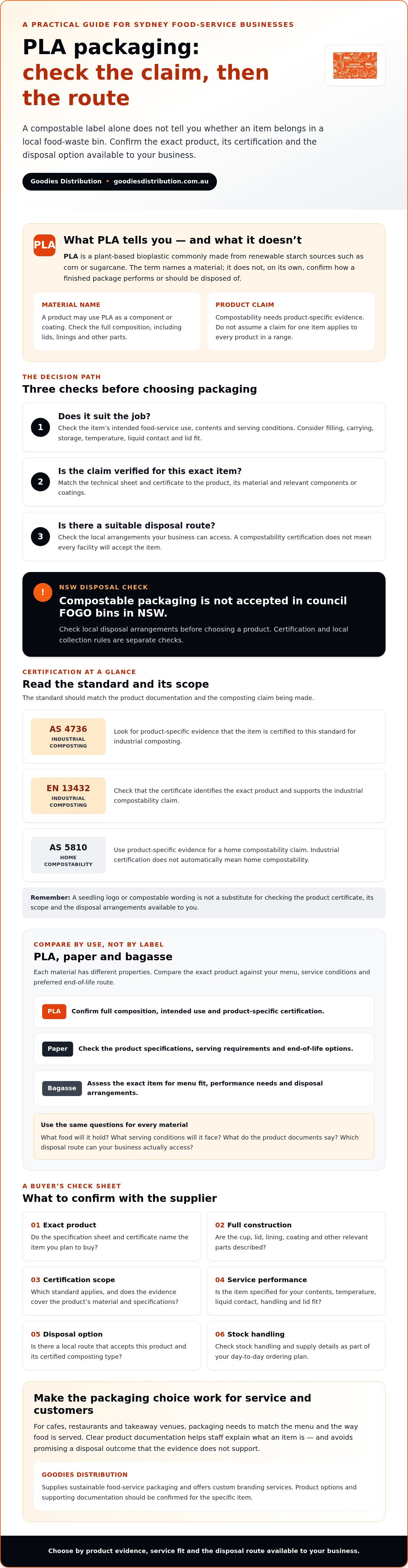
PLA is a plant-based bioplastic commonly made from renewable starch sources such as corn or sugarcane. The term describes a material, not a guarantee about how a finished package performs or should be disposed of. A product may also combine PLA with other materials, so check its full composition rather than relying on a broad label.
Quotable definition: PLA packaging is a product made partly or wholly with polylactic acid, and its intended food-service use and compostability claims should be confirmed against the exact product specifications and certification documents.
What does PLA mean on food packaging?
PLA can be formed into packaging components or used as a coating, but the format and composition depend on the product. For a café or takeaway venue, that distinction matters: the material listed for a cup may not describe its lid, lining or other parts. Polylactic acid (PLA) provides a foundational overview of the material and its uses, but product-level decisions need product-level evidence.
The word “PLA” on a listing doesn’t prove compostability certification. Look for documentation that identifies the specific item and states which compostability standard it meets. A claim about one component, model or product range shouldn’t be assumed to apply to every item from the same supplier. Verified claims help you explain packaging choices clearly to staff and customers, without promising an end-of-life outcome the product documentation doesn’t support.
Where can food businesses consider PLA packaging?
Food-service buyers may encounter PLA in cups, lids or other packaging formats. Consider these only after confirming the exact material and intended use with the manufacturer or supplier. Don’t assume a cup and its lid share the same composition, or that a product described as compostable is suitable for every food or service condition.
Start with the job the packaging needs to do. A takeaway coffee cup has different demands from a container for chilled food. Check the manufacturer’s specifications for the product’s intended contents and serving conditions, then consider how it will be filled, carried, stored and used during your service. Temperature, liquid contact, lid fit and handling can all affect the customer experience.
For businesses comparing compostable pla packaging wholesale, use the product information to assess both practical fit and environmental claims. If specifications or certification details are unclear, ask for the documentation before including the item in your ordering plan. That check helps keep packaging performance, customer communication and disposal arrangements aligned.
How to verify compostable PLA packaging claims in Australia
A compostability claim is useful only if it relates to the exact item you plan to buy and the disposal route your business can access. Before placing a compostable pla packaging wholesale order, check the evidence and practical end-of-life arrangements, not just the wording on a product listing.
What do compostability standards and seedling logos tell buyers?
A certification indicates that a product has been assessed against specific compostability requirements. It doesn’t mean every item made with PLA has the same certification, or that the product can break down in every composting environment. The Australasian Bioplastics Association explains Australian compostability certification, including the difference between industrial and home composting standards.
Use this checklist for each product you’re considering:
- 1. Match the documents to the item. Check that the technical sheet and certificate identify the exact product, including relevant components or coatings.
- 2. Confirm the standard and scope. Look for product-specific evidence of certification to AS 4736 or EN 13432 for industrial composting, or AS 5810 for home compostability. Don’t infer certification from a general supplier statement.
- 3. Check the certification details. Confirm the certificate is current and covers the product’s material and specifications. Ask which seedling logos or home compostable logos are permitted for that item before using them in customer-facing information.
- 4. Read the disposal instructions. Check the stated composting conditions and any directions for separating components. A certified cup, for example, doesn’t automatically establish the status of its lid.
AS 4736 and EN 13432 relate to industrial compostability, where controlled processing conditions are used. AS 5810 concerns home compostability, where conditions are less controlled. Certification under one route doesn’t establish suitability for the other. Verify the applicable standard against the product’s own certificate and technical documents.
Will a compostable PLA item be accepted in Sydney?
Certification describes an item’s tested compostability; it doesn’t confirm that a local collection service will accept or process it. Before making disposal instructions part of your operations, ask your council, commercial waste contractor or collection provider whether they accept the specific packaging type and what conditions apply. Check their current guidance, as accepted materials and services can differ.
That final check connects a verified product claim with a realistic disposal route. Sydney food-service businesses can also explore Goodies Distribution’s packaging range and request product-specific documentation to support an informed wholesale decision.
PLA vs paper and bagasse: compare wholesale packaging by use
PLA, paper and bagasse aren’t interchangeable options. Each can suit different food-service formats, but the material name alone doesn’t tell you whether a product will handle your menu or which end-of-life route is available. Compare the specifications for the exact item, including any lining, lid or coating.
Choose packaging by what the food needs, how it will be served and what disposal route you can verify. This keeps material selection grounded in daily performance and practical end-of-life arrangements, rather than broad claims about one material being best.
| Material | Possible food-service fit | What to verify | End-of-life check |
|---|---|---|---|
| PLA | Some packaging components, including cups or lids where the exact product is confirmed. | Check composition, intended food and temperature conditions, and whether the cup and lid have different materials. | Look for certification for that specific product and confirm whether an available collection service accepts it. |
| Paper | Paper packaging may suit takeaway and café service, depending on the format and construction. | For wet, oily or hot contents, check the product’s barrier details and performance information. Don’t assume all paper products have the same lining or coating. | Check the product’s material information and local collection guidance. A coating or mixed construction may affect the available route. |
| Bagasse | Goodies Distribution offers bagasse containers, trays and bowls for food-service use. | Match the selected item to the food, serving temperature, moisture and time before consumption. Confirm its specifications and any product-specific claims. | Check documentation for the exact item and ask your collection provider whether it accepts it. |
Which packaging material suits your menu and service style?
A café serving takeaway drinks needs to consider cup and lid fit, while a restaurant packing a moist meal needs a container suited to that food and the time it will spend in transit. Caterers may also weigh presentation, stacking and how packaging holds up during service. In each case, test the product in your actual workflow and follow manufacturer guidance. Don’t infer heat, leak or barrier performance from the material name alone.
How do PLA cups, paper and bagasse differ in practice?
Check cup and lid specifications separately. A PLA claim for one component doesn’t establish the composition or certification of the other. Paper products may also include coatings or other components, so ask for details relevant to food contact and disposal. For a broader look at packaging choices, see our sustainable packaging Australian wholesale guide.
For businesses comparing compostable pla packaging wholesale, use the table as a starting point, then confirm specifications, food-service fit and documented end-of-life information for each item before ordering.
How to choose wholesale PLA packaging for daily food-service operations
A packaging option can meet a certification requirement and still be a poor fit for the pace of your service. Before changing your regular stock, assess the product against your menu, handling routine and end-of-life arrangements, then trial it in the conditions your team works in each day.
- Match it to the menu: Check the intended food type, serving temperature, moisture and expected time before consumption.
- Review the specifications: Ask for current material and product details, including information about separate parts such as lids or coatings.
- Check certification: Request documents that identify the exact item and applicable compostability standard.
- Confirm disposal: Check whether your collection provider accepts the product and what conditions apply.
- Trial before wider use: Test filling, carrying, closing and serving in your normal workflow. Gather staff feedback on fit and ease of handling.
What should a wholesale product enquiry confirm?
Give the supplier a clear picture of how you’ll use the packaging. Ask for current product specifications, material composition and any applicable certification documents. Confirm the available formats and carton quantities for the items you’re considering, and check suitability with the supplier rather than assuming a product will work for your menu. If branding matters, ask whether custom branding is available for that specific product and what its print process requires.
Storage also affects day-to-day planning. Follow the supplier’s storage and handling guidance, including any notes about high humidity or other conditions, rather than applying general assumptions to every PLA product. Check how the stock will be stored and moved through your kitchen, café or dispatch area before committing to a larger change.
How can Sydney businesses plan packaging supply and presentation?
Map your available storage space against carton quantities and expected usage. A replenishment routine, including just-in-time inventory where it suits your operation, can help teams plan stock without crowding work areas. When enquiring with Goodies Distribution, confirm current product availability and supply details to help plan your stock.
Packaging is also part of the customer experience. Consider how the format looks with your food and whether custom branding is available for the selected item. For broader sourcing considerations, see Eco-Friendly Packaging: 2026 Australian Wholesale Guide.
Once you’ve checked menu fit, documentation, disposal and stock handling, explore wholesale packaging options for your food-service business.
Source compostable PLA packaging wholesale with a verified supplier
A considered wholesale choice brings together four checks: the exact material, suitability for your food and service routine, product-specific certification, and a realistic end-of-life route. No single label confirms all four. Keep the product documentation with your purchasing records so your team can refer to verified details when ordering or answering customer questions.
Goodies Distribution is a wholesale supplier of sustainable food-service packaging, including a range of BioPak products, and offers custom branding services. Its directors have over 40 years of industry experience, which brings practical context to packaging enquiries. That experience doesn’t replace product evidence: check each item’s specifications and certification rather than assuming a claim applies across a range.
What can Goodies Distribution help food businesses explore?
Food-service businesses can explore product categories including BioPak cups, bagasse containers, trays and bowls, and home compostable products. These options serve different packaging needs, so describe your menu and workflow before settling on a format. For any PLA item, confirm its exact composition, intended use and certification documents. Don’t assume that every cup, lid or other BioPak product meets the same compostability standard.
Goodies Distribution also offers custom branding services. Ask whether branding is available for the product you’re considering and confirm the relevant print process and requirements. Packaging can support a consistent customer experience, but branding decisions should follow product suitability and verified claims.
What information should you prepare before requesting advice?
A little preparation helps make a wholesale enquiry more useful. Have these details ready:
- What you serve: Name the food or drink, including relevant temperature and moisture considerations.
- How you serve it: Note whether it’s for dine-in, takeaway, delivery or catering, and how long it may be packed before consumption.
- What the packaging must do: Describe the format, capacity, closure or presentation needs, and any handling requirements.
- How you plan to dispose of it: Share the collection or composting arrangements available to your business, and confirm acceptance with the provider.
- What matters for your brand: Explain whether you’d like to discuss custom branding for suitable packaging.
This information helps focus the conversation on products worth assessing, while leaving final suitability and certification checks tied to the exact item. Sydney operators can contact Goodies Distribution to discuss wholesale requirements, product documentation and branding options.
Choose packaging that works from service to disposal
The right PLA option is more than a material choice. Match the exact product to your menu and service conditions, check its specifications and certification, and confirm that your collection or composting arrangements can accept it. Compare paper and bagasse on the same practical terms, rather than assuming one material suits every food-service need.
For Sydney businesses weighing up compostable pla packaging wholesale, Goodies Distribution supplies sustainable food-service packaging and offers custom branding services. Its directors have over 40 years of industry experience, helping inform conversations about packaging for food-service operations. Product-specific claims still need to be checked against the relevant documentation.
Ready to discuss packaging formats, verified product information or branding requirements? Explore wholesale packaging options and take the next step towards a choice that fits your business and its disposal arrangements.
Frequently Asked Questions
What is PLA in compostable food packaging?
PLA is a plant-based bioplastic commonly made from renewable starch sources. Food packaging may use it in a particular item or component, but the word PLA alone doesn’t confirm compostability certification. Before ordering, ask for the exact product’s material details, intended use and current certification documents. Sydney businesses should also check whether a local composting or collection service accepts that specific item, rather than relying on a general compostable claim.
Is PLA packaging home compostable?
Not necessarily. Some PLA products may be certified for industrial composting, while home compostability is assessed under different conditions. Check the exact product’s documentation for an AS 5810 certification or applicable home compostable logos, and read any stated conditions for use. Don’t assume that all PLA will break down in a backyard composting environment. If home compostability matters to your business, confirm the claim with the supplier before ordering.
Can compostable PLA packaging go in a food waste bin in Sydney?
Check the rules for the service your business uses, as product certification doesn’t automatically mean a collector accepts the item. NSW EPA guidance states that compostable packaging isn’t accepted in council FOGO bins in NSW. A commercial organics provider may have its own accepted-material list and conditions, so ask directly about the exact packaging item and confirm current guidance before giving staff or customers disposal instructions.
How can I check whether PLA packaging is certified?
Ask the supplier for current technical documents and certification for the exact product, including its material details. Check whether the claim covers industrial compostability or home compostability, and confirm that any seedling logos or home compostable logos are permitted for that item. AS 4736, EN 13432 and AS 5810 refer to different product claims or composting conditions. Don’t assume a certificate for one product applies to a whole range.
Is PLA packaging suitable for hot food and drinks?
Suitability depends on the product’s design, specifications and intended use. Check the manufacturer’s temperature guidance and food-service instructions rather than assuming every PLA item handles heat or liquids in the same way. Trial the packaging in your normal workflow before adopting it widely. For a cup, check the cup and lid specifications separately, as they may use different materials and have different use limitations.
What should a business compare when buying PLA packaging wholesale?
For compostable pla packaging wholesale, compare the exact product’s material, intended use, performance specifications, certification documents and documented disposal route. Check available formats, carton quantities and storage guidance with the supplier, and ask whether custom branding is available for the selected item. A practical trial can help your team assess how packaging fits your menu, service routine and customer experience before making it part of regular stock.
Does compostable PLA packaging always break down in landfill?
No. Compostability certification relates to specified conditions, and it doesn’t promise that an item will break down in every disposal environment. Landfill conditions can differ from those used to assess compostability. Check the exact product’s certification and the disposal route available to your business. Give staff clear guidance about where accepted items should go, and avoid telling customers that packaging will break down in landfill unless product evidence supports that claim.