


A coffee cup is part of the customer experience, not just a vessel. The custom branded coffee cups Sydney cafés serve every day need to suit the drinks on the menu and the pace of service, while giving your artwork room to reproduce clearly and supporting your packaging goals.
It’s easy to focus first on the logo or an environmental claim. Both matter, but neither will compensate for a cup format that doesn’t fit the drinks you serve. Use this guide to select a practical style for your menu and service setting, prepare artwork for review, and distinguish verified compostability claims from broad sustainability language.
We’ll cover how cup formats relate to hot-drink service and customer handling, what to prepare for branded artwork, and how FSC certification and compostability standards apply to specific products. Goodies Distribution supplies wholesale cups and provides in-house custom branding, with a Sydney-based warehouse and Sydney-wide delivery to support local hospitality businesses. Start with the way you serve, then align the cup, brand and end-of-life pathway.
Key Takeaways
- Match cup formats to the drinks you serve and how customers order, dine in or take away.
- Plan artwork around the cup’s print area so your branding remains clear and recognisable.
- Check FSC sourcing and compostability claims separately. Industrial and home compostability refer to different disposal pathways.
- Assess custom branded coffee cups Sydney businesses can align with their menu, brand and service routines.
- Plan artwork, product details and replenishment together to support smoother stock management.
Custom branded coffee cups in Sydney: what should your order achieve?
A well-chosen coffee cup needs to work throughout your service routine and represent your business at the same time. A custom branded coffee cup is a coffee cup printed with a business’s identity, such as its logo, name or brand colours. In a café, that identity moves from the counter into customers’ hands and, with takeaway orders, through the streets and workplaces where they enjoy their coffee.
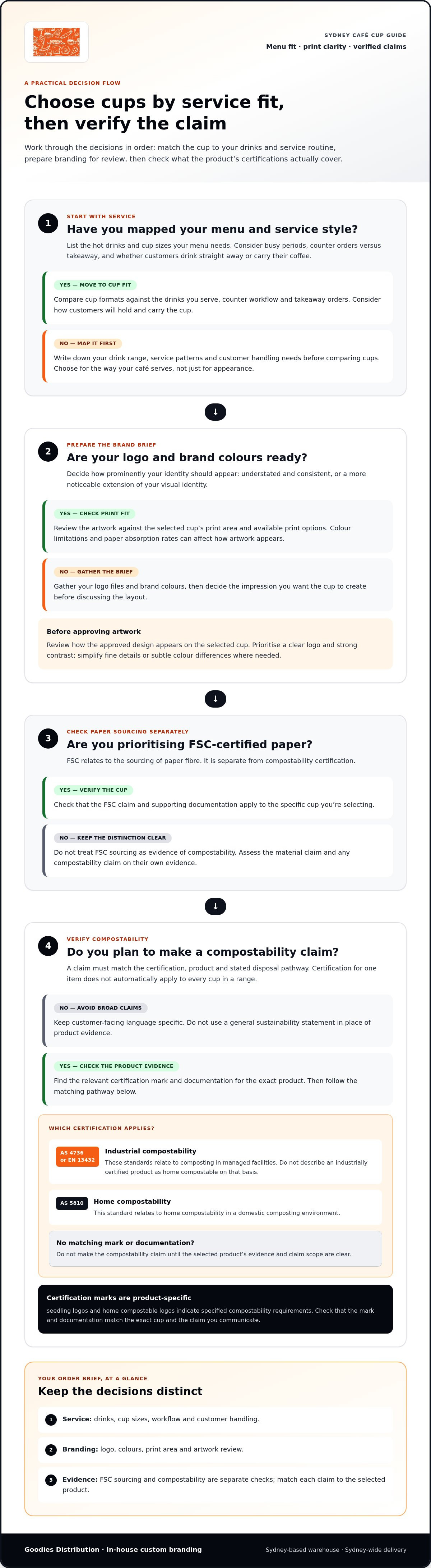
Before choosing a cup, separate your brief into four decisions. This keeps artwork preferences from overshadowing practical service needs, and prevents broad environmental language from taking the place of product-specific evidence.
- Drink range: List the hot drinks you serve and the cup sizes your menu needs.
- Cup format: Consider how each option fits your counter workflow and takeaway orders.
- Branding: Decide how prominently your identity should appear and which colours matter most.
- Environmental requirements: Note the materials and verified claims you want to prioritise.
These choices work together, but answer different questions. A clear brief gives your team a practical basis for comparing BioPak cups and discussing printed artwork with Goodies Distribution.
Start with your menu and service style
Map your hot drinks and service patterns before selecting cup formats. Consider busy periods, the balance between counter orders and takeaway, and whether customers usually drink straight away or carry their coffee with them. The cup should suit the way your café serves, not just look good in a product image.
Think about the customer’s experience, too: how they hold the cup, carry it with other items and drink while on the move. For a wider overview of types of coffee cups and materials, this reference can help explain the broader category. Keep your order brief focused on coffee cups, then compare product details against your menu and daily service.
Set a clear brand and sustainability brief
Gather your logo files and brand colours, then decide what impression the cup should create: understated and consistent, or a more noticeable extension of your visual identity. Clear artwork goals make it easier to discuss layout and print choices through Goodies Distribution’s in-house custom branding service.
Record sustainability requirements separately. For example, specify whether you’re prioritising FSC-certified paper or a cup with a particular compostability certification. FSC relates to responsible sourcing of paper fibre; it doesn’t certify compostability. Make sure any claim you communicate applies to the specific cup and is supported by its product information.
Keeping these decisions separate makes comparisons clearer: assess the cup’s role in service, its brand presentation and the evidence behind its material claims. If you’re considering other packaging decisions alongside cups, the BioPak Australian wholesale guide provides broader product context. For this order, start with a focused brief covering drinks, service style, visual identity and substantiated sustainability requirements.
Cup materials, print and certifications: what Sydney buyers should assess
Good buying decisions rely on product-specific evidence, not a general claim in a brochure or a familiar logo. When choosing custom branded coffee cups Sydney cafés can confidently present, assess three things separately: what the cup is made from, how the artwork will appear, and what the relevant certification covers. Compostability claims apply to the certified product and its stated conditions.
Understand paper sourcing and compostability marks
FSC certification relates to the sourcing of paper fibre. It gives buyers a recognised way to assess whether forest-based material has been sourced under responsible forest management requirements, with chain-of-custody documentation tracking the material through supply. Confirm that the FSC claim and supporting documentation apply to the cup you’re selecting.
Compostability is a separate question. AS 4736 and EN 13432 relate to industrial compostability, where products are assessed for composting in managed facilities. AS 5810 relates to home compostability in a domestic composting environment. These pathways aren’t interchangeable: a product certified for industrial composting shouldn’t be described as home compostable on that basis.
seedling logos are certification marks indicating that a product has met specified compostability requirements. home compostable logos likewise need to relate to the product’s home-composting certification. Look for the relevant mark and documentation for the selected product, and ensure any customer-facing claim matches its scope. Certification for one item doesn’t automatically apply to every cup in a range.
Check print suitability without losing sight of performance
Printed results depend on the cup surface and print process. Colour limitations can affect how closely artwork matches your brand palette, while absorption rates describe how readily paper fibre takes up ink. In practice, fine details or subtle colour differences may need a simpler layout to remain legible on the chosen cup. Review artwork against the actual format and available print area.
Ask to review how the approved artwork will appear on the selected cup. Prioritise a clear logo and strong contrast over intricate details where needed. The final design should fit your brand guidelines and the print options for that product. A careful proof review helps your team catch misplaced elements or colour differences before approving the artwork.
PLA is a plant-based bioplastic commonly made from renewable starch sources such as corn or sugarcane. It differs from paper or fibre, and its presence alone doesn’t establish a compostability claim. Likewise, don’t assume soy-based inks or aqueous coatings are used on a cup unless its product information says so. Check these details alongside performance requirements, including whether the selected cup suits the drinks and service routine you’ve mapped out.
As a practical next step, explore BioPak cups and custom branding options and compare product details with your sourcing, print and certification requirements.
Compare custom coffee cup formats, branding and service fit
Once you’ve set your requirements, compare cup options against how drinks are served and how you want your brand to appear. Choose a cup format by matching its verified specifications to your service needs. Names such as single-wall and double-wall describe construction, but don’t confirm how a particular cup will perform in your café. Review the product details and applicable certifications for the exact format.
Match cup construction to the customer experience
Use the comparison below to guide decisions about your menu, handling and artwork. It’s a selection aid, not a substitute for checking product information. Goodies Distribution supplies BioPak Compostable Cups, including single-wall and double-wall options, so you can compare formats with your service routine.
| Option | Service and handling questions | Branding and claims to assess |
|---|---|---|
| Single-wall cup | Does the format suit the drink and the way customers carry it away? | Review the print area, artwork requirements and product-specific claims. |
| Double-wall cup | Does this construction suit your customer experience and service workflow? | Check the selected cup’s specifications and relevant certification details. |
| Double-wall 8oz cup | Would this listed format fit a drink on your menu and your counter routine? | Assess artwork and verified product information for this specific format. |
| BioPak Art Series cups | Would an existing artwork style suit your café’s look and customer experience? | Compare its visual approach with your brand brief and check product details. |
Consider hand comfort, drink presentation and takeaway handling as questions to resolve, not outcomes to assume from a format name. For example, a café with strong takeaway trade may pay closer attention to how customers hold and carry cups. A counter-focused venue may prioritise a consistent look across its service. Match each choice to your workflow, then review the selected product’s specifications rather than relying on generalisations.
Plan logos, colours, lids and stirrers together
Prepare your logo files and brand colours before discussing print. Note which elements must remain prominent and where you can be flexible if the printable area or colour limitations affect the layout. BioPak Art Series cups offer another visual direction to consider alongside custom artwork. Compare the available design approach with your brand rather than assuming it replaces every branding need.
Include lids and stirrers in the same service review. Consider which drinks need them, how staff add them during busy periods and how customers manage the cup on the move. Review the selected cup and accompanying items as a practical set, checking product information for suitability rather than assuming all formats pair together.
For broader brand decisions across packaging, the custom branded packaging guide can help put cup artwork in context. For custom branded coffee cups Sydney cafés, a focused comparison helps align construction, appearance and substantiated product claims before you settle on a format. Explore BioPak cup options as you refine your brief.
Plan artwork, stock and delivery for a Sydney coffee business
A good order plan connects your approved cup with the way your café works day to day. For custom branded coffee cups Sydney operators can manage confidently, move through four checks before ordering: confirm the use, prepare the artwork, review product details and plan replenishment. This sequence keeps the branding brief, product choice and supply routine aligned.
- Confirm use: Identify the cup formats and quantities your menu requires, based on actual service patterns rather than broad industry averages.
- Prepare artwork: Gather current brand files and decide how you want the design to appear on the selected cup.
- Review product details: Check the chosen cup’s specifications and product-specific sourcing or compostability information.
- Plan replenishment: Decide who monitors stock, how often it’s reviewed and how much storage space is available.
Prepare artwork for a clear branding discussion
Bring together current logo files, colour references and preferred placement, along with any design elements that must remain unchanged. Goodies Distribution’s in-house custom branding service helps you align artwork with your chosen cup. Print outcomes depend on the material and the product’s print suitability, so review the design against the actual cup rather than relying on a screen preview alone.
Build a replenishment plan around Sydney operations
Track cup use during ordinary service and busier periods, then use that record to guide replenishment. Allow for storage limits and seasonal shifts in demand. Keep cartons in a clean, dry area. high humidity can affect paper-based stock handling, so avoid damp locations and follow product storage guidance.
just-in-time inventory means replenishing stock close to when it’s needed. For a café, it can help structure stock reviews around observed usage and available storage, but it depends on accurate monitoring and a supply plan that suits your operation. Set a review point before stock runs low, and allow for the time your own ordering and receiving process requires.
Goodies Distribution’s Sydney-local warehouse and Sydney-wide delivery support local hospitality businesses as they plan cup stocks. Build receiving into your routine: decide where orders will be received, who will check them and how new stock will be rotated with existing cartons. These steps can make replenishment easier to manage without overfilling limited storage.
Keep the four checks together in a short purchasing brief, so staff can refer to the same cup choice, artwork version and stock plan. For a wider view of materials and formats across your packaging needs, explore sustainable packaging options from Goodies Distribution.
Order custom branded coffee cups with Goodies Distribution
Turn your cup preferences into a practical brief your team can use to make a considered choice. Bring together your menu, service routine, visual identity and sustainability priorities, then use them to guide product selection and artwork. A clear starting point keeps decisions connected to what your café needs.
Before preparing your order, note which requirements are essential and where you have flexibility. This makes it easier to compare options and keep the final choice focused on daily use and customer experience.
What to include in a branded cup brief
Use a short checklist to capture the details that will shape your selection:
- Drinks and service: List the drinks you serve and whether cups are used for counter, dine-in or takeaway orders.
- Preferred formats: Note the cup formats you’re considering and why they suit your menu.
- Branding: Gather current logo artwork, colour references and placement preferences.
- Sustainability: Record the materials and product criteria that matter to your business. Keep environmental wording aligned with the selected product’s documentation.
- Related items: Include any requirements for BioPak cup lids and stirrers in your takeaway workflow.
This brief gives the discussion a useful structure and helps your staff work from consistent information when reviewing cup choices, artwork and product documentation. Keep preferred design elements distinct from product claims, so each can be assessed on its own merits.
Make the next step straightforward
Review the brief with the people who handle ordering and service. They can identify practical details that are easy to miss, such as where cups are stored, how staff select a format during a busy period and which artwork version is current. Recording these decisions gives your business a reference point for future purchasing.
With the requirements clear, browse the available options and use your brief to focus the discussion. Choose a cup that suits your operation and gives your brand a considered presence in customers’ hands.
Ready to take the next step? Shop Now with Goodies Distribution and explore options for your café.
Put your cup plan into action
Give your team a simple way to keep cup decisions consistent as menus and service routines evolve. Record the chosen format, intended drinks, approved artwork version and product documentation in one place. This makes it easier to revisit the reasoning behind your choice when requirements change.
For custom branded coffee cups Sydney customers encounter at your café, aim for a choice that feels right in hand, reflects your visual identity and fits the way you serve. Well-documented decisions help keep your packaging connected to the experience you want customers to remember.
Review your brief, then explore options that align with your café’s priorities.
Explore your cup options and take the next step with confidence.
Frequently Asked Questions
Can I order custom branded coffee cups for my Sydney cafe?
Yes. Goodies Distribution supplies wholesale cups and provides in-house branding for Sydney cafés. To make the order brief useful, bring your current menu, examples of how customers order and artwork approved by your team. Note who will review the design and product details. This keeps decisions clear and gives staff a consistent reference when the cups arrive.
Are BioPak coffee cups compostable?
BioPak cups include compostable options, but the claim must be verified for the specific cup you select. Before describing a cup as compostable on menus, signage or social media, match the wording to its product documentation. Consider the disposal route available to your customers, too. Clear instructions help avoid suggesting that every cup can go into the same composting system.
What does the seedling logo on a coffee cup mean?
The seedling logo is a certification mark associated with products assessed for industrial compostability. Treat it as a product-level mark, not an endorsement of every item from a supplier. If your café displays the logo or refers to it in customer information, make sure the cup in use carries the relevant certification. Keeping product records together helps staff answer customer questions consistently.
Can custom coffee cups use my cafe logo and colours?
Yes. Custom cup artwork can reflect your café identity, including its logo and brand colours. For an efficient design review, provide the current approved logo and colour references, and identify any wording that must stay readable. Review the artwork on the selected cup format before approval. This gives your team a chance to refine placement and presentation before the design is finalised.
What is the difference between single-wall and double-wall coffee cups?
The terms refer to cup construction: a single-wall cup has one wall, while a double-wall cup has two. They’re distinct formats, but the names alone don’t establish how either will feel or perform in your setting. Consider the drinks you serve, how customers carry them and the pace of your takeaway service. Then compare the product details against those needs.
Are home compostable coffee cups the same as industrially compostable cups?
No. These certifications refer to different composting environments, so one shouldn’t be treated as evidence for the other. For a café, consider whether the disposal instructions suit the system available to your customers. Use the certification details for the chosen cup when preparing staff guidance or customer-facing messages, and avoid promising a disposal outcome beyond the product’s stated certification.
Does Goodies Distribution deliver custom branded coffee cups across Sydney?
Yes. Goodies Distribution offers Sydney-wide delivery, supported by its Sydney-local warehouse. For a smoother receiving process, include your suburb, delivery access details and the best place for cartons to be received in your stock plan. Make sure the team member responsible for checking incoming orders knows which cup and artwork version to expect. This helps your café organise receipt and storage without relying on an assumed delivery date.