


Choosing custom compostable food packaging in Australia means matching the format to your menu, service and customers’ disposal options. Cafés, restaurants and takeaway businesses can choose from compostable cups, bagasse containers, trays and bowls, and paper bags. Consider how the packaging performs with the food and how it fits your service.
Packaging needs to protect food in transit, work smoothly during busy service and present your brand well. Its disposal claims should also match the options customers can actually access.
This guide explains the difference between compostable and biodegradable materials, what to consider when selecting packaging, and how local disposal options affect your choice. It also covers how product type, custom branding and order volume shape wholesale orders, helping you assess what fits your business.
Key Takeaways
- Choose packaging around your menu, food texture, holding time and whether orders are served in-house, taken away or delivered.
- Compostable packaging is designed to break down under composting conditions; “biodegradable” alone doesn’t explain where or how quickly material breaks down.
- Distinguish industrial and home compostability, then match the packaging to a disposal pathway customers can access.
- Compare material strength, dimensions, branding needs and order volume to plan a practical wholesale supply for your venue.
- Custom branding across takeaway containers and paper bags can help create a more consistent customer experience.
Compostable versus biodegradable packaging
What types of custom compostable food packaging are available in Australia? Food businesses can choose cups, lids, takeaway containers, trays, bowls, plates, bags and cutlery. The right format depends on the food, how you serve it and the disposal options available to customers.
“Biodegradable” means a material can break down through biological processes, but the term alone doesn’t say where or how quickly. Compostable packaging is biodegradable under defined composting conditions. The distinction matters: all compostable packaging is biodegradable, but not all biodegradable packaging is compostable.
For compostable plastic materials, Australian Standard 4736-2006 sets measurable requirements. At least 90% must biodegrade in compost within 180 days, and at least 90% must disintegrate into pieces smaller than 2mm within 12 weeks. The resulting compost must have no toxic effect on plants and earthworms. These requirements help distinguish a tested compostability claim from a broad biodegradable label.
The standard also requires plastic materials to contain more than 50% organic materials, with hazardous substances such as heavy metals below maximum allowed levels. For a purchasing decision, look for a relevant certification and seedling logos, then match the product’s certified claim to its intended disposal conditions. A logo from another country alone doesn’t confirm compliance with Australian compostability standards.
Compostable, biodegradable and recyclable packaging serve different purposes. Compostable items need suitable composting conditions, while recyclable packaging must be accepted by a recycling system. A label doesn’t guarantee that local collection services accept the item, so consider the actual disposal route as well as the packaging.
- Compostable plates: Bagasse plates use fibre from sugarcane processing. They can suit catered meals or takeaway dishes, while their compostability claim should match the product’s certification.
- Compostable containers and bowls: These formats can hold meals, sides or mixed dishes. Choose shape and structure around portioning, food texture and transport.
- Paper and plastic alternatives: Paper bags and cups may fit takeaway service; compostable plastic items are a separate material choice, with certification and disposal conditions to consider.
Compostable packaging labelling isn’t mandatory in Australia, but false or misleading product labels are illegal under Australian Competition and Consumer Commission rules. Hospitality operators should describe verified materials and disposal conditions rather than making vague claims such as “completely green”. Clear information helps staff explain packaging choices and customers sort items appropriately.
Packaging disposal and environmental impact
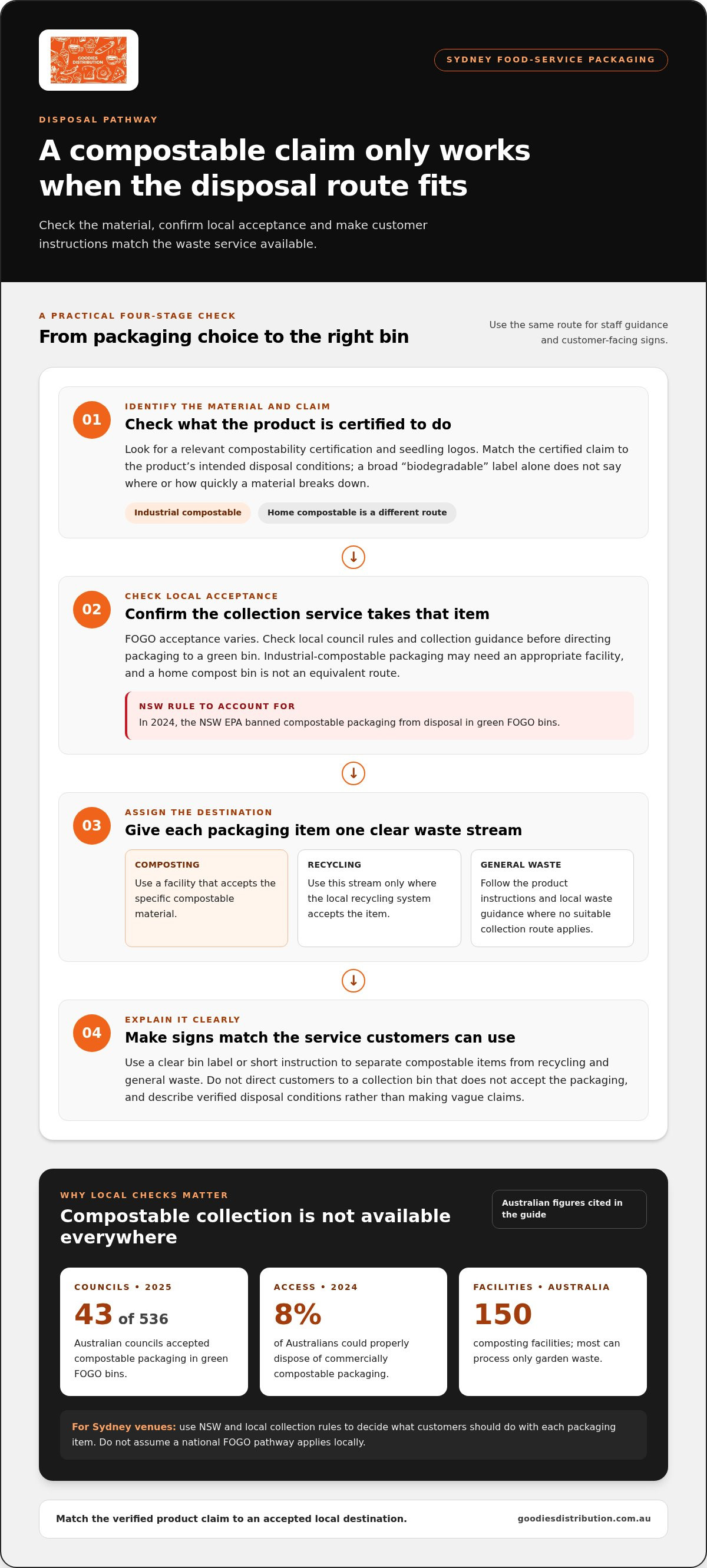
A compostable label only supports an environmental benefit when the packaging reaches a suitable processing facility. For Australian cafés and takeaway venues, disposal planning should account for local FOGO rules, customer habits and the packaging material.
Compostable Packaging Disposal Options
Industrial-compostable packaging may require access to an appropriate composting facility rather than a home compost bin. An accepting FOGO green-bin collection may be suitable where the local council permits the packaging. Before choosing a product, identify the collection option customers can access and whether it accepts that material. Without a suitable route, the packaging won’t be processed as intended.
Customer Disposal Pathways
Customer disposal pathways determine what happens to packaging after a takeaway meal, coffee or catering order. A clear bin label or short instruction can help customers separate compostable items from recycling and general waste. If a café has no suitable compost collection, for example, it shouldn’t direct customers to a bin that doesn’t accept the packaging. Make instructions match the local service.
FOGO acceptance varies across Australia. In 2025, 43 out of 536 Australian councils accepted compostable packaging in green FOGO bins. In 2024, the NSW EPA banned compostable packaging from disposal in green FOGO bins. These figures show why Sydney businesses need to account for NSW rules rather than assume a national disposal pathway applies everywhere.
Access also affects the practical environmental value of compostable packaging. In 2024, only 8% of Australians could properly dispose of commercially compostable packaging. Australia has 150 composting facilities, most of which can process only garden waste. Industrially compostable packaging should go to a facility that accepts it; a home compost bin isn’t an equivalent route.
Cellophane bags need separate consideration. Standard cellophane bags can store food for up to 2 years under dry conditions and can be used in the freezer at -18 degrees. Those storage details don’t establish a composting or recycling route. Identify the bag’s material and follow its disposal instructions instead of treating “cellophane” as proof of compostability.
For a practical disposal plan, assign each packaging item to a destination: composting facility, recycling collection or general waste. Then use customer-facing signs that name the accepted stream. Label packaging as compostable only where the collection service accepts it. This helps prevent contamination and keeps environmental claims aligned with actual disposal options.
What's the difference between compostable and biodegradable packaging?
Yes. The ACCC says false or misleading product labels are illegal under Australian consumer law. For food businesses, the practical questions are whether packaging meets a compostability standard and whether a suitable disposal route exists.
Home and Commercial Compostability
Commercially compostable packaging is designed for processing at an industrial composting facility. Certified products must disintegrate within 12 weeks and completely biodegrade within 6 months. Home-compostable products are assessed for different conditions: they need to disintegrate within 180 days and completely biodegrade within 12 months. These timelines help businesses describe the intended composting setting accurately.
Australian home-compostable packaging certification is tested against AS 5810-2010. For a cafe, that distinction affects the disposal instructions on a takeaway order: a home-compostable claim relates to domestic composting, while a commercial claim relies on an industrial facility. A certified home-compostable product may become compost in as little as 6 weeks at a composting facility, but that doesn’t make every commercially compostable item suitable for a backyard bin.
Compostability Logos and Certification
Look for relevant certification and home-compostable or seedling logos, then match the claim to the packaging’s intended conditions. An overseas compostability logo alone doesn’t confirm that a product meets Australian standards. Clear labelling helps staff explain the product and gives customers useful disposal guidance.
Certification is more useful than a general “biodegradable” claim because it identifies a tested composting pathway. When comparing products, read the specific claim and check whether it refers to home or industrial composting. A logo should support that precise claim, not a broader environmental promise.
For home-compostable NatureFlex™ bags, assess the bag’s certification and disposal instructions rather than relying on its name or material description. Describe a bag as home compostable only when the product claim is supported by appropriate certification. Apply the same care to printed labels, staff guidance and customer-facing signs.
Use a simple three-step check before adopting a packaging item: identify the claim, match it to the relevant Australian certification, then make sure disposal instructions reflect the intended composting setting. For example, don’t direct customers to a home compost bin based only on an industrial-composting logo. Specific descriptions help customers make informed choices without overstating environmental benefits.
Custom packaging materials, strength, dimensions and branding
Compostable packaging can be made from paper, bagasse, plant fibres and PLA, a plant-based bioplastic commonly made from renewable starch sources. Suitability for hot or wet foods depends on the individual product, so match its intended use to your menu and service conditions.
Before ordering, assess the food, holding time, takeaway or delivery use, disposal route and order volume. Then match dimensions and branding to your portions, packing routine and customer experience.
Packaging Materials and Renewable Raw Materials
Material choice affects both packaging function and its end-of-life pathway. Paper can suit bags and cups; PLA may be used in compostable packaging; and bagasse is a plant-fibre material made from sugarcane processing. Renewable raw materials don’t automatically make a finished item compostable, so assess the whole product and its environmental claim.
For a more sustainable choice, compare the material with the food and disposal route. A compostable claim should describe the finished packaging, not just one ingredient. Renewable content alone doesn’t prove that an item will decompose in every setting.
Plant-Fibre Materials
Bagasse containers, trays and bowls provide a plant-fibre option for food service. Their shapes can help organise meals, sides or shared dishes. Choose a format to suit portion size and how customers carry or serve the food, and review the whole item, including any lining or attached components.
Paper is another familiar fibre choice for bags and cups. Consider whether each item needs to hold a meal briefly, travel in a delivery bag or present a takeaway order neatly. These practical details help you choose the right material and format.
Material Suitability for Hot or Wet Foods
Hot soup, saucy dishes and freshly cooked meals place different demands on packaging than dry baked goods. Packaging that suits a dry pastry may not work for a wet meal or a longer delivery trip. Compare the product’s stated use with food temperature, moisture, holding time and transport conditions.
A takeaway venue serving pastries and curry, for example, may need different formats for each menu item. Test the fit during normal packing and service, including how the food sits and whether the package is easy to carry. Compostability alone doesn’t establish suitability for hot or wet foods.
Strength, Dimensions and Branding
Choose dimensions to suit the portion: the meal should fit without excessive empty space or awkward packing. Then consider stacking, transport and the customer’s experience when opening the order. Strength matters throughout the holding period, especially when takeaway meals travel from the kitchen to delivery or collection.
Custom branding can make packaging part of your venue’s presentation. Prepare artwork for the chosen format, available print area and colour limitations. Some sustainable packaging products can be custom branded, depending on product type, artwork and quantity. Make sure the final design suits the packaging’s practical role and verified material claims.
Food packaging costs and wholesale supply
Australian hospitality businesses can source custom compostable packaging from wholesale distributors and packaging manufacturers. These suppliers support different needs, from selecting existing formats to arranging custom branding. For Sydney cafés and takeaway venues, define the packaging specification and supply plan before ordering.
Start with a product schedule for each menu item and its packaging format. Note the portion, how the food is served, and whether orders are collected, delivered or eaten on site. This keeps the order focused on packaging your team actually uses.
Custom orders need clear production details. Prepare the artwork, packaging format, print requirements and order quantity together. Minimum order quantities and lead times depend on the product, production method, artwork and volume. Include these details when planning launches, menu changes or seasonal promotions.
Before approving artwork, check that the design fits the selected packaging and presents your brand clearly. A logo that works on a paper bag may need adjusting for a cup or takeaway container. Keep product claims accurate, and make sure any compostability wording matches the packaging’s certification and disposal guidance.
Plan wholesale supply around how quickly each format moves through your kitchen. Review past ordering patterns, storage space and carton quantities, then set a replenishment point for regularly used items. A café with limited storage might prioritise a smaller range of versatile formats, while a caterer may need separate packaging for individual portions and shared dishes.
For a consistent customer experience, consider how the packaging formats work together. A coordinated visual style across cups, bags and food containers can make collection orders feel cohesive. Keep the design practical: staff should be able to identify the right format quickly during busy service, and each package should suit the food it carries.
Wholesale suppliers in Australia include distributors and manufacturers offering compostable packaging and custom branding. To make a supplier discussion productive, provide your product schedule, intended uses, artwork direction, order quantity and preferred supply timing. These details help identify suitable formats and organise the order.
Before confirming an order, review the product specification, quantity, artwork and replenishment plan together. A clear record helps your team reorder the same formats and design consistently, while allowing you to adjust quantities when the menu or service pattern changes.
Minimum order quantities and lead times vary according to packaging format, production process, artwork requirements and order size. Confirm the quantities and timing for your order with the supplier.
Goodies Distribution: Custom Branding Services
Goodies Distribution helps hospitality businesses bring packaging choices and brand presentation together with Custom Branding Services. This is a practical next step once you’ve identified the formats your menu needs and want packaging that carries your business identity.
Custom branding can be applied to suitable takeaway containers and paper bags, creating a consistent look across collection and delivery orders. Goodies Distribution also offers Biodegradable Cutlery for businesses planning their takeaway service. Choose packaging for food performance and disposal requirements first, then consider how its design will appear to customers.
For a focused branding discussion, prepare your preferred packaging types, intended uses and artwork direction. Goodies Distribution can help align branding with your selected packaging. Contact Goodies Distribution or visit goodiesdistribution.com.au to discuss your packaging needs.
Make your next packaging choice count
Your next packaging decision can bring practical service needs and brand identity together. Start with one frequently used item, then consider how its format, material, disposal instructions and design fit the customer experience. This measured approach gives your team a clear reason for making changes and helps avoid replacing packaging without considering its daily performance.
For custom compostable food packaging australia, Goodies Distribution offers certified compostable cups, takeaway containers and custom branding services. These options help cafés and takeaway businesses create a consistent presentation around the packaging their menus require.
Bring your packaging needs and branding ideas together with Contact Goodies Distribution. A thoughtful next step can help your business make packaging choices that feel right for the food, the service and the customers you welcome.
Frequently Asked Questions
What sustainable packaging options are available on the market now?
Options include paper cups, paper bags, bagasse containers, trays and bowls, biodegradable cutlery, and home-compostable products. For a Sydney café, match each format to a service moment: cups for takeaway drinks, bags for collection orders and containers for meals. Then compare food performance, branding needs and disposal pathways. A suitable choice should fit both the food and how customers handle the packaging.
Do you sell sustainable packaging in Australia?
Yes. Goodies Distribution supplies wholesale sustainable packaging to Australian hospitality and food-service businesses, including BioPak Compostable Cups, Takeaway Containers, Paper Bags and Biodegradable Cutlery. The range also includes home-compostable products and bagasse containers, trays and bowls. Purchases require an Australian Business Number (ABN). Sydney businesses can choose products to suit their menu, service style and packaging needs, with custom branding available for suitable packaging.
What Makes Packaging More Responsible?
Responsible packaging does its job without unnecessary material or misleading environmental claims. Start by matching the format to the portion: a correctly sized container can avoid excess packaging while keeping food easy to carry. Consider how long the food needs protection, whether customers can access the stated disposal route and whether the material claim is precise. Clear staff guidance also helps customers sort packaging after use.
What does 'compostable' really mean?
“Compostable” means packaging is designed to break down under defined composting conditions and meet specified compostability requirements. The practical question is where those conditions apply: a home compost bin and an industrial facility are different settings. A product intended for industrial composting, for example, shouldn’t be described as suitable for backyard composting. Match the product’s claim to its certification and the disposal instructions customers receive.
Which logos should I look for on my packaging and what do they mean?
Look for seedling or home-compostable logos that match the product’s stated composting claim. A logo helps identify certification, but read the accompanying wording to see whether the product is intended for home or industrial composting. Don’t give home-composting instructions for packaging labelled for commercial processing. Keep bin signs consistent with the product claim and collection service.
How much does custom compostable food packaging cost in Australia?
Custom orders depend on packaging format, material, dimensions, quantity and branding requirements. Artwork, print method and intended use also inform the specification. To prepare a clear order, outline the food being packed, serving size, service setting, chosen format and design direction. These details help Goodies Distribution discuss a suitable configuration and organise an order around your venue’s operational needs.
What Australian standards and certifications apply to compostable food packaging?
Australian compostability certifications include AS 4736 for industrial composting and AS 5810 for home compostability. EN 13432 is also identified for industrial compostability in the BioPak range. These references aren’t interchangeable: check which certification applies to the particular product and its intended processing conditions. FSC certification relates to paper sourcing, so it addresses a different packaging attribute from compostability.
Can compostable packaging go in council food-waste or green-waste bins across Australian states?
No. Acceptance varies between councils and states. A FOGO collection may accept food scraps but exclude compostable packaging, depending on local collection and processing arrangements. For a Sydney takeaway venue, give customers disposal instructions that reflect the applicable council service, rather than assuming every green bin accepts compostable items. If packaging isn’t accepted, direct customers to the appropriate alternative waste stream.