

Bagasse gives sugarcane fibre a useful second life. It is the fibrous residue left after juice is extracted from sugarcane, and it can be moulded into packaging that resists water and grease. One of the benefits of using bagasse packaging is turning this by-product into practical food-service items.
For cafés, restaurants and takeaway businesses, packaging needs to protect food, travel well and present meals neatly. Bagasse offers a plant-fibre option for balancing those everyday needs.
This article explains how bagasse is made and what gives it resistance to moisture and oil. You’ll learn how it can be shaped into clamshells, trays and bowls for different meals, and how cups and cutlery fit into food-service packaging choices. We’ll also cover what to consider when selecting items for your menu, and why compostability claims and disposal conditions matter.
Key Takeaways
- Learn how sugarcane processing creates bagasse fibre and why it can be shaped into food packaging.
- Understand what helps bagasse packaging resist moisture and grease, and how that can matter for takeaway meals.
- Explore how clamshells, trays, bowls and other formats can suit different menu items and service needs.
- See where cutlery fits into packaging choices and why compostability depends on the product and disposal conditions.
Bagasse as a sugarcane-processing byproduct
Bagasse is the fibrous material left after sugarcane is crushed to extract its juice. Turning this residue into packaging gives food businesses a plant-fibre option alongside traditional plastic.
Sugarcane as a renewable resource
Sugarcane is a renewable resource that can be harvested and regrown, making its fibres a potential packaging material. A practical benefit is that a by-product of sugar production can be shaped into durable items, rather than relying only on newly made plastic. For Sydney cafés, the material’s origin can help explain packaging choices to customers, but performance and end-of-life disposal matter too.
Residue from sugar processing
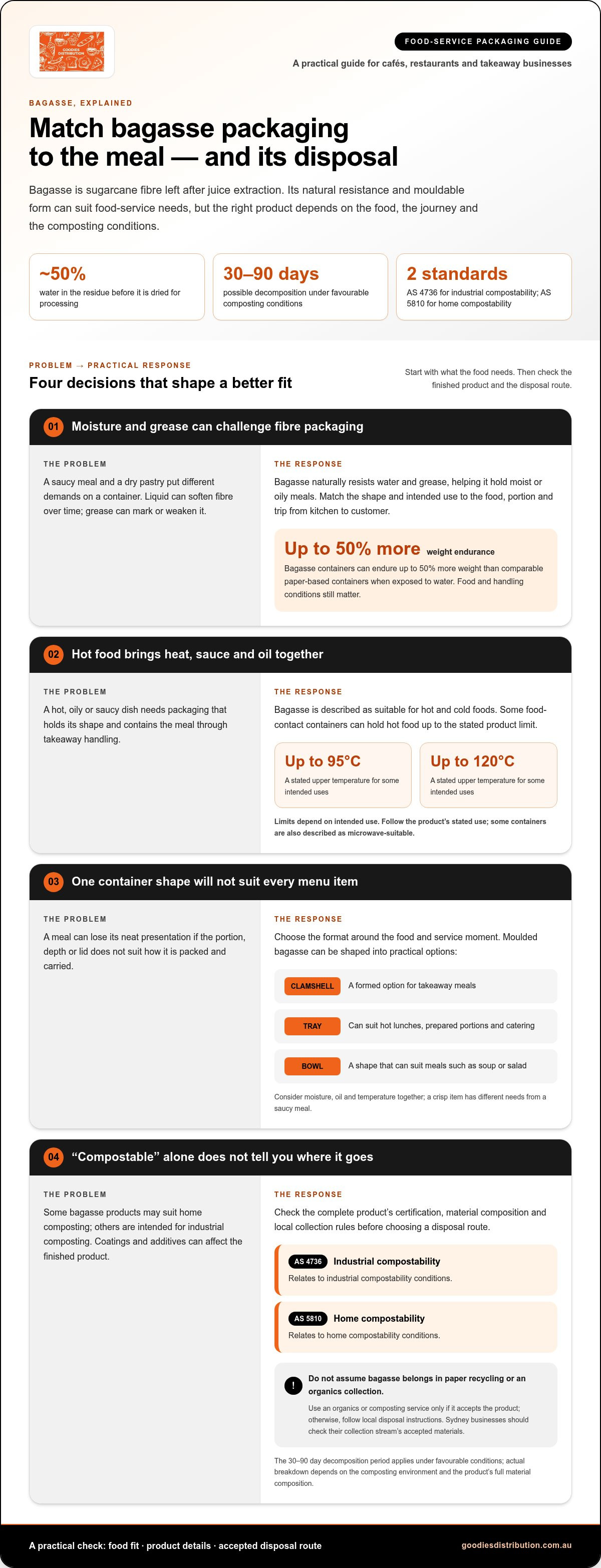
During sugar processing, crushing separates juice from the fibrous stalk; the remaining fibre is bagasse. It is a by-product of extracting sugarcane juice, not sugar refining itself. Before drying, the residue contains about 50% water. Processing then prepares the fibre for forming into products such as trays and bowls. This gives a sugar-industry by-product another use as packaging, rather than treating the fibre solely as waste.
Is bagasse packaging compostable at home or only in industrial composting facilities? Some bagasse products may suit home composting, while others are intended for industrial composting. The certification and full material composition, including any coating, determine the appropriate route.
What Australian regulations and standards apply? AS 4736 relates to industrial compostability, while AS 5810 relates to home compostability. These standards help distinguish the conditions a product is designed to meet; don’t treat the word “compostable” alone as proof of either certification.
How long does it take to biodegrade or compost? Bagasse products can decompose within 30 to 90 days under favourable conditions. Actual breakdown depends on the composting environment and the product’s full material composition.
Is it recyclable in Australia, and how should it be disposed of? Compostable bagasse shouldn’t automatically go into paper recycling. Use an organics or composting service only if it accepts the product; otherwise, follow your area’s disposal instructions.
What are the disadvantages and risks, including coatings and additives? Moisture, food residue and coatings can affect how packaging performs and breaks down. Coatings or additives change the finished material, so assess compostability claims for the complete product, not just the fibre.
Which Australian councils or commercial composting services accept bagasse? Acceptance depends on local council collection rules and the commercial service’s accepted materials. Sydney businesses should treat bagasse as compostable waste only if their collection stream explicitly accepts it.
Water and oil resistance
Bagasse fibre naturally resists water and grease, helping it hold moist or oily takeaway meals. One of the benefits of using bagasse packaging is this practical resistance, though it doesn’t make every container leakproof or suitable for every dish.
For example, a tray holding a saucy meal faces different demands from one holding a dry pastry. Liquid can soften fibre over time, while grease can mark or weaken packaging. Match the container’s shape and intended use to the food, portion and journey from kitchen to customer.
What are the food safety and heat resistance properties of bagasse packaging? Bagasse products intended for food contact can hold hot food. Depending on intended use, containers can hold hot food at temperatures up to 95 or 120 degrees Celsius. Some bagasse containers are also described as microwave-suitable, but follow the product’s stated use.
Heat, moisture and grease often come together in takeaway service. A hot curry, for instance, combines warmth, sauce and oil, so its packaging needs to retain its shape and contain the meal. Bagasse is described as suitable for hot and cold foods, with natural insulation properties that help it serve both.
Water resistance affects strength as well as leakage. Bagasse containers can endure up to 50% more weight than comparable paper-based containers when exposed to water. This can help explain why fibre-based packaging may suit heavier, moist meals, though the food and handling conditions still matter.
Coatings can change grease resistance, so consider the finished packaging rather than fibre alone. Bio-based coatings researched by the University of California increased bagasse packaging’s oil resistance by 60%. For cafés weighing the benefits of using bagasse packaging against service demands, this shows how material design can respond to different food needs.
Bagasse can decompose under suitable composting conditions, but resistance during a meal doesn’t establish its disposal route. Check the product’s compostability information and local acceptance rules. For food businesses comparing bagasse containers, trays and bowls, consider the menu, heat, moisture and grease together.
Food packaging and cutlery applications
Bagasse food packaging can suit different stages of a Sydney food-service order, from kitchen pass to takeaway handover. Moulded fibre can form portion cups, plates, bowls and meal trays for sides, mains and shared dishes. A café might use a tray for a hot lunch, while a caterer could use larger trays for prepared meals. Match the shape and depth to the portion, menu and how customers carry it.
For takeaway, containers need to keep food organised during transport. A lidded tray can separate components, while a bowl suits meals such as soup or salad. Bagasse fibres can also be used for greasy takeaway foods without added PFAS. This describes a potential material application, not every product on the market, so assess the finished item and its stated composition.
Food packaging also has a role at prepared-food counters. A deli could use a suitable tray for prepared portions, while a bakery might use a plate for pastries. Consider moisture, oil and temperature together: a crisp item has different needs from a saucy meal. Unlike traditional plastic, bagasse is plant-fibre packaging, but its environmental footprint depends on production, use and disposal. Compostable claims should reflect the complete product, including any coatings.
Cutlery is a separate part of the service decision. Pairing a bagasse meal container with biodegradable cutlery can give customers a practical set for eating away from the venue. Choose utensils that suit the food, such as a fork for pasta or a spoon for soup, and include them when the meal requires them. The container material alone doesn’t prove that every component has the same composition or disposal pathway. For Sydney cafés, matching containers and cutlery to the menu and service makes packaging decisions more useful than choosing by material alone.
Bagasse clamshells, trays, cups and bowls
Bagasse can be moulded into different shapes and sizes, so one fibre can serve distinct roles across a café menu. Clamshells have a hinged lid, making them useful for takeaway meals that need a single-piece pack. Their form keeps the base and lid together during handover. Choose a size that fits the food without crushing it or leaving excess space.
Trays work well for meals with separate components. A compartmented design can keep a sandwich apart from a side, while a flat tray suits items arranged for service. For catering, lidded trays can help present and transport shared food. Select the format based on how the meal is packed and carried, rather than assuming every tray suits every menu item.
Bowls offer depth for foods that need room, including generous portions and liquid-based meals. A lid can make a bowl easier to transport, while its shape suits salads and other entrées. Bagasse cups with lids are described as a leak-resistant beverage option. For cafés, this format may suit a particular drink service, but the lid and intended use remain part of the packaging choice.
These formats give hospitality businesses flexibility: a clamshell, bowl or tray can meet different serving needs while using the same fibre material. Bagasse can be a sustainable alternative to traditional packaging when the item performs well for the food and has an appropriate disposal pathway. “Compostable” doesn’t mean every product belongs in every organics collection. Sending it to landfill removes the opportunity for composting where a suitable service accepts it.
The practical takeaway is to map each menu item to its packaging job: hinged closure for a meal, depth for a bowl, or an open surface for a tray. Comparing bagasse packaging options for these formats helps you match the pack to your portion and presentation needs.
Goodies Distribution: Custom Branding Services
Goodies Distribution offers Custom Branding Services for hospitality businesses looking to make packaging part of the customer experience. A consistent look across takeaway containers, paper bags and biodegradable cutlery can help customers recognise your café at the counter and on the go.
Consider branding when choosing packaging for a new menu, refreshing your venue’s presentation or bringing several takeaway items into a coordinated style. Goodies Distribution’s custom branding can help you create a consistent identity across the items customers handle and carry. Clear, considered design can connect the meal with your venue, while the packaging still needs to suit the food and service.
For Sydney cafés planning a packaging refresh, explore how custom branding could fit your takeaway presentation. Contact Goodies Distribution or visit goodiesdistribution.com.au to discuss your packaging needs.
Make your next packaging choice count
For your next menu or packaging refresh, start with the customer journey. Think about how an order is packed, carried, opened and eaten, then choose formats that suit those moments. The benefits of using bagasse packaging matter most when the material, food and disposal route work together, not when packaging is chosen on appearance alone.
Goodies Distribution offers Takeaway Containers, compostable cups and Custom Branding Services for hospitality businesses considering takeaway service and presentation. A coordinated design can make packaging feel like a natural extension of your café, while practical fit remains central to the decision.
Ready to plan packaging that suits your menu and brand? Contact Goodies Distribution to discuss your next step. Thoughtful choices can support a better customer experience, one takeaway order at a time.
Frequently Asked Questions
What is bagasse?
Bagasse is the fibrous residue left after sugarcane stalks are crushed to extract juice. It comes from an existing agricultural process, rather than a separate crop grown solely for packaging. Once processed into fibre and moulded, it can become food trays, bowls and other items. For a Sydney café, the key distinction is its plant-fibre origin, not an automatic guarantee of compostability.
How does it measure up to traditional food packaging?
Bagasse offers a moulded-fibre option for food packaging, while traditional materials can have different performance and disposal profiles. Compare the container’s shape, closure, resistance to food moisture and fit with your menu. A bowl for a saucy dish has different demands from a tray for dry pastries. Consider the full disposal pathway too, since material choice alone doesn’t determine environmental impact.
What makes it a great alternative to other materials?
Bagasse’s main point of difference is that it uses sugarcane fibre left over from juice extraction as a resource for another product. This can make it a useful alternative for businesses seeking plant-fibre packaging. The choice still depends on the meal, transport and end-of-life system. A compostable claim, for example, is most useful when the relevant collection service accepts the item.
Why is sugarcane the future of food packaging?
Sugarcane fibre could contribute to future packaging choices because processing sugarcane produces material that can be moulded into food-service items. This gives manufacturers another agricultural material to consider as businesses review packaging formats. It isn’t a universal replacement: cafés still need to weigh food protection, presentation and local disposal options. Treat sugarcane fibre as one part of a broader material mix, not an answer for every order.
What is bagasse packaging made from and how is it manufactured?
Bagasse packaging is made from the fibrous part of sugarcane left after juice extraction. Broadly, the residue is prepared as fibre, formed into a chosen shape and dried into a finished item. The mould determines whether the result is a tray, bowl or another form. Any coating or additional material affects the finished product, so assess its claims as a whole.
What are the environmental benefits of bagasse packaging compared with plastic and paper?
Bagasse makes use of sugarcane-processing residue, and suitable products can be composted when the right facilities accept them. That differs from packaging designed for another disposal stream. A fair comparison with plastic or paper depends on production, product construction, use and local waste handling. For Sydney businesses, the practical environmental benefit depends on choosing an appropriate item and keeping its disposal route clear.