


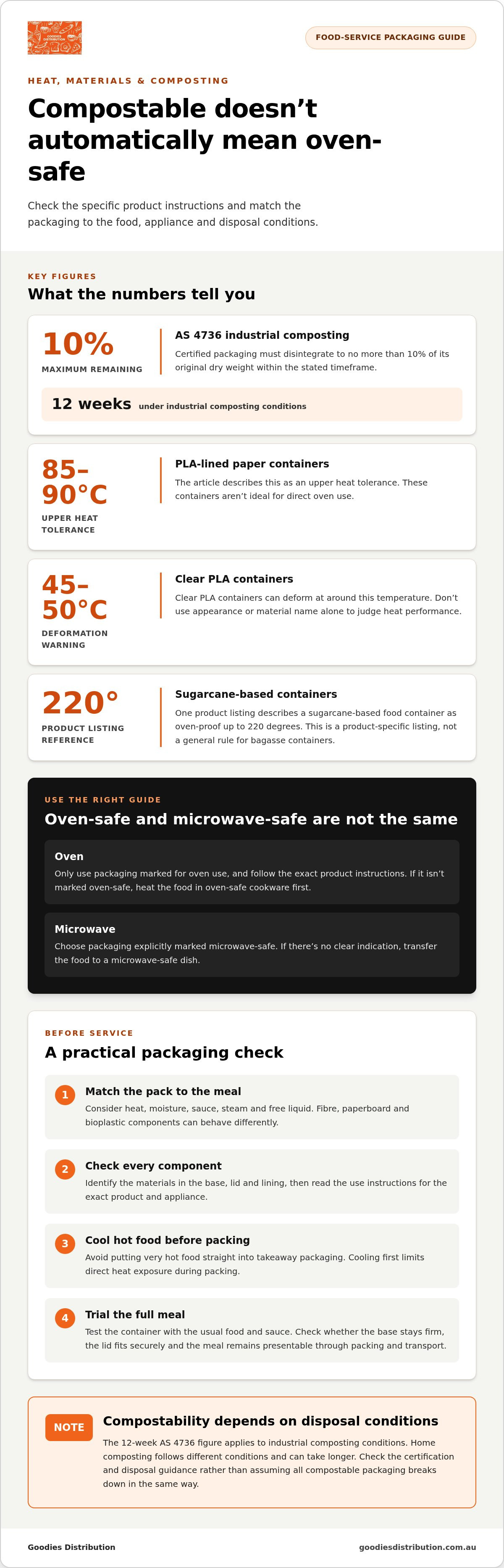
Oven-safe compostable containers can suit reheating and baking, but compostable doesn’t automatically mean oven-safe. For packaging certified to AS 4736, the standard requires it to disintegrate to no more than 10% of its original dry weight within 12 weeks in industrial composting conditions. Home composting follows different conditions and can take longer.
Choosing oven safe compostable containers means matching heat guidance to the food you serve. A fibre container may behave differently from lined paper when exposed to heat or moisture, so check the exact product’s instructions rather than relying on its material name. This matters for Sydney cafes, restaurants and takeaway businesses that need packaging suited to both food service and disposal.
This guide explains how compostable packaging breaks down, how materials suit hot or wet foods, and what to check before heating food in a container. It also explains the difference between industrial and home compostability, and how to read certification marks so your packaging works for both service and disposal.
Key Takeaways
- AS 4736-certified packaging must disintegrate to no more than 10% of its original dry weight within 12 weeks under industrial composting conditions.
- Match the container material to the food: moisture, heat and the type of lining can affect how well packaging performs.
- Don’t assume compostable packaging is oven-safe; follow the product’s instructions before using it for baking or reheating.
- Check whether packaging is certified for industrial composting or home compostability, as disposal conditions affect how long it takes to break down.
- Compare container performance, composting certification and presentation together to choose packaging that suits your menu and service.
Benefits and materials of compostable containers
- Map your menu before choosing a material. List the foods each container needs to hold, then note portion shape, serving style and whether items are packed together. A grain bowl with separate toppings, for example, may need a different format from a single pastry. This helps your team compare containers against real menu needs instead of choosing by colour or appearance alone.
- Compare plant-fibre formats by shape and use. Bagasse is the fibrous residue left after sugarcane processing, formed into containers, trays and bowls. Its moulded shape provides defined space for food, which can suit a meal with distinct components. Paperboard, made from paper fibres, can be formed into boxes, trays or tubs. Match the format to the meal, such as a tray for a plated-style takeaway or a box for a sandwich.
- Choose paperboard for the format your service needs. A paperboard box offers a familiar fold-and-close format for items such as baked goods or takeaway lunches. A tub or tray may better suit another portion or presentation. Compare how each container opens, stacks and fits your packing routine. For example, a café packing a sandwich and side separately can assess the formats for counter-space needs and the customer’s unboxing experience.
- Distinguish fibre from bioplastic components. Compostable packaging includes plant-based fibres, paperboard and bioplastics such as PLA. These materials aren’t interchangeable: a clear PLA lid, paperboard base and moulded fibre bowl are different components with different uses. When comparing a meal pack, identify the materials in its base, lid and lining. This helps staff handle and sort each part after service.
- Build material choice into your packaging trial. Select a representative menu item and pack it in each shortlisted format. Ask staff to note how easily it fills, closes and stacks, and how it moves through the service workflow. Packing a takeaway lunch during a busy café period, for example, reveals practical handling needs that a display sample won’t. Record the chosen format beside the menu item to keep ordering and packing consistent across shifts.
Choosing containers for hot and wet foods
If a compostable container isn’t oven-safe, transfer the food to oven-safe cookware before baking or reheating. For microwave use, choose packaging marked microwave-safe and follow its instructions.
- Match the container to the serving conditions. Hot curry, soup and baked pasta expose packaging to heat and moisture in different ways. Assess the food as served, not just when cold. Note, for example, whether a takeaway meal contains free liquid, sauce or steam. This helps identify where leaks, softening or loss of structure could affect transport and the customer’s meal.
- Read the material description and use instructions. Compostable packaging isn’t automatically suitable for ovens or microwaves. PLA-lined paper containers have an upper heat tolerance of around 85-90°C and aren’t ideal for direct oven use. Clear PLA containers can deform at around 45-50°C. Treat these figures as practical warnings, not oven settings or reheating instructions.
- Separate oven use from microwave use. A container described as microwave-safe isn’t necessarily oven-safe. Check the packaging or product description for guidance on the specific appliance and follow it. If there’s no clear microwave-safety indication, transfer the food to a microwave-safe dish. Don’t judge heat performance by appearance or material name alone.
- Plan an alternative before service. If a container isn’t marked for oven use, bake or reheat the food in oven-safe cookware, then serve it in compostable packaging if appropriate. For microwave reheating, use a container explicitly labelled microwave-safe. Keeping heating separate from takeaway presentation helps avoid packaging softening or distortion.
- Let hot food cool before packing. Let hot food cool before packing it into a compostable container. For example, don’t ladle hot soup straight from the pot into takeaway packaging. Cooling first limits direct heat exposure during packing. Then close and handle the container as intended, especially if the meal will travel before serving.
- Test the full meal, not an empty pack. Trial the container with a representative menu item, including its usual sauce or liquid, and observe it through packing and transport. Record whether the base stays firm, the lid fits securely and the food remains presentable. For Sydney takeaway venues, this practical test helps compare packaging with real kitchen and delivery conditions.
For hot or wet takeaway meals, compare compostable takeaway containers by material, intended use and the instructions supplied for each format.
Heat tolerance of sugarcane bagasse containers
Sugarcane bagasse containers may suit some oven and microwave uses, but always follow the specific product’s instructions. Excess heat can soften or deform packaging. A compostable label alone doesn’t establish safe heating conditions or chemical migration performance.
-
Check bagasse heat tolerance
Read the product’s temperature guidance before putting a sugarcane bagasse container in an oven. One product listing describes sugarcane-based food containers as oven-proof up to 220 degrees, while the recommended oven reheating temperature is no higher than 350°F/175°C, subject to the container’s guidelines. These figures don’t replace the instructions for the exact container you’re using.
For a café or takeaway kitchen, build product guidance into the food-preparation routine. Keep each container’s stated limits accessible to staff, and don’t assume every bagasse tray, bowl or lid has the same heat rating. Check each component, especially when a lid uses a different material. This helps teams avoid applying one product’s instructions to another format.
-
Consider heating risks
Follow the manufacturer’s directions to reduce the risk of softening, distortion or container failure during heating. Product guidance identifies heat tolerance and instructions; it doesn’t set a universal chemical migration threshold for all compostable materials. A compostable label doesn’t make a container suitable for every temperature or heating duration.
For example, remove a lid before oven heating if the product instructions require it, and never put a container in an oven without explicit oven-use guidance. If a container changes shape, leaks or loses strength, stop using it for that heating task. Transfer the food to oven-safe cookware rather than extending the exposure or raising the heat.
- Use a microwave only as directed. Sugarcane bagasse containers can be used in a microwave for short reheating bursts. This is limited use, not permission for prolonged cooking. Follow the product instructions and inspect the container after heating. If it softens or loses its shape, move the food to a suitable dish for further heating.
- Match the heating method to the meal. A single portion of baked pasta may need a different reheating approach from a saucy curry. For oven dishes, follow the container’s stated temperature guidance and don’t exceed it. For microwave reheating, use short bursts and check the food between them. This gives staff a repeatable process without assuming all foods or containers heat alike.
- Set a clear kitchen procedure. Record which bagasse formats are intended for oven use and which are for serving or microwave reheating only. Train staff to check the base and lid instructions before heating. This is especially useful in busy food-service kitchens, where similar-looking containers may have different materials, limits or intended uses.
Commercial versus home composting standards
In Australia, AS 4736 covers industrial compostability, while AS 5810 covers home compostability. These standards describe different composting conditions, so a certification for one route doesn’t automatically mean packaging suits the other.
- Match the certification to the disposal route. AS 4736 is the relevant Australian standard for industrially compostable packaging. AS 5810 applies to packaging designed for home composting. Check the product’s certification and seedling logos, then identify whether your venue or customers can access the corresponding composting system. A container intended for an industrial facility shouldn’t be treated as suitable for a backyard compost heap.
- Understand what AS 4736 measures. AS 4736-certified packaging must disintegrate to no more than 10% of its original dry weight within 12 weeks. It must also achieve 90% biodegradation within 180 days. These are separate test requirements: disintegration measures physical breakdown, while biodegradation measures conversion by biological processes. For a takeaway container, certification offers a clearer basis for environmental claims than appearance alone.
- Account for industrial composting conditions. PLA requires industrial composting temperatures above 55-60°C, sustained over several weeks, to break down properly. Those controlled conditions differ from a home pile, where temperature, moisture and aeration can vary. For a food-service business, this distinction matters at the serving and disposal stages. A compostable label won’t ensure the item breaks down as intended if it enters an unsuitable waste stream.
- Read home compost claims separately. AS 5810 home composting systems typically operate at 20-40°C, considerably cooler than industrial composting conditions. A certified home-compostable food container may take up to two years to break down in a home composting environment. That timeframe reflects a different setting from industrial certification. Look for home compostable logos rather than assuming an industrial compostability mark covers backyard use.
- Check the whole package and communicate clearly. A container, lid and lining can use different materials, so assess each component’s compostability claim. EN 13432 is a European industrial compostability standard broadly aligned with AS 4736, but it is not the same identifier. For example, if a meal’s container is certified for industrial composting, explain that route clearly and avoid implying home compostability without the relevant certification.
- Build disposal instructions into service. Train staff to sort packaging according to its certification and the waste streams available at your venue. At a Sydney café, a simple staff guide can distinguish home-compostable items from those intended for industrial composting. Clear customer-facing wording can also prevent confusion. Keep each claim specific to the certified material and its intended composting conditions.
Oven-safe takeaway containers
Choose a container only when its label or product specifications explicitly state that it is oven-safe and provide temperature guidance. Australian food-service businesses can source suitable packaging through wholesalers; the amount depends on the selected material, size and order quantity.
-
Check labels and specifications
Read the full product description and packaging before heating food. Look for an explicit oven-safe statement and any temperature limit, then follow the instructions. “Compostable” or “microwave-safe” alone doesn’t establish oven suitability. Check the base, lid and lining separately, as one component may have different heat guidance from another.
For example, PLA-lined paper containers aren’t ideal for direct oven use, while clear PLA containers can deform at around 45-50°C. Don’t infer oven performance from a natural-fibre appearance or a compostability mark. If the specification doesn’t direct oven use, transfer the food to an oven-safe dish.
-
Compare Australian buying options
Compare packaging wholesalers and food-service distributors serving Australian businesses. Assess formats by material, size, stated oven use and compostability certification. The amount varies with the chosen format and order quantity, so compare like-for-like specifications when reviewing listings. Don’t choose the lowest listed amount if the container can’t perform the intended task.
For takeaway service, consider whether the container suits the portion size, sauces and transport. A format that holds a baked meal securely may differ from one suited to lighter foods. Match packaging to your menu and heating process, then make sure staff can quickly find its use instructions.
- Compare heat guidance with your kitchen process. Sugarcane-based containers are described as oven-proof up to 220 degrees, while guidance recommends reheating oven dishes at no higher than 350°F/175°C, subject to the container’s instructions. Treat the exact product guidance as the deciding factor. Don’t apply one container’s rating to another format or its lid.
- Choose between reheating and baking. A container intended for short reheating may not suit longer baking. Reheating prepared pasta, for example, differs from cooking a meal from raw ingredients. Choose packaging for the actual task, check its stated temperature and follow any limits on duration or components.
- Trial the format with a real menu item. Test a representative portion, such as a saucy baked dish, using the stated heating method. Check whether the container retains its shape and holds the food securely. This practical kitchen trial helps staff assess performance before using the format across takeaway service.
- Review suitable takeaway formats. BioPak’s 750 ml and 1000 ml Natural Fibre Takeaway Containers are described as microwave- and oven-safe, home compostable and made without added PFAS. Compare their stated use with your menu and heating needs. Explore takeaway container options for food-service packaging choices.
Goodies Distribution: Custom Branding Services
Goodies Distribution offers Custom Branding Services for food-service businesses creating a consistent customer experience. Consider how your takeaway containers, paper bags and biodegradable cutlery work together at the counter and after a meal leaves your venue. A coordinated branded look can help customers recognise your business, from collecting lunch to carrying it away.
Start with packaging that suits your menu and daily workflow, then consider how custom branding can complement it. Thoughtful presentation makes packaging feel like part of your hospitality experience, not an afterthought. To discuss packaging and branding for your business, visit goodiesdistribution.com.au.
Make packaging part of your next menu decision
Treat oven-safe compostable containers as part of your service design, not just a disposal choice. As menus change, review packaging during recipe trials: consider heating method, portion presentation, transport and the disposal route available to customers. This gives your team a practical way to assess packaging alongside food quality and customer experience.
A clear kitchen routine helps staff use each format as intended. Record the relevant product instructions, make them easy to follow during service and explain disposal guidance in plain language. Thoughtful choices can make sustainable packaging more workable in day-to-day operations.
For support choosing packaging that fits your food-service needs, contact Goodies Distribution. Take the next step towards packaging choices that serve your menu and your customers with confidence.
Frequently Asked Questions
How long do the biodegradable containers take to break down?
There’s no fixed timeframe for every biodegradable container. Material, composting conditions and the facility’s accepted waste stream all affect how it breaks down. For a café, identify the exact container and lid, then align staff disposal instructions with the product’s certification. “Biodegradable” alone isn’t a reliable guide to where packaging belongs after service.
Sugarcane Bagasse vs PLA vs Paper: Which Material Suits Your Business?
Choose the material that fits your menu and service workflow. A moulded format can suit meals that need separate compartments, while paperboard may suit a box-style pack. PLA may appear in clear components where customers can see the food. Compare how staff fill, close, stack and hand over each option, then consider how the packaging looks alongside your venue’s presentation and customer experience.
What are the disposable food storage containers made of?
Common compostable formats use plant fibre, paperboard or PLA, sometimes in combination. A container’s base, lid and lining may use different materials, so the main material name may not describe the whole item. For example, a paper-based base may have a separate clear lid. Check product descriptions component by component, especially when planning storage, food presentation and disposal procedures.
Are compostable food containers oven safe?
Some are, but compostability alone doesn’t establish oven suitability. Choose a container whose product directions explicitly permit oven use, and follow the stated conditions. In a busy kitchen, record the approved format beside the dish it’s used for, so staff can select the right packaging during service. If oven use isn’t stated, heat food in suitable cookware and transfer it for serving afterwards.
What temperatures can compostable containers withstand?
There’s no single temperature limit for all compostable packaging. Material, construction and intended appliance affect performance. Follow the temperature guidance for the exact product, including separate directions for lids or other components. During menu trials, assess the finished food and container together: a long heating task may differ from briefly warming an already prepared portion.
Which compostable container materials are oven safe, such as bagasse or PLA?
Some bagasse containers are intended for oven use, while PLA formats aren’t automatically suitable for direct oven heating. Check the instructions for the specific item instead of choosing by material name alone. For a menu with baked meals, compare the complete package, including its lid, and trial the intended format in your kitchen. Keep approved-use directions accessible to staff preparing takeaway orders.
Can compostable containers go in a conventional oven, microwave, or air fryer?
Use a container only with the appliance named in its product directions. Approval for one appliance doesn’t automatically cover another, and don’t infer air-fryer suitability from oven or microwave guidance. If the packaging instructions don’t cover the required heating method, use cookware intended for that appliance. This keeps appliance choice separate from the container used for takeaway presentation.
Can oven-safe compostable containers be composted at home or only commercially in Australia?
Some products are certified for home composting, while others are intended for industrial composting; oven suitability doesn’t determine the disposal route. For Australian venues, make disposal guidance specific to the certification shown on the packaging and the composting service available to staff or customers. If a takeaway meal includes separate packaging components, give clear directions for each rather than assuming they share a disposal pathway.