

The right paper straws for your Sydney venue aren’t necessarily the ones with the boldest environmental claims. They need to suit the drinks on your menu, hold up during service and fit the way your business handles waste. If straws have softened before customers finish their drinks, or you’re unsure what “compostable” means in practice, check those points before ordering.
For cafes, restaurants and takeaway businesses, choosing a straw affects both daily operations and the customer experience. NSW restrictions on single-use plastic straws also make it important to check that the format you choose is suitable for your venue. This guide covers how to assess paper straw performance, match formats to different drinks and check the evidence behind compostability claims. It also includes practical questions for your procurement process and staff guidance, so your team can explain disposal options without making claims the product or local waste service can’t support.
Key Takeaways
- Match paper straws to the drinks you serve, your service pace and the customer experience you want to provide.
- Ask for product documentation on construction, coatings and specifications rather than assuming all paper straws perform alike.
- Check that compostability claims are supported by relevant product-specific certification and clear disposal guidance.
- Use a practical approval process: define the use, review evidence, trial products, confirm disposal options and then approve.
- Before requesting a quote or ordering, ask a supplier about paper straw availability, specifications, documentation and ordering arrangements.
Paper straws for food-service businesses: what to assess before choosing
Paper straws are single-use drinking straws made primarily from paper. For a food-service venue, choosing one involves more than selecting a material. It needs to suit the drink, work with your service format, feel comfortable to use and have a disposal route your team can explain. Products can differ in composition and performance, so ask suppliers for details about the specific straw you’re considering.
Paper straws are part of a longer history of drinking straws, including the invention of the modern paper version. For background, see this overview of the history of the drinking straw. When comparing products, focus on evidence for the specific item you may buy.
A product claim describes what a supplier says about an item; verified certification provides documented evidence that the specific product meets stated requirements. Check that any certification applies to the exact product and the conditions described in its documentation.
Which drinks and service styles need different straw choices?
Group drinks by thickness, serving temperature and how long customers are likely to drink them. A chilled juice ordered for takeaway may place different demands on a straw from a thick smoothie enjoyed over a longer sitting. Treat these as trial scenarios rather than assumptions about how a particular straw will perform.
Consider the service setting too. Dine-in orders may be used soon after serving, while takeaway, delivery and event service can involve different handling and waiting times. Test candidate products with representative menu drinks and service routines before standardising. Record any changes in ease of use, structure or customer feedback, and ask the supplier to confirm relevant specifications.
What customers notice about paper straws
Customers experience a straw as part of the drink and your venue’s presentation. Consider mouthfeel, appearance and ease of use alongside how it fits your cups and brand. A straw that looks suitable on the counter still needs to feel practical in the customer’s hand.
Trial candidate straws with a range of drinks and service styles. Ask front-of-house staff to record what they observe, and gather customer feedback without steering people towards a preferred answer. Different customers may value different features, so look for patterns rather than assuming one format suits everyone. This gives your team a sound basis for balancing customer experience with service needs and clear disposal guidance.
How paper straw construction affects performance during service
A straw’s paper construction, any coatings and the manufacturing process can all influence how it behaves in a drink. Appearance alone won’t tell you how a particular product will perform. Ask the supplier for product-specific specifications and trial the exact item you’re considering, especially if your venue serves drinks at different temperatures or customers may take time to finish them.
Storage conditions may also be relevant to your assessment. Check the supplier’s storage guidance, then include realistic storage and handling conditions in your trial. Research on paper straw performance discusses ways to evaluate issues such as liquid absorption and loss of strength. Use this as context for your testing, not as proof of how a particular product will perform.
How to test paper straws with your actual menu
Choose representative drinks, including options with different thicknesses and serving temperatures, and test them under conditions customers will experience. Include dine-in and takeaway routines where relevant, and allow for the expected time between serving and finishing the drink.
At planned, consistent intervals, record softening, structural changes and ease of use. Ask staff to note handling issues and gather customer feedback without leading responses. Repeat the trial with the exact product you may order. If the product or supplier changes, the previous results may no longer apply.
Testing checklist: record the product tested, drink and service conditions, storage context, observations at each interval, and staff and customer feedback.
Which supplier details help compare straw options?
Request written product specifications and material details, along with documentation supporting any environmental claims. Ask whether information about coatings or adhesives is available and relevant to the product’s composition or end-of-life claims. If a supplier refers to certification, check that its evidence identifies the specific item and the conditions covered. A broad statement about a product range isn’t enough.
Confirm carton quantities, ordering requirements and other commercial details directly with the supplier. Don’t infer them from a sample or a similar product listing. Keep the documentation with your trial notes so you can review the decision if the product changes.
Once you’ve settled your straw requirements, consider how they work alongside the rest of your takeaway presentation. For related takeaway packaging options, Goodies Distribution’s wholesale range includes compostable cups and takeaway containers. Ask the supplier about current product availability and specifications before ordering.
Paper straws and compostability: how to check environmental claims
A description of a product’s material isn’t proof of how it can be disposed of. “Paper” tells you what the straw is made primarily from; “compostable” is an end-of-life claim that needs supporting evidence. Ask for documentation identifying the exact product and the conditions under which its compostability has been assessed.
In Australia, check product documents for relevant standards such as AS 4736 for industrial composting or AS 5810 for home composting. EN 13432 may also appear in documentation. The National Compostable Packaging Strategy provides useful context on compostable packaging standards. A standard mentioned in a general product range description doesn’t prove that a particular item is certified to it.
What do compostability logos and certificates tell buyers?
Seedling logos are certification marks associated with specified compostability requirements. Check the logo and certificate details against the exact product, including any licence or certification information provided by the supplier. Confirm which standard applies and whether the certification relates to industrial or home composting. A claim or logo that can’t be matched to product documentation leaves important details unknown.
Certification supports claims only for the product and conditions stated in its documentation. Don’t assume that certifications held by a supplier or another item in its range also apply to its straws.
Where should used paper straws go?
The appropriate disposal route depends on the product’s certification, how it has been used and whether your local collection service accepts it. Even a certified item may not be accepted in every local organics collection. Check with your waste provider or relevant council before advising staff or customers which bin to use. Don’t describe a straw as home compostable without product-specific evidence for that claim.
Use this comparison to guide your questions to suppliers. Where evidence or local acceptance hasn’t been established, treat it as unknown rather than guessing.
| Claim wording | Evidence to request | Disposal route |
|---|---|---|
| “Paper” | Material details for the exact product. Compostability status: unknown unless documented. | Unknown; check local waste guidance. |
| “Compostable” | Product-specific certification details and the conditions covered. Standard: unknown until verified. | Unknown; confirm acceptance with your waste provider or council. |
| “Certified industrial compostable” | Documentation identifying the product and relevant standard, such as AS 4736 or EN 13432. | Industrial composting only if the local service accepts the item; acceptance: unknown until confirmed. |
| “Home compostable” | Product-specific evidence for home compostability, such as documentation referencing AS 5810. | Home composting only if supported by product evidence; suitability: unknown otherwise. |
A practical paper straw checklist for Sydney cafes and takeaway venues
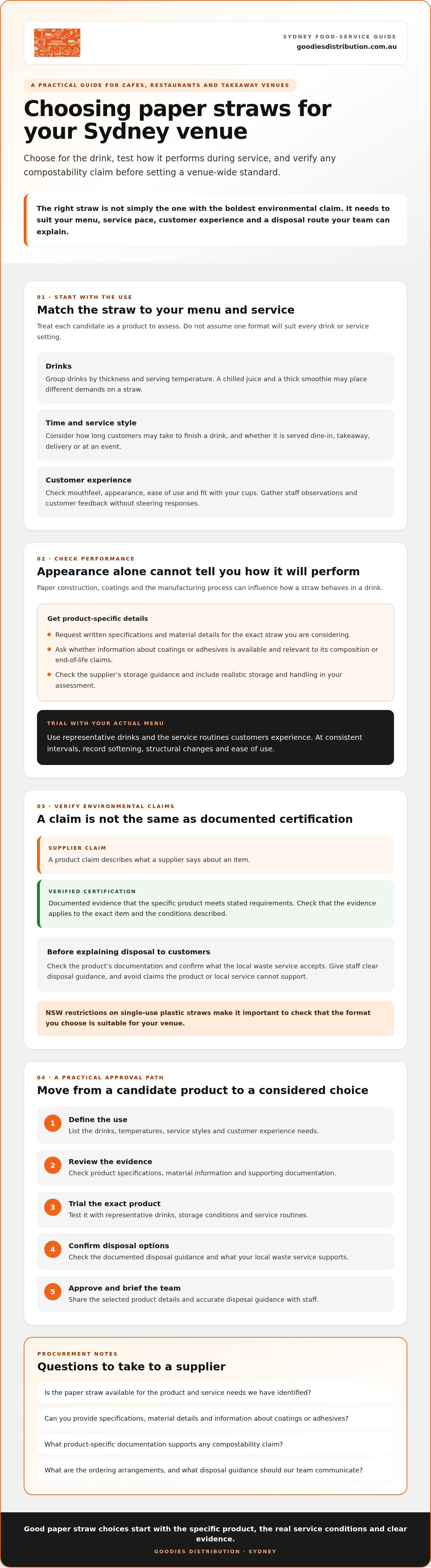
A simple approval process helps your team balance drink performance, customer experience, environmental evidence and stock needs. Work through these steps before making a new straw part of your standard packaging:
- Define the use. List the drinks and service settings the straw needs to suit, such as dine-in, takeaway, delivery or events. Consider expected use time and how it will work with your cups and lids.
- Review the evidence. Ask the supplier for product specifications, material details and documentation supporting any compostability claims. Check that certificates relate to the exact item you’re considering.
- Trial the product. Test it with representative drinks and service routines. Include realistic storage conditions and follow the supplier’s storage guidance.
- Confirm disposal. Check the product’s documented end-of-life conditions, then ask your waste provider or relevant council whether the item is accepted through local collection.
- Approve and communicate. Record the decision, share handling and disposal guidance with staff, and set a date to review the choice if the product or collection arrangements change.
How should a venue run a staff and customer trial?
Ask staff to test the same candidate product across representative drinks and shifts, including busy periods when handling matters. Use a short feedback form covering usability, appearance and service issues, with space for specific observations. Gather customer feedback without prompting a preferred answer. Decide who will review the results and approve any change before updating the venue’s standard packaging.
Assess the whole presentation, not just the straw. Check how it fits the cup and lid, suits your brand and feels in the customer’s hand. A small trial can help catch mismatches before a new item is used across every service point.
How can venues plan ordering and storage?
Use your venue’s records to estimate usage, separating routine service from seasonal or event demand. Confirm carton quantities, ordering requirements, product availability and delivery arrangements directly with the supplier. Plan replenishment around those details and the way your venue manages stock.
Keep stock clean and dry, and follow the supplier’s storage instructions. If your storage area is exposed to high humidity, ask whether additional product-specific guidance applies. Clear stock rotation and staff instructions can help keep trial conditions consistent with everyday handling.
For coordinated cups, lids and takeaway packaging, Explore wholesale packaging options and ask the supplier about product availability and specifications.
Finding a suitable wholesale packaging partner for paper straws
A wholesale supplier should help you check product details and plan ordering, not just provide a catalogue description. Before requesting a quote or placing an order, ask whether paper straws are available and request specifications and supporting documentation for the exact product. Availability, material, dimensions, coatings and certification can vary, so don’t assume details from a similar item apply.
Compare suppliers on the information they can provide, their commercial ordering requirements, delivery arrangements and the support available when you need to clarify a product claim. Confirm delivery coverage and dispatch arrangements directly, and check how carton quantities and repeat ordering fit your venue’s purchasing routine.
What should Sydney businesses ask a packaging supplier?
Use a short set of questions to guide the conversation: Are the straws available? Can you provide documentation for the exact product, including material details and specifications? Which certification, if any, applies, and how can it be verified? Also confirm order requirements, delivery coverage and dispatch arrangements rather than relying on general statements.
Goodies Distribution is a wholesale supplier of sustainable food service disposables, serving businesses in Sydney and across Australia. Its range includes cups, takeaway containers, bagasse containers, trays and bowls, paper bags and biodegradable cutlery. Ask the team about paper straw availability and product documentation before requesting a quote or ordering.
How can paper straws fit a wider packaging decision?
Assess the straw alongside the cups and lids it needs to work with, as well as the other disposables customers see and use. Coordinated packaging can support a consistent service experience, but each product still needs its own performance and environmental evidence. For context on wholesale options, read the sustainable packaging wholesale guide. For a broader look at material choices, see the Australian eco-friendly packaging guide.
Goodies Distribution’s wholesale range includes compostable cups and takeaway packaging, alongside other food-service packaging. Ask about the availability and specifications of any item you’re considering, and check that its documentation supports the claims you plan to communicate to staff and customers.
Ready to review packaging for your venue? Explore Goodies Distribution’s wholesale packaging range and ask the team about current product details and ordering arrangements.
Make your next packaging choice with confidence
Choose paper straws based on how they perform with your actual drinks and service routines, not just their appearance or broad claims. Request product-specific specifications and compostability evidence, then check whether your local waste service accepts the item before setting disposal guidance for staff and customers.
A practical trial brings those checks together. Assess the straw alongside your cups and lids, record staff and customer feedback, and approve a product only when its performance and documentation suit your venue.
For Sydney hospitality businesses reviewing their wider packaging needs, Goodies Distribution supplies compostable cups and takeaway packaging, including BioPak products. The directors have over 40 years of industry experience. Ask the team whether paper straws are available and request product specifications before ordering.
Explore Goodies Distribution’s wholesale packaging range and contact the team to discuss packaging options for your venue.
Frequently Asked Questions
Are paper straws compostable?
Some paper straws may be certified compostable, but it depends on the specific product and the conditions covered by its certification. Check documentation for the exact item rather than relying on a general “compostable” claim. Then confirm whether your local waste service accepts it in the relevant collection. Certification for industrial composting doesn’t automatically mean a product is suitable for home composting or accepted in your local food-waste service.
Can paper straws be used for hot drinks?
Suitability for hot drinks varies by product, so don’t assume a straw will perform well at a particular temperature. Ask the supplier for product specifications and guidance, then trial the exact straw with drinks from your menu. Include realistic serving conditions and expected drinking time, and check usability and any structural changes during the trial. Confirm that the cup and lid combination works for your service too.
How do I stop paper straws going soft?
There isn’t one fix that suits every product, as performance can vary with construction, the drink and time in use. Ask the supplier for handling and storage guidance, then test the exact straw with representative menu drinks. Record when softening or other changes occur and whether they affect usability. Keep trial conditions consistent with normal service, including storage conditions, so the results help inform a practical product choice.
Are paper straws accepted in food-waste or compost collections in Australia?
Acceptance varies by product certification and local collection service, so don’t assume a paper straw belongs in a food-waste or compost bin. Check whether the product meets the service’s requirements, including any conditions about contamination, and ask your waste provider or relevant council what it accepts. For a Sydney venue, confirm the guidance for your specific collection arrangement before advising staff or customers.
What certification should I look for when buying compostable paper straws?
Ask for product-specific documentation that identifies the certification and the conditions it covers. Depending on the intended disposal route, check whether the documents refer to AS 4736 for industrial composting or another relevant standard, such as EN 13432. Don’t assume a standard mentioned for a supplier’s wider range applies to the straws. Request the certificate details and check they match the exact product you plan to order.
Where can Sydney cafes buy paper straws wholesale?
Sydney cafes can ask wholesale packaging suppliers whether paper straws are available and request specifications before seeking a quote or ordering. Confirm carton quantities, ordering requirements, delivery coverage and dispatch arrangements directly. Goodies Distribution supplies wholesale food-service packaging in Sydney. Ask the team whether paper straws are available and request product documentation before making a decision.
Are paper straws better for the environment than other straw options?
There isn’t a universal environmental ranking that applies to every straw or venue. Consider material sourcing, product performance, verified certification and the disposal options available where your business operates. An end-of-life claim is useful only when supported by evidence and accepted by your local collection service under the stated conditions. Compare documented information for the specific products you’re considering, rather than relying on broad environmental language.