


What makes takeaway coffee cups the right fit for your café: the cup format, the material, or what happens after the last sip? The best choice brings these decisions together, fitting your drinks menu, service routine and the experience you want customers to take with them.
If you’re weighing up hot-drink options and sustainability claims, you’re not alone. It can be difficult to balance practical service needs with clear, accurate information about what a cup is made from and how it can be composted. Claims should match the specific product, not be assumed across a whole range.
This guide explains how to choose takeaway coffee cups for your menu and takeaway service, assess materials and presentation, and read compostability certifications in practical terms. You’ll learn the difference between industrial and home compostability, and why checking the certification for each product matters.
Goodies Distribution is a trusted wholesale distributor, with a Sydney-based warehouse and Sydney-wide delivery. Our range of compostable cups and custom branding services help Sydney cafés bring product choices and brand presentation together. Use the guidance below to compare options against your menu and service needs.
Key Takeaways
- Match takeaway coffee cups to your drinks menu, serving routine and the way customers carry their orders.
- Compare single-wall and double-wall formats by their intended service use, and choose based on your café’s workflow.
- Check compostability claims against the specific cup’s certification evidence; industrial and home compostability are separate claims.
- Use certifications such as AS 4736 and EN 13432 accurately, and don’t assume a claim applies to every product in a range.
- Plan wholesale supply around your business needs with a Sydney-based partner offering Sydney-wide delivery.
What makes takeaway coffee cups work for café service?
A takeaway coffee cup is a food-service item selected to contain and serve a drink in a takeaway setting. Its function is the same whether it’s made from paper or another material; construction, material and certification are separate attributes to assess for each product. Start by considering what the cup needs to do during service, then review what it’s made from and what product evidence supports any claims.
The cup is part of a brief but important interaction. A staff member prepares the order, passes it across the counter, and the customer carries it away. A cup that suits the hand-off helps the exchange feel considered, while its shape and appearance remain visible after the customer leaves. Across a café’s takeaway service, the cup can become a familiar part of how customers recognise the business.
That role is one reason a cup shouldn’t be chosen on appearance alone. A natural-looking finish or printed design may suit your café’s identity, but it doesn’t establish how the cup is constructed or what environmental claims apply. The general disposable cup category includes different materials and designs, so specific product information is more useful than assumptions based on looks.
How cup construction relates to everyday use
Paper cups can have different layers and coatings, which can affect how they contain a drink. Construction varies by product, so don’t assume every paper cup has the same lining or barrier. Use the product’s own documentation to understand its materials and intended use.
In practice, think about the moments between filling and hand-off. A cup may be filled at the coffee machine, set down while another part of the order is prepared, then passed to the customer. Consider how the documented construction fits that service sequence and the drinks you serve. This keeps the choice grounded in your café’s real use, rather than a general label.
What café operators should consider beyond appearance
Look at the whole interaction, not just the cup’s appearance on the shelf. Does it fit the way your team prepares takeaway orders? Does its presentation feel consistent with the café customers see at the counter? These questions connect operational decisions with the experience your packaging creates.
For a practical review, consider:
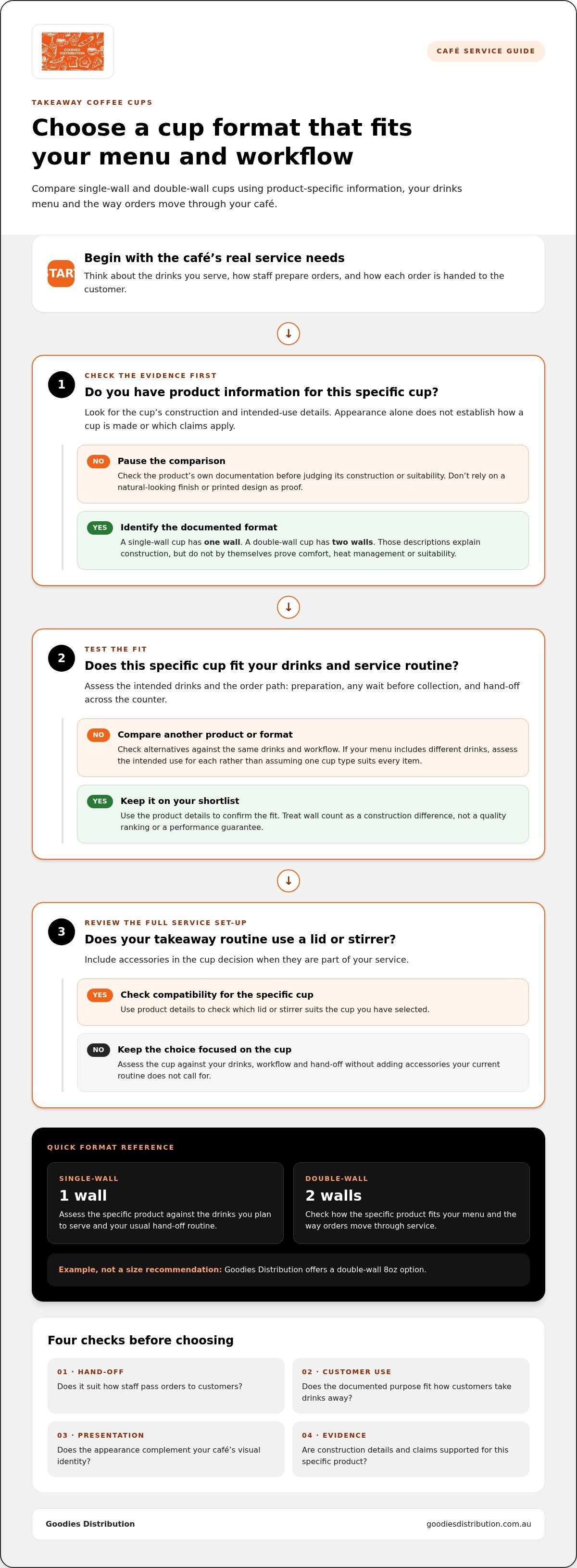
- Hand-off: How does the cup fit the way staff pass orders to customers?
- Customer use: Does the product’s documented purpose fit how customers take drinks away?
- Presentation: Does its appearance complement your café’s visual identity?
- Evidence: Are construction details and any environmental claims supported for that specific product?
Keeping these points separate makes the decision clearer. Choose a cup for its role in service, assess its construction from product information, and treat appearance as one part of the customer-facing experience. That way, takeaway coffee cups can support a thoughtful hand-off without relying on visual cues to imply qualities they don’t prove.
How to compare takeaway coffee cup formats for your menu
The right cup format depends on the drink and service context. A useful comparison starts with what each format is, then considers how it fits your menu and order hand-off. Don’t treat a format as a quality ranking or assume construction alone proves how a particular cup will perform. Check product information and assess the options against the drinks your café actually serves.
Single-wall and double-wall cups: what to assess
In plain terms, a single-wall cup has one wall and a double-wall cup has two. Those descriptions tell you about construction, but don’t by themselves establish a particular level of comfort, heat management or suitability. The practical question is how the specific product fits the way your café prepares, handles and hands over drinks.
| Format | Verified construction difference | Questions for your café |
|---|---|---|
| Single-wall | One cup wall | Does the product suit the drinks you plan to serve and your usual hand-off routine? |
| Double-wall | Two cup walls | Does this product fit your menu and how orders move through service? |
Use the comparison as a prompt for checking details, not as a substitute for them. For example, if staff prepare several orders before customers collect them, consider how cups are stored and passed across the counter within that workflow. If customers order a mix of drinks, assess formats against each intended use rather than assuming one cup type covers every menu item. Goodies Distribution offers a double-wall 8oz option as an example of a format, not as a size recommendation. For detailed size comparisons, refer to the dedicated cup-size guide.
Cup lids and stirrers as part of the service set-up
Accessories are part of the cup decision when they’re used in your service. Consider whether your takeaway routine calls for a lid or stirrer, and whether the chosen accessory is compatible with the specific cup. Goodies Distribution supplies BioPak cup lids and stirrers, with product details guiding which accessories suit the cups you select.
Review the full order path: how a drink is made, whether an accessory is added, where the finished order waits, and how it reaches the customer. This helps your team identify practical fit issues before making a format part of everyday service. Keep the comparison focused on your own menu and workflow; a different venue may have different requirements.
For cafés considering presentation alongside format, Goodies Distribution also offers BioPak Art Series cups. Review the product details and consider how their presentation fits your café’s identity.
Explore BioPak compostable cups as you compare formats and accessories for your takeaway service.
How to assess compostability and environmental claims on coffee cups
Compostability claims need to be checked against the evidence for the exact cup. Industrial compostability and home compostability describe different composting settings, so a product intended for industrial processing shouldn’t automatically be described as suitable for a backyard compost bin. For café operators, this distinction matters when selecting packaging, briefing staff and deciding what to tell customers.
AS 4736 and EN 13432 are standards for industrial compostability. AS 5810 relates to home compostability. Treat each standard as a product-specific claim: check which cup the certification covers and don’t assume every item in a supplier’s range has the same certification. The BioPak range includes products with AS 4736, AS 5810 and EN 13432 certifications, but evidence for the individual product is what supports its claim.
What certification marks tell a café operator
Seedling logos are certification marks that indicate a product meets specified compostability requirements. A seedling logo should be read with its certification scope: it identifies the compostability claim supported for that product, not automatic acceptance by every composting facility or waste service. Check the accompanying product information to establish whether the claim relates to industrial compostability or home compostability.
The distinction has practical consequences for customer instructions. A cup certified for industrial composting shouldn’t be labelled home compostable unless separate evidence supports that claim. Likewise, a home compostability claim doesn’t establish that a council collection or commercial facility will accept the cup. Certification describes the product’s assessed compostability conditions; local collection arrangements are a separate matter.
Keep relevant documentation with the product’s purchasing or packaging information. That makes it easier for staff to answer questions consistently and reduces the risk of applying one cup’s certification to a different product or accessory. If packaging or product details change, make sure customer-facing wording still matches the evidence for the item being supplied.
How to communicate environmental claims responsibly
Choose precise wording that reflects what the product documentation supports. If the evidence relates to industrial compostability, state that rather than using wording that could imply home compostability. Broad descriptions such as “planet-friendly” don’t tell customers what has been certified or what disposal route is relevant, so avoid them unless there’s clear, verifiable support for the specific claim.
Disposal guidance should also avoid promising a local outcome. A certification doesn’t prove that a Sydney council collection or processing facility accepts that cup. Where local acceptance is established, make instructions consistent with the service’s current guidance. If it isn’t established, stick to the product’s documented certification and don’t direct customers to a particular bin or collection.
- Match the claim to the cup: Keep certification statements specific to the documented product.
- Name the setting accurately: Distinguish industrial compostability from home compostability.
- Brief staff clearly: Use consistent wording based on product information.
- Keep disposal advice grounded: Don’t imply local acceptance without evidence.
Clear, product-specific language helps your café discuss compostability responsibly, while giving customers an honest explanation of what a certification does and doesn’t establish.
A practical checklist for selecting takeaway coffee cups
A short, repeatable review can help you choose cups that suit your menu and the way your café runs. Base the decision on your actual drinks, service routine and product information rather than a general preference for one format. Work through these steps before settling on an option.
- Review your drinks menu. List the beverages you serve for takeaway and note how each is prepared and handed over. Include variations in your menu, such as espresso-based drinks and other hot beverages, so you can consider the full range of uses rather than choosing around a single popular order.
- Map your service style. Consider how orders move from preparation to collection, whether customers usually carry drinks away immediately, and how cups fit into busy service periods. Think about the customer’s usual journey too: a drink carried a short distance from the counter may be handled differently from one taken on a longer commute.
- Compare cup formats against those needs. Assess single-wall and double-wall formats based on the specific product information and your service context. Don’t treat a format as a universal quality ranking. Keep size decisions tied to the beverages you serve; use the dedicated cup-size guide for detailed size comparisons rather than relying on a general rule.
- Review claims and accessories. Check the product documentation for construction, any environmental claim and the certification evidence that supports it. Confirm that the accessories you plan to use, including lids or stirrers, fit the selected cup and your hand-off routine. Keep claims specific to each product, and avoid extending one item’s certification to an entire range.
- Plan supply around your operation. Review storage capacity, ordering routines and expected service demand. Consider how much room cup cartons take up alongside other packaging and how often your team can manage replenishment. just-in-time inventory, where stock is replenished close to when it’s needed, may suit some routines, but only if it aligns with your ordering process and storage needs.
Match cup choices to drinks and customer service
Make your menu the starting point. Note which drinks are offered for takeaway, how customers tend to carry them, and what your team needs for a smooth collection hand-off. This gives you a practical basis for comparing cup formats without assuming that one option suits every drink. Keep size-specific decisions grounded in your menu and refer to the dedicated cup-size guide for more detailed comparisons.
Plan ordering and stock around café operations
Think through where packaging is stored, who monitors stock and how ordering fits into your regular café tasks. A routine that works for one venue may not suit another, so base your plan on your own service demand and replenishment process. Avoid relying on assumptions about quantities or delivery timing; focus on a supply routine your team can manage.
Once you’ve reviewed your menu, workflow, product claims and stock routine, explore wholesale cup options for your café.
Wholesale takeaway coffee cups in Sydney: a local supply partner
For Sydney cafés, cup selection is only one part of a reliable takeaway set-up. You also need a wholesale supply partner who understands hospitality operations and can support your business locally. Goodies Distribution is an authorised BioPak wholesale distributor, with a Sydney-based warehouse and Sydney-wide delivery for local businesses.
That local base gives cafés a practical point of connection for wholesale packaging. The directors bring more than 40 years of combined hospitality industry experience, grounding the business in the day-to-day realities of food service. Whether you’re reviewing cup formats or planning how packaging fits your takeaway workflow, choosing options with your menu and operating routine in mind helps make the decision more useful.
What Goodies Distribution brings to Sydney cafés
Goodies Distribution offers BioPak compostable cups and FSC-certified paper cups for hospitality businesses. These are distinct product attributes: FSC certification relates to the paper, while compostability claims need to match the evidence for the particular cup. Product-level documentation helps you describe each option accurately, rather than treating a certification or material claim as if it applies to every cup in the range.
A Sydney-based warehouse and Sydney-wide delivery support local wholesale supply. For café operators, this means you can consider cup selection as part of a broader packaging plan, including the products your team needs to serve takeaway orders and how stock fits into your storage and ordering routines.
Bring cup supply and brand presentation together
A takeaway cup travels beyond the counter with your customer. Its appearance can help carry your café’s visual identity into the takeaway experience, while the format and product information remain central to practical selection. Goodies Distribution’s in-house custom branding services help businesses make packaging more closely reflect their brand. Consider how a branded cup will sit alongside your other customer-facing packaging, and keep any environmental wording specific to the product’s supporting documentation.
When you’re comparing wholesale takeaway coffee cups, bring together the details that matter to your venue: drink menu, service routine, cup format, accessories and evidence for any sustainability claim. That gives your team a clearer basis for choosing packaging that supports both daily service and a consistent customer experience.
Shop takeaway coffee cups for your Sydney café and explore wholesale options from Goodies Distribution.
Make your next cup choice count
Your next packaging decision is a chance to shape a takeaway experience that feels considered from the café counter to the customer’s next stop. Set a clear standard for how your team assesses cup options, product information and environmental wording, then make it part of your regular packaging review. That way, each choice can reflect your café’s real service needs and the claims you’re prepared to stand behind.
Start with the priorities that matter most to your venue, and choose takeaway coffee cups that align with them. Thoughtful decisions don’t need to be complicated. A practical approach can help your packaging support your café’s identity while keeping environmental communication clear and specific.
Shop takeaway coffee cups and take the next step towards a cup choice that feels right for your business. Small, considered changes can help create a better experience for your customers.
Frequently Asked Questions
Are takeaway coffee cups recyclable?
Some may be, but disposal depends on the cup’s construction and what your recycling service accepts. Don’t assume a cup belongs in the recycling bin just because it looks like paper. Follow the product guidance and local waste-service instructions before advising customers. If you describe a cup as recyclable, keep the claim specific to that product and supported by evidence, rather than applying it to all takeaway coffee cups.
Can compostable coffee cups go in a home compost bin?
Only if the specific cup is certified for home compostability. Industrial compostability doesn’t automatically mean a product is suitable for a home compost bin. Look for the product’s home compostable logos and supporting certification before making that claim to customers. Even with home compostability certification, avoid promising the same result in every backyard, as composting conditions can vary between households and home compost systems.
Can takeaway coffee cups be used for cold drinks?
Use a cup specified for the beverage you plan to serve, rather than assuming every hot-drink cup is suitable for cold service. For example, if you offer iced coffee for takeaway, check the product information for its intended use and relevant features before selecting a cup. Keep statements about how a cup performs tied to that exact product. A general category description isn’t evidence that every cup suits every drink.
Do takeaway coffee cups need a lid?
Not every takeaway order needs a lid; the choice depends on your service style and customer needs. Consider whether customers will carry drinks away, how orders are handed over, and whether lids fit your café’s routine. Select compatible accessories for the cup you use, rather than treating all lids and cups as interchangeable. A lid may suit some journeys, but don’t claim it prevents every spill or works for every drink.
How can a café explain compostable cup claims to customers?
Use clear wording that matches the certification and disposal guidance for the exact cup. For example, explain whether its claim relates to industrial or home compostability, rather than using “compostable” without context. Avoid suggesting that every local waste service accepts it. A short sign or staff explanation can identify the certified pathway and direct customers to follow local instructions, helping them understand what the claim does and doesn’t cover.
Can all compostable coffee cups go in a Sydney council food-waste bin?
No, don’t assume every compostable cup is accepted in a Sydney council food-waste bin. Acceptance depends on the local collection service and the processing facility it uses. Follow current guidance for your council and the cup’s disposal instructions before directing customers to that bin. If your café uses disposal signage, make sure it reflects the collection service available to your business, not a general compostability claim.
What is the difference between industrial and home compostability?
They refer to different composting settings, so the terms aren’t interchangeable. Industrial compostability applies to products certified for processing in an industrial composting environment; home compostability applies to products certified for domestic composting conditions. Check the evidence for the specific cup: AS 4736 and EN 13432 relate to industrial compostability, while AS 5810 relates to home compostability. Use the relevant seedling logos when explaining a product’s certified status.