


A compostable label alone won’t tell you whether a coffee lid fits your cups or suits your waste system. If you’re sourcing compostable coffee cup lids wholesale for a Sydney café, look beyond the label: a poor fit can interrupt takeaway service, while an unclear compostability claim can leave customers unsure how to dispose of the lid.
You need a practical choice that works at the counter and supports your venue’s packaging goals. This guide explains what to check for cup compatibility, product-specific compostability evidence and carton quantities. It also clarifies the difference between industrial compostability under AS 4736 and home compostability under AS 5810, so you can plan a packaging change with the right information.
We’ll also compare single-use compostable lids with reusable options for venues that can support repeat use. Goodies Distribution is an authorised wholesale distributor with a Sydney-local warehouse, supplying sustainable food-service packaging for local businesses. Use the steps below to assess plant-based cup and lid options alongside reusable cup and lid configurations, and choose a setup that fits your cups, workflow and takeaway service.
Key Takeaways
- Map your takeaway and repeat-use service needs first to decide whether compostable lids, reusable cups or both suit your café.
- When comparing compostable coffee cup lids wholesale, look for product-specific certification evidence and a disposal route that matches the certification.
- Match the lid to the cup using the product’s stated compatibility, rather than assuming lids with similar capacities will fit.
- Record cup sizes, daily usage patterns and storage limits, then use listed carton quantities to plan stock.
- Consider a Huskee reusable cup and lid configuration if your service can support repeat use. Reuse and compostability are different approaches.
Compostable coffee cup lids wholesale: start with your café’s service needs
Start with the service you need to support: a convenient single-use lid for takeaway, a reusable cup system for repeat use, or both for different orders. The answer shapes what to buy. Before comparing compostable coffee cup lids wholesale, list the cups and drink sizes you use, how customers take their orders and how lids will be collected or disposed of after use.
A compostable coffee cup lid is a single-use lid designed to break down under specified composting conditions. The word “compostable” alone doesn’t prove that a particular product is certified for home or industrial composting. Look for product-specific evidence, such as relevant certification and seedling logos, rather than relying on broad environmental wording. Compost is organic material formed through composting, but the process and conditions matter when interpreting a product’s claim.
Fit matters just as much. A lid must match the cup’s rim and work with the way your team serves hot drinks, handles takeaway orders and passes drinks to customers. Include cup compatibility, service requirements and end-of-use handling in the same buying brief. This gives your team a clear basis for comparing options and reduces the risk of choosing packaging that slows service.
What does wholesale mean for a Sydney café?
Wholesale ordering means planning around the product’s listed order unit, which may be a carton. That quantity affects how much stock you hold, where it fits and how often you need to replenish it. Compare the listed quantity with expected service volume, available storage and the space needed for cups and other packaging.
Goodies Distribution has a Sydney-local warehouse and offers Sydney-wide delivery, supporting local cafés with their packaging orders. To estimate stock needs, record the cup sizes you use, takeaway patterns during busy and quieter periods, and your storage limits. These details help you plan an order that suits your venue rather than taking up more storeroom space than you can spare or leaving a service line short.
Compostable or reusable: which service model fits?
Compostable lids are a single-use packaging choice. Their end-of-use pathway depends on the specific product’s evidence and the composting facilities available to your business or customers. Certification for industrial composting isn’t the same as home compostability, so match the claim to the waste route you can support.
Reusable cups and lids serve a different model: they’re intended for repeat use rather than composting after one drink. A café might choose reusable cups for a return or dine-in system while keeping single-use packaging for takeaway orders. These options aren’t interchangeable, and neither is automatically right for every venue. Consider how customers receive, use and return cups, as well as your team’s washing, storage and service routines.
Start with your actual workflow, then select packaging that supports it. That practical brief will guide your checks on materials, certifications and cup fit.
Materials, fit and certifications: how to assess compostable coffee cup lids
A lid’s material, certification and fit each affect whether it’s right for your café. Assess them separately: a plant-based material isn’t automatically compostable, a compostability claim doesn’t prove cup compatibility, and a certified product still needs a suitable end-of-use pathway.
How to read compostability claims and seedling logos
PLA is a plant-based bioplastic commonly made from renewable starch sources such as corn or sugarcane. Its origin describes the material, not the conditions in which a particular lid can compost. When sourcing compostable coffee cup lids wholesale, use the product listing and supporting documentation to confirm what the specific lid is certified for.
Check certification against the exact product. A material description or logo on one item doesn’t prove that another lid has the same certification or disposal route. In Australia, AS 4736 relates to industrial compostability, while AS 5810 relates to home compostability. EN 13432 is also an industrial compostability standard. These standards aren’t interchangeable: AS 4736 includes requirements for biodegradation and disintegration in industrial composting conditions, while AS 5810 addresses home composting conditions.
Seedling logos indicate that a product meets specified compostability requirements. Match the logo and standard to the product documentation, then consider the waste system available to your business and customers. Certification doesn’t mean every council collection, commercial composting service or home compost bin will accept the item. Don’t assume a certification shown for one BioPak product also applies to all its lids. Check each product listing before making a claim on menus or packaging.
How to check lid fit and service performance
Fit is product-specific. Compare the lid listing with the cup you use, including cup capacity, rim or lid dimensions and any stated compatibility. Similar capacity doesn’t establish a match, so use the product’s fit information rather than judging by appearance alone. If your café serves several cup sizes, record each one and match it to the corresponding lid before ordering.
Next, review the functional details that affect handover at the counter. Check the listed drink opening, closure style and other stated features, then consider how staff will seat the lid and pass the drink to a customer. Don’t infer leak-proof performance from a compostability mark or general product description. A practical trial using the intended cup and your normal service routine can help your team assess handling before changing its standard setup.
Keep the evidence with the product decision. Record the exact lid name, material, compatible cup details, certification and disposal route in your ordering notes. If your planning also includes repeat-use cups, explore Huskee reusable cups and lids as a separate option, with its own cup and lid configuration to consider.
Compostable lids or Huskee reusable cups: compare the options for your venue
These options support different workflows. Compostable lids are a single-use packaging choice; Huskee cups and lids are part of a repeat-use approach. Neither is automatically right for every café. Consider how customers order and take away drinks, what your team can manage during service, and what product evidence supports any compostability claim.
Decision rule: choose a single-use lid format when your service relies on takeaway packaging and its end-of-use pathway is clear. Choose a reusable cup system when your venue can support repeat use as part of its daily workflow. Some cafés may use both for different types of orders.
| Consideration | Compostable lid | Huskee reusable cup and lid |
|---|---|---|
| Service model | Single-use takeaway service | Repeat-use service |
| Repeat use | Designed for one use, not repeated service | Intended for use again, subject to the venue’s system |
| Cup compatibility | Match the listed lid fit to your cup | Choose a suitable cup and lid configuration |
| End-of-use handling | Follow the specific certification and available composting route | Reuse; end-of-life recycling is through the HuskeeLoop programme |
When compostable coffee cup lids suit takeaway service
A single-use lid can suit a fast takeaway workflow where customers leave with their drinks and staff need a ready-to-serve format. Before ordering, check the exact product’s certification and whether an appropriate composting collection or processing arrangement is available. A certified lid won’t necessarily be composted after use. Its pathway depends on how it’s collected and accepted locally.
When a Huskee reusable cup and lid system may suit
A repeat-use system needs planning beyond the cup itself. Consider how cups will be supplied, returned, cleaned, stored and brought back into service, and whether those steps fit your team’s routines and customer habits. Huskee cups and lids are not compostable single-use items. The HuskeeOriginal range uses an eco-composite polymer including coffee husk and BPA-free polypropylene, with end-of-life recycling through HuskeeLoop.
Keep the product decision separate from the operating model. Compostability evidence describes a particular product and its composting conditions, while reuse depends on your venue’s repeat-use process. Check the selected cup and lid configuration for compatibility, then decide where it fits in your service. To explore this option, browse Huskee reusable cups and lids.
How Sydney cafés can plan a wholesale cup and lid order
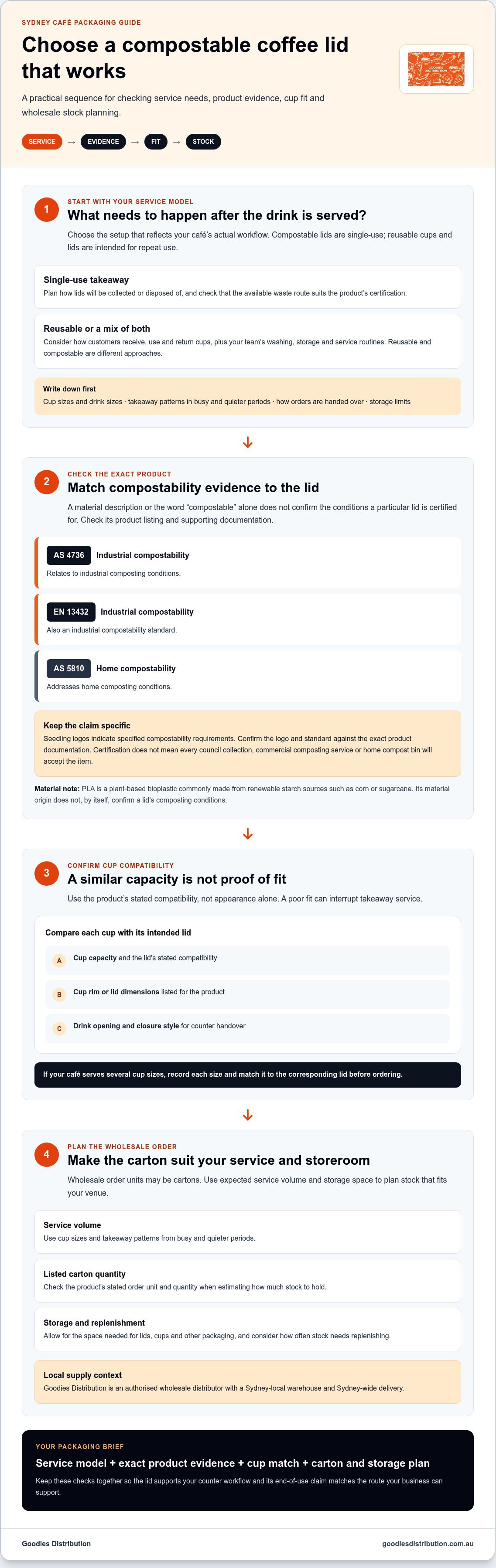
A sound order starts with service records, not a guess at how many cartons might fit in the storeroom. For compostable coffee cup lids wholesale, plan around the cups your café uses, the pace of takeaway service and the product information for each lid. A clear buying brief makes it easier to compare options and avoid unnecessary changes at the counter.
Use this four-step process before placing an order:
- Map your service. Record current cup sizes, daily usage patterns and which drinks are most often ordered to take away. Note busy and quieter periods so your estimate reflects the rhythm of your café.
- Check compatibility. Match each cup with the lid identified as compatible in the exact product listing. Don’t rely on capacity alone to assume the rim and lid will fit.
- Verify claims. Keep product-specific certification evidence and disposal instructions with your purchasing notes. The waste pathway should align with the product’s stated compostability.
- Plan stock. Compare the listed pack or carton quantity with expected usage and available storage before deciding how much to order.
Match the order to service volume and storage
Use recent ordering records alongside service patterns to estimate when you’ll need to replenish stock. Compare that estimate with the product’s listed order unit. A carton quantity that looks convenient on paper still needs to fit your back-of-house space, especially if cups, lids and other packaging share the same storage area.
Check storage conditions, too. High humidity may affect your storeroom, so follow the product’s storage guidance and organise stock to support rotation. Just-in-time inventory means planning replenishment close to when stock is needed. It’s a stock-planning approach, not a promise of supply timing, so account for your ordering routines and storage limits.
Build a product check before ordering
Keep a short record for each selected item: exact product name, compatible cup, listed order quantity, certification evidence and disposal instructions. Review the listing for functional details that matter at handover, then trial the setup as part of your operational planning. This gives staff a chance to assess fit and handling with the cups and service routine they use every day.
For a wider view of packaging choices, Goodies Distribution’s sustainable packaging wholesale guide can help frame cup and lid decisions alongside your other packaging needs. If your planning includes a repeat-use setup, explore Huskee reusable cups and lids and consider how that system could fit your café’s workflow.
Explore Huskee reusable cups and lids for a repeat-use service
For Sydney cafés with a service model that supports repeat-use cups, Huskee offers an alternative to compostable single-use lids. The collection includes cup and lid options in several listed sizes and formats. Choose based on how your venue will manage repeat use, then use the product listings to distinguish combined cup-and-lid options from separate components.
This is a different buying decision from sourcing compostable coffee cup lids wholesale. Compostability certification relates to a specific product and its disposal conditions; a reusable setup depends on how cups move through your service. Don’t compare them as interchangeable packaging formats. Instead, consider which arrangement your team can support and what customers are likely to use.
Compare Huskee cup sizes, colours and pack formats
The collection lists HuskeeCup and lid options in 6oz, 8oz and 12oz sizes, with charcoal and natural colour options. Treat these as listed capacities, not as a guide to particular drink types. Check the product listing for the configuration you need, and match the selected cup and lid using the stated product details rather than assuming separate components will fit.
Order formats differ, too. The listings include cup-and-lid options, four-pack listings and bulk cup listings. These are different ordering formats, so compare the exact listing and its stated contents with the quantities your venue needs. Don’t infer a carton quantity or pack contents from the product name alone. Clear records are especially useful if your café is introducing repeat use alongside its existing takeaway setup.
Consider separate lids and saucers for your setup
Separate accessories are listed too, including universal lid four-packs and classic saucer four-packs in charcoal and natural. Use the listing name and product details to guide your selection. Don’t extend the word “universal” beyond the compatibility stated for that product or assume it fits every cup in the collection. Review the relevant cup and accessory details together before choosing a configuration.
For a café, the operational questions are practical: where cups will be stored, how staff will serve them, and how the venue will manage them after use. A repeat-use format may suit a dine-in or return-based workflow, while some takeaway orders may still call for a single-use cup and lid. Keeping these routes distinct helps you brief staff and present the right option to customers.
Browse the Huskee reusable cups and lids collection to compare the listed sizes, colours and pack formats for your Sydney hospitality business.
Make your next packaging choice count
Your cup and lid setup can evolve with your café. Include packaging in regular service reviews: note when customer preferences or workflow change, then revisit whether your current format still suits the way your team serves drinks. If you’re comparing compostable coffee cup lids wholesale with a repeat-use system, choose the approach your team can support consistently.
Plan any change around the customer experience as well as the product. Confirm the cup and lid pairing, brief staff on the chosen disposal or return process, and keep product evidence with your purchasing records.
For a repeat-use option, shop the Huskee reusable cups and lids collection. For compostable packaging, explore Goodies Distribution’s BioPak wholesale range and plan a cup and lid setup for your Sydney café.
Frequently Asked Questions
Are all coffee cup lids labelled compostable suitable for industrial composting?
No. Before adding a disposal instruction to staff notes or customer-facing signs, match the exact lid’s documentation to the processing route you intend to use. Record the product name and supporting evidence with your purchasing information so the claim remains traceable if the item changes. Apply the same evidence checklist to each option rather than relying on packaging wording alone.
Can compostable coffee cup lids go in the recycling bin?
Don’t place a lid in recycling just because it has a sustainability claim. Set a clear sorting procedure for staff based on the written instructions for your local collection system, and keep lids separate until the correct route is clear. This helps prevent different sorting decisions during a busy shift. Review the procedure when your collection service or selected product changes, and update bin-area signs to match.
How do I know whether a coffee cup lid fits my cups?
Check the product details, then assess the pairing in your normal service routine. For example, try seating the lid on the cup after a drink has been prepared, check that staff can handle it comfortably during handover, and see whether the cups and lids are easy to store and access together. Record the exact cup and lid combination that works for your workflow. Don’t assume the same result applies to other sizes or brands.
What does a seedling logo on a coffee cup lid mean?
A seedling logo indicates that a product meets specified compostability requirements, but the product information is still needed to understand the claim. If you use environmental wording on a menu, website or customer sign, align it with the evidence for the precise lid you purchase. An internal record linking the product name, logo and approved wording helps staff answer questions consistently and makes claims easier to review when packaging changes.
Is a reusable cup and lid the same as a compostable cup lid?
No. Consider where each format belongs in your ordering journey. A café might make a reusable option part of its dine-in routine while keeping a separate takeaway setup for orders leaving the venue. Decide how customers will be offered each format and how staff will identify the correct option at the point of service. Planning by service channel helps you create a workable mix without treating the formats as substitutes.
How should a Sydney café estimate its wholesale lid order?
Count usage by cup size and shift. Note how many lids are used during representative service periods, then compare that figure with stock on hand and the quantity stated in the listing. This gives you a café-specific reference instead of relying on another venue’s pattern. After introducing a different lid, track usage and remaining stock again, then adjust your reorder trigger to reflect your own operating records.
Are Huskee reusable cup lids compostable?
Don’t treat a Huskee reusable lid as compostable based on its name or intended service. For purchasing and customer information, record the listing’s stated material, care directions and end-of-use instructions for the exact item. Keep those details separate from documentation for compostable single-use lids. This helps staff explain the product accurately and prevents compostability wording from being applied without supporting evidence.