


What if the container that looks like the greener choice struggles with your menu during the lunch rush? Choosing biodegradable food containers wholesale means weighing environmental credentials against the practical demands of service. Sydney cafés, restaurants and takeaway operators need packaging that suits the food, holds up during handling and presents well to customers.
Materials, formats and compostability claims can be difficult to compare. A label alone won’t tell you whether a container suits a hot meal, a saucy dish or your disposal arrangements. Start with how you serve the food, then check product performance and the evidence behind each environmental claim.
This guide explains how to compare bagasse containers, trays and bowls, check relevant certification standards and assess performance for your menu and service conditions. You’ll also find practical ways to plan wholesale quantities around storage space and actual usage, reducing the risk of running short or holding more stock than your venue needs. Goodies Distribution’s Sydney-local warehouse supports businesses looking for packaging choices that bring function, presentation and environmental responsibility together.
Key Takeaways
- Match container formats to your menu and service journey, then assess how each option performs with the food you serve.
- Compare materials such as bagasse by their practical role. Don’t assume one format suits every dish.
- Check compostability claims against certification evidence for the specific product, not just its material or brand.
- Plan biodegradable food containers wholesale orders by tracking usage, choosing core formats, reviewing storage and setting a replenishment routine.
- Use a Sydney-based wholesale supplier’s hospitality experience and product range to support considered packaging choices.
How to choose biodegradable food containers wholesale for your menu
A container has to do more than hold food on the counter. It needs to suit the menu, work through packing and transport, and fit the way customers receive their order. For cafés, restaurants, caterers and takeaway venues, choosing biodegradable food containers wholesale means considering the whole service journey, not just the material named on a label.
A fit-for-purpose container matches the food it holds, the handling it goes through and the end-of-life requirements stated for that product. Keep those checks in view alongside your venue’s ordering routine. A material described as biodegradable plastic doesn’t, by that description alone, tell you how a specific product will perform or what composting conditions it requires.
Start with the food and how customers receive it
Group your menu before comparing formats. Hot meals, chilled items, moist dishes, oily foods and dry products each raise different packaging considerations. Note sauces, steam and how long food may remain packed: moisture can affect the food’s quality and the container’s condition. Takeaway collection, delivery, catering and display also involve different handling, stacking and transport demands. Consider the full journey from portioning to handover, rather than judging a container when it’s empty.
Turn venue requirements into a simple buying brief
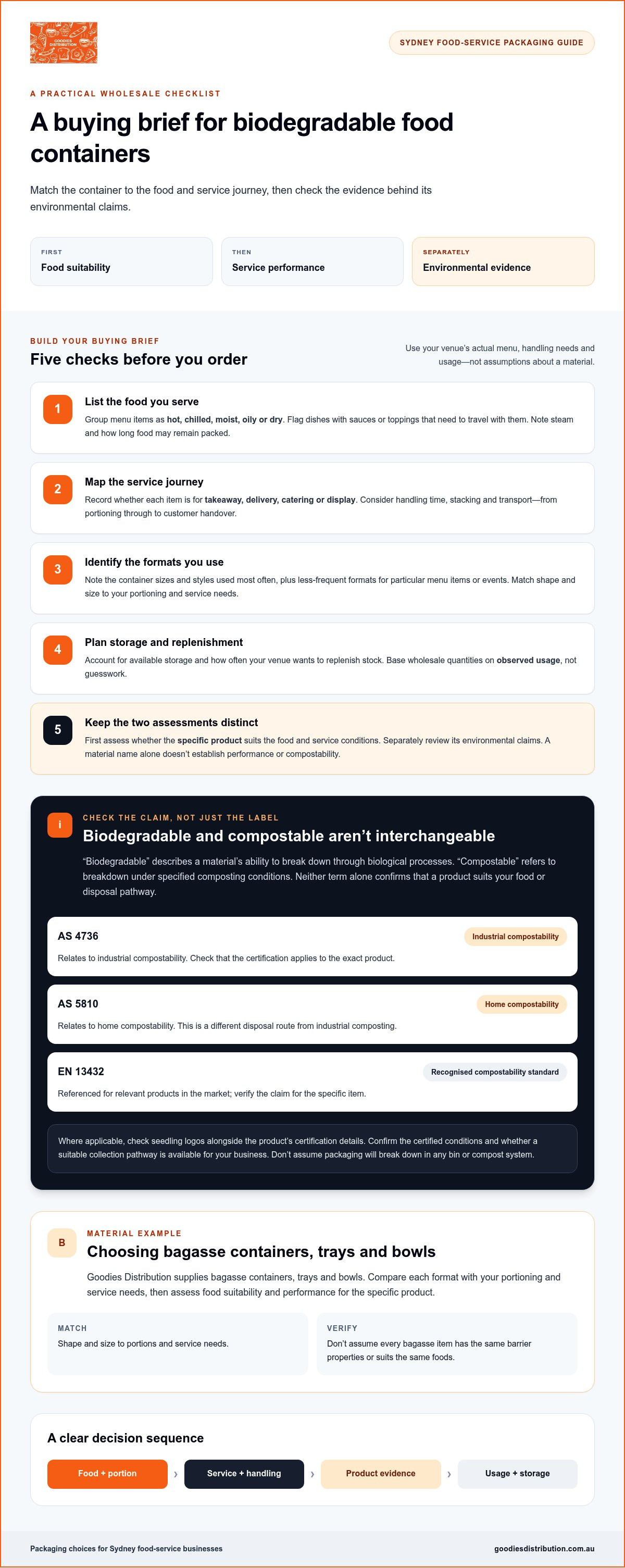
Write down what your operation needs, then assess food-service performance separately from environmental evidence. This makes product comparisons clearer and keeps a wholesale order focused on the formats your team uses regularly.
- List core menu items: Note which foods are hot, chilled, moist, oily or dry. Flag dishes with sauces or toppings that need to travel with them.
- Map service formats: Record whether each item is packed for takeaway, delivery, catering or display. Consider handling time, stacking and the journey to the customer.
- Identify frequently used formats: Note the container sizes and styles used most often, along with less-frequent formats needed for particular menu items or events.
- Review storage and ordering rhythm: Account for available storage and how often your venue wants to replenish stock. Base the order on observed usage, not guesswork.
- Keep two checks distinct: Assess whether the specific product suits the food and service conditions, then review its environmental claims separately. A material name alone doesn’t establish performance or compostability.
Use the brief to compare products against actual service needs, not broad assumptions about a material. If a format is being considered for food that’s especially moist, oily or hot, make that use case explicit. This gives you a practical basis for selecting containers, planning wholesale quantities and making environmental choices with clearer evidence.
How to assess container materials and compostability claims
Material names can help narrow your options, but they don’t prove how a particular container performs or how it should be disposed of. “Biodegradable” describes a material’s ability to break down through biological processes, while “compostable” refers to breakdown under specified composting conditions. The terms aren’t interchangeable. Neither one alone tells you whether a product suits your food or your local disposal pathway.
Certification evidence applies to the specific product and the composting conditions stated in its certification. Don’t infer certification from a material, a supplier’s general environmental messaging or a brand name. When buying biodegradable food containers wholesale, look for product-specific supporting information and match it to the exact format you intend to order.
What bagasse containers can offer food-service businesses
Goodies Distribution supplies bagasse containers, trays and bowls. These formats can contribute to the look and feel of takeaway or catering presentation, but the right choice still depends on the product and the task. Compare the shape and size with your portioning and service needs, then assess food suitability and performance separately. Don’t assume every bagasse item has the same barrier properties or suits the same foods.
How to read compostability marks and supporting information
Where applicable, check the product’s seedling logos alongside its certification details. A mark is useful when you can connect it to the specific product and the conditions it has been certified for. In Australia, AS 4736 relates to industrial compostability, while AS 5810 relates to home compostability. EN 13432 is another recognized compostability standard referenced for relevant products in the market. Each claim applies only where verified for the exact item.
Industrial compostability means a product is intended for processing in an industrial composting facility; home compostability relates to decomposition in a domestic composting environment. They aren’t the same disposal route. Check which certification a product carries and whether a suitable collection pathway is available for your business. Don’t assume packaging will break down in any bin or compost system. For broader background on how standards and claims are discussed internationally, see this overview of compostable packaging regulations and standards; it doesn’t replace checking Australian product certification.
For a fuller explanation of the terminology, Goodies Distribution’s guide to biodegradable versus compostable packaging can help clarify what different claims mean. You can also explore Goodies Distribution’s wholesale packaging range as you compare material, certification evidence and service needs.
Compare wholesale biodegradable containers by format and performance
The best format depends on how a dish is portioned, presented and handled after packing. Bagasse containers, trays and bowls serve different roles, and no single shape suits every menu. Use the comparison below to shortlist formats, then assess the exact product against your food and service conditions. Certification evidence should relate to the specific item, not just the material category.
| Format | Typical service role | Practical checks | Certification evidence |
|---|---|---|---|
| Bagasse bowl | Serving dishes that benefit from a bowl-shaped presentation, such as a composed salad or a meal with components gathered together. | Check portion fit, ease of filling and carrying, and how the food’s moisture or sauce affects the meal during service. | Review the certification details for the exact bowl. Don’t assume another bagasse product has the same claim. |
| Bagasse tray | Presenting or packing foods arranged across a broader surface, including catering portions or items served together. | Consider available bench and storage space, how staff will pack it, and whether the layout keeps the food presentable in transit. | Match any compostability mark and supporting claim to the tray’s product information. |
| Bagasse container | Containing a portion where the menu and service call for a defined pack format. | Assess fit for the portion, how it stacks in your workflow and how customers will handle it after collection or delivery. | Check the specific container’s stated certification, rather than applying a claim across the material range. |
| Compatible lid, where offered | Closing a selected format when the service task calls for a lid. | Confirm the lid is designed to fit that exact container, and consider how the closed pack will be handled and transported. | Check claims for the lid and container as relevant; don’t assume their certification status is identical. |
Match trays, bowls and containers to the service task
Start with presentation. A bowl-shaped format may suit food served together, while a tray can help arrange several items for a catering handover. A container may be more practical when a portion needs a defined pack. Then consider whether staff can fill, stack and hand it over smoothly, and whether customers can carry and open it comfortably. These are selection prompts, not guarantees of product suitability.
Check fit, handling and food quality before standardising
Before making a format part of your regular wholesale order, assess it in your actual packing workflow and delivery journey. Notice whether steam or moisture could soften the food or affect its crispness, and whether the packed item remains easy to handle. For broader takeaway format comparisons, see takeaway containers for Sydney’s delivery market.
Performance depends on the exact product, food and service conditions. A sound biodegradable food containers wholesale decision considers format, handling and verified product information together, rather than treating a material label as proof that every option will work the same way.
Plan wholesale container orders around Sydney venue operations
A reliable wholesale order starts with how packaging moves through your venue, not a guess at how many cartons might be useful. Sydney cafés, restaurants and caterers may have changing menus, uneven service periods and limited back-of-house storage. Build a simple routine around observed usage, then adjust it as the business changes.
Usage tracking helps you plan replenishment around demand, so your ordering decisions reflect what your venue actually uses. Follow this sequence to create a workable plan:
- Map usage: Record how many of each container format your team uses by menu item and service period.
- Select core formats: Separate the formats used regularly from those reserved for occasional catering, seasonal menus or special events.
- Review storage: Check the space available for cartons and whether staff can move and access stock safely during service.
- Set a replenishment routine: Choose a regular review point and use stock on hand and recent usage to guide the next order.
Estimate demand without overcomplicating the process
Use recent usage as a planning baseline instead of trying to forecast every possible change in demand. A simple record by format and service period can show which containers move consistently and which are used only for catering or particular menu items. Review the pattern after a menu, trading or service change before adjusting your ordering routine.
Keep core formats visible in your stock records. If a container supports several regular menu items, its usage may be steadier than a format reserved for a one-off event. Treat those needs separately so occasional requirements don’t distort the quantities you plan for everyday service.
Make wholesale storage and replenishment workable
Before settling on an order pattern, measure the dry storage space available and consider how cartons will be received, stacked and accessed. Keep frequently used formats within easy reach, while protecting packaging from high humidity and damp areas. Clear stock locations also help staff spot when a format needs replenishing.
Just-in-time inventory means replenishing stock closer to when it’s needed, rather than holding a large reserve for an extended period. For a food-service venue, that approach depends on reliable usage records, sensible storage and an ordering routine that leaves time to respond to changing demand. It doesn’t mean assuming a supplier can deliver on a particular timetable.
Goodies Distribution has a Sydney-local warehouse and offers Sydney-wide delivery, giving local venues a wholesale supply option as they plan their routine. Align orders with actual use and available storage, while allowing for menu changes without losing sight of core needs. A considered biodegradable food containers wholesale plan can make stock decisions easier to manage as your operation evolves.
To plan packaging around your venue’s regular requirements, explore wholesale container options from Goodies Distribution.
Source biodegradable food containers wholesale with Goodies Distribution
Choosing biodegradable food containers wholesale is easier when product knowledge and hospitality experience come together. Goodies Distribution is a specialist wholesale supplier serving Sydney businesses and customers across Australia, with a range that includes takeaway containers and bagasse containers, trays and bowls. As an authorised BioPak wholesale distributor, Goodies Distribution supplies packaging options for hospitality businesses to consider alongside their menus and service requirements.
The directors bring more than 40 years of combined experience in the hospitality industry. That perspective matters when packaging has to work for a busy café, restaurant, catering operation or takeaway venue, where presentation and practical handling both shape the customer experience. Base selection on the requirements of the particular food and service, and check certification claims against the exact product.
Bring product selection and brand presentation together
Packaging is part of how customers experience a venue beyond the counter. A suitable container format helps present a meal as intended, while consistent packaging can connect takeaway orders with your brand. Goodies Distribution offers in-house custom branding services to help businesses align packaging presentation with their customer experience. Keep the design focused on your brand while preserving the container’s practical role.
Keep the checks distinct. Consider whether the container fits its intended food and service conditions, then review environmental claims against the product information and relevant certification. A branded design or material description doesn’t establish that a product is compostable. BioPak products with certifications such as AS 4736, AS 5810 or EN 13432 should be described in line with the certification applying to each specific item.
For a wider view of BioPak options and their role in food-service packaging, explore the BioPak sustainable packaging guide. It can help you consider how individual formats fit alongside your broader packaging requirements, while keeping product selection grounded in your own operation’s needs.
Take the next step with a practical wholesale brief
Before you browse, bring together a few useful details about your venue. A concise brief makes it easier to compare wholesale packaging and branding needs without losing sight of day-to-day operations:
- Menu items and portion styles you need to pack
- Service conditions, such as collection, delivery or catering
- Preferred container formats and the items used most often
- Available storage space and your usual replenishment routine
- Product-specific certification evidence for any compostability claims
- Brand presentation goals for customer-facing packaging
With those details in hand, Sydney operators can compare packaging choices for function, presentation and verified environmental information. Shop wholesale food packaging with Goodies Distribution and take the next step towards a packaging range suited to your venue.
Make your next packaging choice count
Your packaging can grow with your venue. When your menu, service style or brand presentation changes, review whether your current containers still suit the customer experience you want to create. Staff feedback is useful too: the people packing orders often spot practical issues early.
As you plan your next order of biodegradable food containers wholesale, focus on the products your team needs and the claims you can support. This lets you make considered improvements over time rather than changing everything at once. Goodies Distribution’s in-house custom branding services can also help connect functional packaging with the way your venue presents itself to customers.
Ready to take a practical next step? Explore wholesale food packaging options and find packaging choices to support your service and brand.
Frequently Asked Questions
Are biodegradable food containers the same as compostable containers?
No. The terms aren’t interchangeable, so use wording supported by the specific product rather than treating one as shorthand for the other. This matters when staff answer customer questions or describe packaging on menus and signs. Give your team a short, consistent explanation and avoid promising a disposal outcome based only on a broad material description.
Are bagasse food containers suitable for hot food?
The material alone doesn’t establish suitability. Assess the exact container with a representative hot dish and your usual holding and handover process. Notice whether the pack remains manageable for staff and customers, and whether the meal arrives in the condition you intend. Follow the product’s stated food-use guidance rather than generalising from another bagasse item.
How can I check whether a wholesale food container is certified compostable in Australia?
Look for certification information that identifies the exact product, then match its product name or reference to the supporting documentation. In Australia, relevant standards include AS 4736 for industrial compostability and AS 5810 for home compostability. If a later order uses a different size or format, treat it as a separate item and check its evidence too. Keep the documentation accessible to staff responsible for packaging claims.
Can biodegradable food containers go in a home compost?
Only if the particular item is identified as suitable for home composting and its product information supports that use. Don’t assume a lid, label or other attached component shares the same status. When explaining disposal to customers, keep the message specific to the certified item and don’t direct them to home compost it based on the word “biodegradable” alone.
What should a Sydney café consider before ordering food containers wholesale?
Consider how packaging fits the café’s service point as well as its menu. Check whether staff can reach and fill containers without disrupting the pass, and whether completed orders are easy to hand over during a busy period. Think about what customers need to carry away too. These observations can reveal practical issues before a format becomes part of routine service.
Can wholesale food containers be custom branded?
Yes. Goodies Distribution offers in-house custom branding services. For branded packaging, keep essential product information and applicable certification marks clear and legible. This helps staff and customers distinguish product details from the venue’s brand message. Start by identifying which packaging formats need consistent branding, then organise the relevant artwork and product information together.
How should a food business store compostable containers?
Use a simple stock rotation system: place newly received cartons behind existing stock and mark receipt dates so staff use older packaging first. Keep formats clearly identified to reduce mix-ups during service, and avoid stacking cartons in a way that could crush or deform them. These receiving and rotation habits help keep the supply area orderly and stock easy to manage.