


A compostable label alone won’t tell you whether a container will protect your food or suit its disposal pathway. For Sydney cafes, restaurants and takeaway operators, choosing compostable takeaway containers Sydney businesses can use day to day starts with two checks: how the product performs with your menu and which certification applies to that specific item.
Packaging needs to support your environmental goals without compromising food quality, presentation or service. Bagasse containers, trays and bowls offer useful formats to compare, while product-specific certification helps distinguish industrial compostability from home compostability and supports accurate customer information.
This guide explains how to match container shape and size to your dishes, portions and takeaway workflow. You’ll also learn what to look for in certification information, why disposal instructions matter, and how Sydney-based wholesale supply and custom branding can make sustainable packaging a practical part of the customer experience.
Key Takeaways
- Choose a container for the food, portion and takeaway workflow, then assess how it performs during service.
- Compare bagasse containers, trays and bowls with other suitable formats, and consider the disposal pathway alongside material claims.
- Check certification details for each product: AS4736 and EN13432 relate to industrial compostability, while AS 5810 certification is available for home composting options.
- Plan carton quantities, storage space and just-in-time inventory around your Sydney operation.
- Source compostable takeaway containers through Goodies Distribution, with Sydney-local warehouse support, Sydney-wide delivery and custom branding services.
What makes a compostable takeaway container right for a Sydney food business?
The right container suits the food you serve and a composting pathway your business can use. For Sydney cafes and takeaway venues, look beyond the compostable claim. Assess how the container performs with your menu, how it will be disposed of and what customers need to know. Considering material, format, certification and everyday handling together helps you choose packaging that works at the counter and after the meal.
What does compostable mean on a takeaway container?
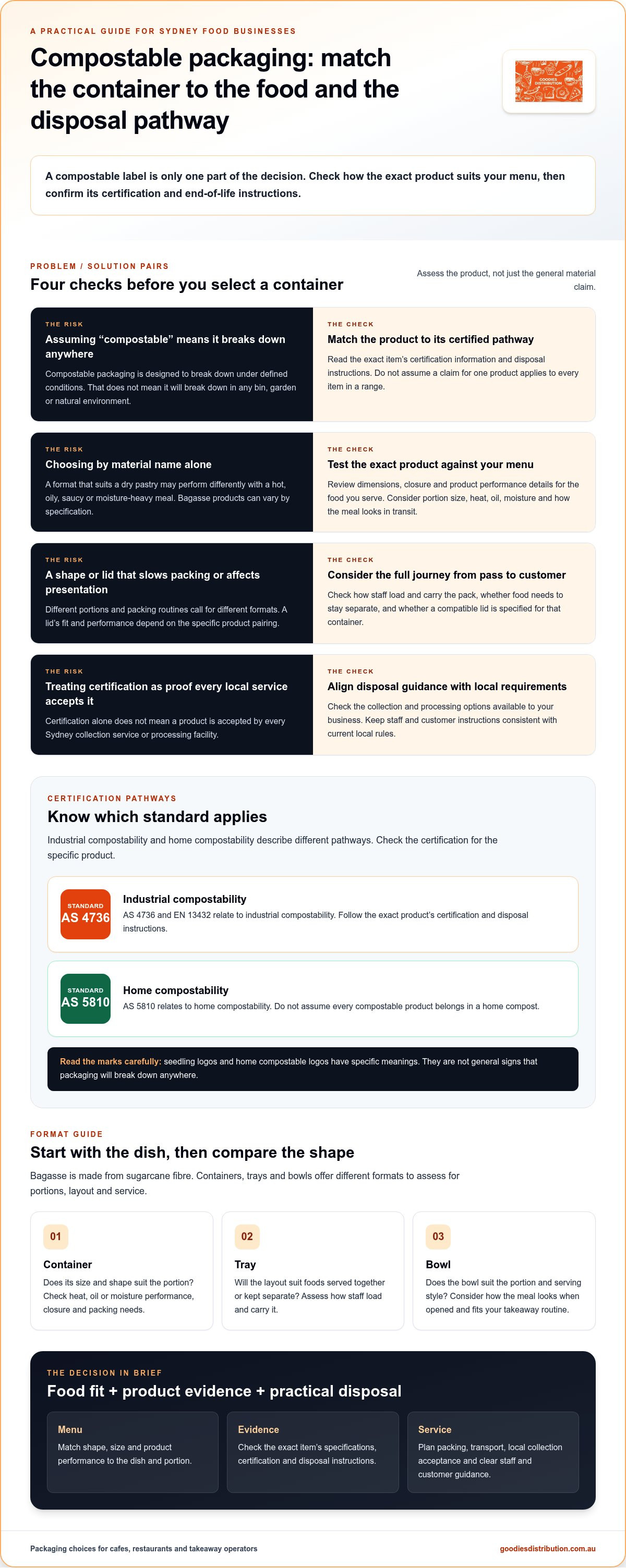
Compostable packaging is designed to break down under defined composting conditions. That doesn’t mean it will break down in any bin, garden or natural environment. The product’s certification and disposal instructions explain the conditions and pathway it is designed for.
Industrial compostability and home compostability describe different pathways. AS 4736 and EN 13432 relate to industrial compostability, while AS 5810 relates to home compostability. The practical choice depends on the product and the composting options available to your business and customers. The Sustainable packaging overview provides broader context on packaging materials and end-of-life considerations.
seedling logos and home compostable logos are certification marks with specific meanings, not general signs that a package will break down anywhere. For the exact container, read the applicable standard, product certification information and disposal instructions. Don’t assume a claim for one item applies to every product in a range.
Why should Sydney businesses look beyond the label?
A certified container can follow its intended composting pathway only if it reaches a suitable collection and processing system. Your venue might have a commercial organics collection service, while customers may have access to a home compost, or neither option may be available. The label alone doesn’t identify which route is practical for your business or your customers.
Local collection rules and facility acceptance determine whether a particular container belongs in a disposal stream. Keep staff and customer instructions aligned with current local requirements, and don’t imply that certification alone means a product is accepted by every Sydney collection service or facility.
Compostability is one part of the buying decision. A container also needs to suit the food, portion and service conditions, and present the dish well. Compare materials and formats against your actual menu rather than choosing by label alone.
Compare bagasse and other container materials for your Sydney menu
Start with the food, not the material label. A format that suits a dry pastry may perform differently with a hot, oily or moisture-heavy meal. Goodies Distribution supplies bagasse containers, trays and bowls, as well as home compostable products. The right match depends on the specifications of the individual product and your service routine.
When might bagasse containers suit a takeaway menu?
Bagasse is made from sugarcane fibre. Containers, trays and bowls give cafes different shapes to consider for portions and presentation. A bowl may suit a meal served in a bowl at the venue, while a tray may work for an arrangement of separate items. Treat these as starting points, then assess the exact product against your menu.
For hot, oily, saucy or moisture-heavy dishes, review the product’s dimensions, closure and performance details before choosing it. Don’t assume all bagasse items have the same capabilities, or describe a container as leakproof or microwave-safe without product-specific evidence.
How do format and lid choices affect service?
Shape affects how food sits in the pack and how staff assemble orders. A bowl, tray or closed container may suit different portion shapes and separation needs. A compatible lid can support handling and transport, but fit and performance depend on the specific product pairing. Consider the full packing routine, from the pass to the customer’s table.
| Material or format | Menu questions to ask | Handling and presentation | Disposal pathway |
|---|---|---|---|
| Bagasse container | Does its size and shape suit the portion? How does the product perform with the food’s heat, oil or moisture? | Check closure and packing requirements. Consider whether the food stays presentable in transit. | Use the product’s own certification and disposal instructions. |
| Bagasse tray | Will the layout suit foods served together or kept separate? | Assess how staff load and carry it, and whether a compatible lid is specified. | Follow the exact product’s stated end-of-life pathway. |
| Bagasse bowl | Does the bowl’s form suit the portion and how it is served? | Consider how the meal looks when opened and how it fits into your takeaway routine. | Check product-level certification and local collection acceptance. |
| Home compostable product | What material and format does the individual item use? | Review its specifications and intended food application before use. | Follow its home compostable instructions; don’t assume every compostable product belongs in a home compost. |
For a practical explanation of Australian standards and disposal considerations, read Understanding compostable plastic certifications in Australia. When comparing compostable takeaway containers Sydney options, match the product to your menu first, then consider its certification and the disposal pathway available to your business or customers. Explore bagasse takeaway containers and bowls as part of your menu-led review.
How to verify compostability certifications and end-of-life claims
A compostability claim is useful when it applies to the exact item you’re buying and matches a pathway your business can use. For Sydney food venues, review product information before making customer-facing claims or adding disposal instructions to packaging. Certification and local waste acceptance are separate questions: a certified product isn’t automatically accepted by a collection service or composting facility.
What do AS4736, EN13432 and AS 5810 tell a buyer?
AS4736 and EN13432 are industrial compostability standards named for relevant products in the BioPak range. They relate to composting under specified industrial conditions, rather than confirming that an item will break down in a home compost. AS 5810 relates to home compostability, and certification to this standard is available for some products in the BioPak range. Apply a standard to an individual item only when its supporting documentation confirms the claim.
Look for the product’s certification information and any relevant seedling logos, then read the disposal instructions that accompany the claim. A logo or general statement about a range doesn’t replace checking the specific container, lid or other component in your order.
How can a business communicate compostability accurately?
Use clear, product-specific wording. Describe an item as certified for industrial composting only when its documentation supports that claim. If it’s certified for home compostability, make that clear for the specific product and follow its stated pathway. Avoid broad phrases such as “fully green” or “harmless”, which can imply more than the evidence establishes.
Use this short verification check before approving product claims or staff guidance:
- Exact product: Does the evidence refer to this container and any paired lid or component?
- Certification mark: Is the mark shown on, or linked to, product-specific information?
- Standard: Does the documentation identify AS4736, EN13432 or AS 5810 as applicable?
- Disposal instructions: Do they explain the intended composting pathway clearly?
- Local acceptance: Is the item accepted by the collection service or facility your business uses?
Keep disposal directions simple for staff and customers, and don’t direct an industrially compostable item to a home compost. Certification doesn’t establish that a Sydney collection service accepts the packaging. This product-by-product approach helps your venue make accurate claims and gives customers practical guidance after their meal.
How to choose and manage compostable containers for Sydney service
A suitable container needs to work throughout service, from packing at the counter to the customer opening their order. Use this five-step process to compare compostable takeaway containers Sydney options against your menu, workflow and storage capacity.
- 1. Map your menu. Group dishes by portion size, temperature, moisture and how they travel. Note which meals need separate sections, a bowl shape or a tray layout.
- 2. Assess handling. Consider how staff fill and close each format, how orders are stacked or carried, and how long food may travel. Test options with representative menu items during normal service. Check presentation and whether the food’s quality changes.
- 3. Confirm product specifications. Review the dimensions, closure details and performance information for the exact container and any paired lid. Similar-looking products may have different capabilities.
- 4. Review claims and disposal instructions. Match any compostability statement to the product’s supporting information, then ensure the stated pathway aligns with your business’s collection options. Keep staff guidance consistent with what you tell customers.
- 5. Plan stock around demand. Estimate usage from your own sales patterns and storage capacity rather than relying on a standard order quantity. Account for carton quantities, space for different formats and how often you can replenish stock.
Storage is part of the plan. Allow room for cartons without crowding areas staff need during service, and follow the product’s storage guidance. If your venue experiences high humidity, consider how storage conditions may affect packaging handling and organise stock so staff can rotate through it. A just-in-time inventory approach may help align replenishment with demand, provided your ordering routine allows for normal variations in trade.
Supply planning matters too. Goodies Distribution’s Sydney-local warehouse and Sydney-wide delivery support wholesale ordering for local hospitality businesses. Include replenishment in your stock plan without assuming a particular arrival time.
Choose a shape and appearance that suit counter service, takeaway or delivery, and present the food as intended. Custom branding can extend your café’s identity beyond the counter. For further ideas, read the Sydney eco-friendly packaging guide.
Ready to put your menu and workflow into practice? Explore takeaway packaging options for your Sydney business.
Source compostable takeaway containers in Sydney with Goodies Distribution
For Sydney cafes and takeaway venues, wholesale packaging needs to suit both the menu and the pace of service. Goodies Distribution supplies takeaway containers, bagasse trays and bowls, and home compostable products. As an authorised BioPak wholesale distributor, we provide food businesses with options to compare against their menu, presentation needs and packaging workflow.
What can Sydney food businesses source through Goodies Distribution?
Start with the dishes you pack most often, then compare container formats and product details. Bagasse containers, trays and bowls offer different shapes and serving styles, while home compostable products provide another category to consider for your packaging plan. Certifications vary by product, so use the supporting information for the specific item when describing its certification or disposal pathway.
The directors bring more than 40 years of combined hospitality industry experience. That background informs a wholesale approach grounded in the everyday needs of cafes, restaurants and takeaway operators, from choosing packaging formats to planning regular stock use.
How can local supply and branding support your next step?
A Sydney-local warehouse and Sydney-wide delivery support wholesale ordering for local businesses. Factor carton quantities, venue storage and demand into your replenishment plan. A menu-led selection also gives each format a clear role in service, helping keep the packing station organised.
Packaging is part of the customer experience. In-house custom branding services can carry your café’s identity through takeaway orders and create a consistent impression from the counter to the customer’s table. Read the BioPak sustainable packaging wholesale guide as you consider your options.
Choosing compostable takeaway containers Sydney businesses can use starts with matching the product to your menu, reviewing product-specific claims and planning supply around your operation. Explore Goodies Distribution’s takeaway packaging range and select formats that fit the way you serve customers.
Choose packaging that works for your menu and your customers
The right container balances food performance, presentation and a realistic end-of-life pathway. Match bagasse formats and other compostable options to your portions and service routine, then review the certification and disposal instructions for the exact product. A compostable claim supports clear customer guidance only when it reflects the product’s evidence and the pathway available to your business.
Goodies Distribution is an authorised BioPak wholesale distributor, with a Sydney-local warehouse and Sydney-wide delivery to support local hospitality businesses. The directors bring more than 40 years of combined hospitality industry experience, and in-house custom branding services can make takeaway packaging a consistent part of your customer experience.
Ready to find a suitable fit for your menu? Shop compostable takeaway containers with Goodies Distribution and take the next step towards a considered packaging choice for your business.
Frequently Asked Questions
Are compostable takeaway containers suitable for hot food?
Some may suit hot food, but suitability depends on the exact container and its product specifications. Consider the food’s temperature, oil and moisture, along with the closure and how long the meal will be packed. A container that works for one dish may not suit another. Test it with representative menu items before adding it to regular service.
Can compostable takeaway containers go in a home compost bin?
Only containers certified for home compostability should go in a home compost bin, and you should follow the product’s disposal instructions. Industrially compostable packaging is designed for specified commercial composting conditions, not necessarily a backyard compost. Check certification for the exact item rather than relying on a general compostable claim. If packaging is intended for commercial composting, your business needs an accepting collection pathway.
What is the difference between AS4736 and AS 5810?
AS4736 relates to industrial compostability, while AS 5810 relates to home compostability. The distinction helps you match a product’s certified pathway to how it can be collected and processed. Neither standard should be assumed to apply to every container in a product range. Check the documentation for the exact item and use the standard in customer-facing claims only when supporting product information confirms it.
How do I choose the right size takeaway container for my menu?
Match the container’s dimensions and shape to the portion, how the food is arranged and whether components need separation. Consider how staff will fill, close and stack it, and how the meal will look when opened. Compare candidate formats using actual menu portions, then review product specifications and lid compatibility. For compostable takeaway containers Sydney cafes should also plan around carton quantities, storage space and expected stock use.
Are bagasse containers compostable?
Bagasse is a sugarcane-fibre material, but the material name alone doesn’t confirm a particular container’s compostability certification or disposal route. Review product-specific documentation for the applicable certification and instructions. If a container is certified for industrial composting, it needs an appropriate commercial pathway; don’t assume it belongs in a home compost bin. Assess its specifications against the food you plan to pack as well.
Can businesses in Sydney get compostable takeaway containers delivered?
Yes. Goodies Distribution offers Sydney-wide delivery and operates a Sydney-local warehouse to support wholesale packaging supply for local food-service businesses. Its range includes takeaway containers, bagasse containers, trays and bowls, as well as home compostable products. Plan orders around your menu, storage capacity and stock use, and review product specifications and compostability information for each item.
How can I make sure compostable packaging claims are accurate?
Review the exact product, its certification mark, the standard named in its supporting documentation and its disposal instructions. Don’t apply a claim for one item to other containers or lids, or describe industrial compostability as home compostability. Certification also doesn’t mean a local collection service or facility accepts the packaging. Keep local acceptance requirements separate from certification, then give staff and customers clear instructions that match the product’s certified pathway.