

The lowest unit price doesn’t always make packaging the simplest choice. Choosing between compostable and plastic packaging involves more than the material: performance, product design and fit with your food-service operation all matter.
For Sydney cafés, restaurants and takeaway businesses, choosing between compostable packaging and plastic involves more than comparing materials. Packaging must protect food, work smoothly during busy service and suit how customers carry their order. Compare options for material, size, performance and purchasing requirements to understand the practical trade-offs.
This article explains how material choices and performance, including strength and barrier properties, shape packaging decisions. You’ll learn what to compare when choosing cups, bags and takeaway containers, and how composting options and daily operations affect the fit for your business.
Key Takeaways
- Match compostable packaging certification to the disposal pathway available to your customers and business.
- Choose cup styles, lids and stirrers around your drinks and service needs, while considering relevant compostability certifications.
- Select carry bags and bagasse containers, trays or bowls to suit your menu, portions and takeaway service.
- Custom branding can bring packaging together with your customer experience; explore tailored options for takeaway containers, paper bags and cutlery.
Choosing Certified Compostable Packaging for Your Business
Start with the material and its job. Plant-based bio-resins made from materials such as corn starch or sugarcane are used in some compostable packaging. Paper and bagasse suit different food-service formats, including takeaway containers and bowls. Since materials and product construction vary, compare the specific items you would buy and how they perform for your intended use. Choose for the job, not an environmental claim alone.
Next, consider what the packaging must handle. A takeaway bag needs to carry the order securely, while a container must suit the food’s moisture and temperature. Some compostable packaging can have weaker barrier strength unless specially designed. For a saucy meal, for example, barrier performance and resistance to softening matter. A product suited to dry pastries may not suit wet or oily food.
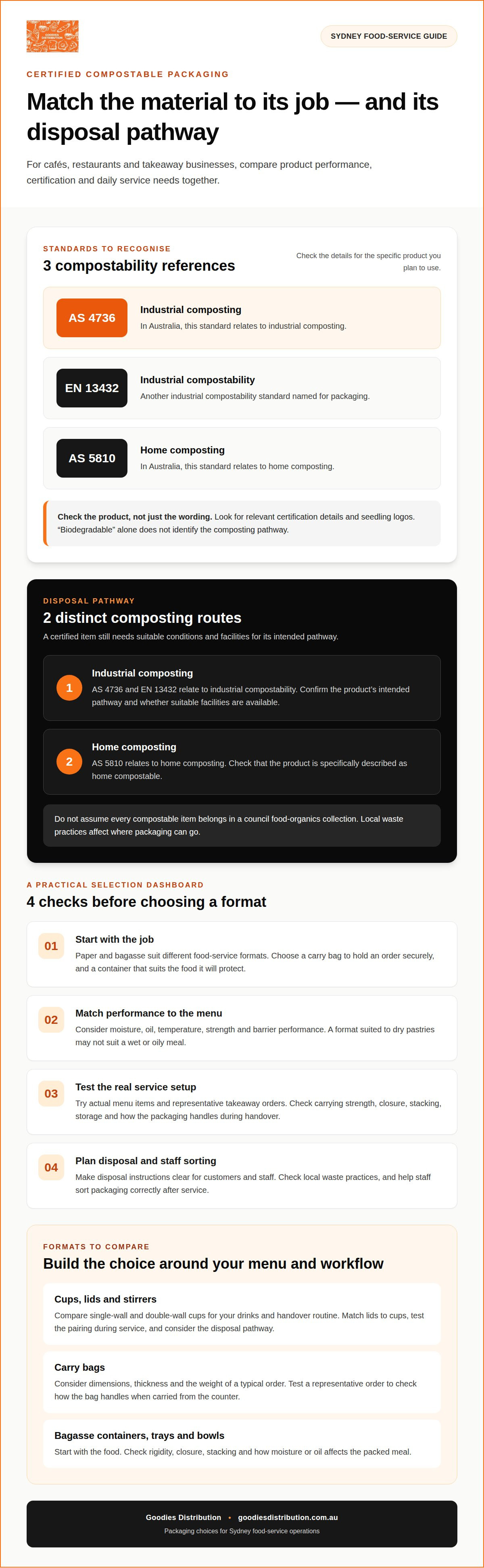
Certification helps distinguish industrial compostability from home compostability. In Australia, AS 4736 relates to industrial composting, while AS 5810 relates to home composting. EN 13432 is another industrial compostability standard named for packaging. Look for relevant certification details and seedling logos, rather than relying on words such as “biodegradable”. A certified product still needs suitable composting conditions and facilities to follow its intended pathway.
For home-compostable products, check that the product is specifically described as home compostable. This differs from packaging intended for industrial composting. The distinction matters for Sydney food businesses: customers and staff need clear disposal instructions, and local waste practices affect where packaging can go. Compostable packaging does not automatically belong in every council food-organics collection.
Finally, assess the whole supply and service routine. Test the chosen format with actual menu items, including hot drinks, oily foods or stacked takeaway orders. Review how it stores in your kitchen and whether staff can sort it correctly after service. These steps help you weigh practical performance and disposal needs without assuming every material suits every business.
BioPak Compostable Cups for Sydney Cafes and Takeaway Venues
For Sydney coffee service, certified single-wall and double-wall cups offer formats for different serving routines. Consider your menu, counter workflow and how customers carry their drinks. A single-wall cup suits a straightforward takeaway handover, while the double-wall format adds another layer around the cup. Choose the style that fits your service and customer experience.
Goodies Distribution’s mixed colour cold cups are made from FSC™ Mix certified paper. When comparing cup options, consider the drink, cup construction and disposal pathway together. Clear product details also help businesses describe their packaging accurately to customers.
Quality disposable cups are industrially compostable to Australian AS4736 & European EN13432 standards. These certifications relate to industrial composting conditions, rather than every disposal stream. A certified cup does not automatically belong in every council organics bin. Clear staff instructions can help direct used cups into the appropriate waste pathway.
Lids and stirrers complete a takeaway coffee setup, but compatibility matters. Match the lid to the cup and drink, then test the pairing during service. Check how the combination fits your existing dispensers and storage arrangements before making a change. A well-matched lid supports a smoother handover and helps manage spills during busy periods.
For a practical selection process, consider the drink format, cup construction, lid fit and disposal pathway together. A café serving flat whites and iced drinks may need different cup and lid combinations across its menu. Confirm that staff can identify each format quickly during peak service, and store compatible components together.
Cup linings and paper construction affect how a cup performs. The right comparison depends on the job the cup must do, the available composting pathway and the venue’s service setup. This gives Sydney cafés a practical way to assess packaging without assuming one cup format suits every drink or business.
Carry Bags, Bagasse Containers, Trays and Bowls
Choose packaging by the task it needs to perform. A carry bag must hold an order securely, while a container needs to protect food during packing and transport. Compostable bags can use plant-based bio-resins made from materials such as cornstarch or sugarcane. Goodies Distribution also supplies bagasse containers, trays and bowls for different takeaway formats.
For bags, consider dimensions, thickness and the weight of a typical order. A café packing a drink, pastry and lunch container needs a bag that can carry the combined load during handover. Test a representative order and check how the bag handles when carried from the counter. This gives staff a practical way to assess fit before using a format across service.
For bagasse containers, trays and bowls, start with the menu. A bowl may suit a meal with sauce, while a tray can hold shared food and a container can keep a takeaway lunch together. Consider rigidity, closure, stacking and how the food behaves after packing. Some compostable packaging can have weaker barrier strength unless specially designed, so food moisture and oiliness matter when selecting a format.
Disposal is another part of the decision. Compostable packaging needs a suitable composting pathway, and acceptance depends on the product and available facilities. Don’t assume every council organics collection accepts every compostable item. Staff sorting instructions should distinguish packaging from food scraps and other waste, helping prevent unsuitable items from entering an organic waste stream.
Use these practical checks when selecting formats for your menu:
- Match bag dimensions and carrying strength to a typical customer order.
- Test containers with the actual foods they will hold, including moist or oily dishes.
- Check whether trays and bowls stack securely in your kitchen and during delivery.
- Align disposal guidance with the packaging’s certification and intended composting route.
Reducing unnecessary packaging can also simplify service, provided food remains properly protected. For Sydney cafés, restaurants and takeaway businesses, the best choice balances food handling, customer convenience, storage and disposal. Assess each format against its specific job rather than treating every compostable material as interchangeable.
Custom-Branded Packaging with Goodies Distribution
Goodies Distribution supplies compostable food packaging and offers Custom Branding Services for food-service businesses. Custom designs can help create a consistent presentation across takeaway orders, counter service and customer handover. Consider branding after narrowing down the material and format, so the design works with the packaging your venue needs.
Start with the items your team uses most. Goodies Distribution’s Takeaway Containers need to suit the menu, portions and handling routine; Paper Bags need to carry the order comfortably. Cutlery can complete a takeaway meal when customers need utensils. Comparing these items together helps you plan a packaging set rather than selecting each piece in isolation.
Branding is only one part of the decision. A printed design should work on the selected packaging surface and remain clear during everyday service. For example, a café may want its name and visual identity to appear consistently on a bag and a takeaway container. Custom branding can connect the handover experience with how customers recognise the business.
Packaging choices also affect kitchen routines. A restaurant can consider container size, how orders are packed, where bags are stored and which cutlery suits its menu. These details help guide a suitable packaging mix. Environmental claims should match the product’s documented features and certification, while disposal instructions should reflect the intended composting pathway.
For a useful discussion, bring together the decisions your team has already made:
- Which menu items need containers, bags or cutlery?
- What handling and presentation needs matter during service?
- Which packaging formats need custom branding?
- What verified material or compostability details should inform customer communication?
This approach helps connect packaging function, brand presentation and responsible material choices without relying on a single format for every order. To discuss packaging for your food-service business, contact Goodies Distribution.
Frequently Asked Questions
Performance and Reliability: How Do They Stack Up?
Both compostable and plastic packaging can perform reliably when the format suits the food and service conditions. For a busy Sydney takeaway counter, assess whether a bag stays secure during handover and whether a container holds its shape with a full meal. Test the complete setup during a normal service period, including stacking and transport. This reveals practical issues that a material description alone won’t show.
The Economics of Compostable Bags: Are They Worth the Investment?
Compostable bags can make sense when their function and disposal pathway align with your business priorities. Assess a bag against typical orders, including weight, shape and the number of items customers carry. Then consider how customers are instructed to dispose of it. A bag that carries your orders and supports clear waste sorting may suit your operation better than one chosen on material alone.
What is the average cost of compostable packaging compared with plastic packaging in Australia?
There isn’t one useful average for every Australian business, because packaging formats and purchasing requirements differ. A café comparing cups needs a different like-for-like measure from a restaurant comparing meal containers. Compare equivalent size, capacity, construction and order quantity. Include any lids or other components needed for service, so the comparison reflects a complete usable pack rather than one item in isolation.
How do prices of compostable bags compare with plastic bags per unit in Australia?
Compare bags per unit only when they serve the same purpose. Match dimensions, thickness, handle style and expected load, then consider how each bag performs with a typical takeaway order. A lighter bag and a heavier carry bag are not equivalent just because both hold food. Order quantity and supply format also affect the comparison, so assess the terms against your actual purchasing pattern.
How much more do compostable food containers cost than plastic containers in Australia?
The difference depends on the container’s material, size, construction and intended use. Compare containers designed for similar portions and foods, then include any lids needed for takeaway. For example, a container for a dry snack is not a fair match for one holding a hot, saucy meal. Check how the format fits your menu and packing routine before comparing per-item prices.
What extra costs come with compostable packaging, such as shipping, storage, or waste collection?
Additional costs can include freight, storage, staff training and waste collection arrangements. Their impact depends on order size, available storage space and the waste service your business uses. For instance, a venue without a suitable composting collection may need different sorting procedures from one with an established organics service. Include these operational requirements when planning a packaging change, alongside the product price.