


The largest clamshell isn’t always the best fit for a takeaway menu. A 9-inch sugarcane bagasse clamshell measures 229 × 229 × 76 mm, while a related two-compartment snack option measures 229 × 152 × 76 mm, giving food-service businesses different formats to consider when buying bagasse clamshell containers wholesale.
Choosing a size is only one part of the decision. The container must suit the portion, keep food presentable in transit and handle the meal’s grease and moisture. Testing a sample with your menu helps you assess fit before arranging supply.
This guide explains how to match clamshell dimensions and compartments to burgers, fried foods and takeaway meals, and how to assess grease resistance and leaks. It also covers sample testing, production lead times and custom supply, so you can plan packaging around your menu and service needs. Use the checklist to assess performance, fit and product-specific environmental claims before making a wholesale decision.
Key Takeaways
- Match the clamshell’s footprint and compartments to your menu portions, then consider how the packed meal will stack and travel.
- Assess grease and leak performance with the foods you serve, paying attention to moisture, sauces and how the closure holds.
- Use sample testing to evaluate fit, handling and presentation before planning supply around your service needs.
- Explore how bagasse containers, trays and bowls, alongside bespoke packaging and tailored branding, can support a consistent customer experience.
Grease resistance and leak performance
Grease and leak performance depend on the fibre construction, food temperature, moisture and handling. Compostability claims should distinguish industrial compostability from home compostability. The material alone does not establish either claim, so check the certification for the specific product.
Resistance to Heat, Oil and Water
Test each container with the food it will hold, not a dry sample. Hot chips, oily fillings and sauces expose packaging to different combinations of heat, oil and water. Test hot-oil resistance using the actual food and serving temperature. Bagasse is not a plastic film barrier, so fibre construction and exposure time affect results. Record softening, oil marks, seepage and loss of shape before approving catering orders.
Lid Fit and Leak Control
A good fit helps contain food during takeaway, stacking and delivery. Close a filled sample and inspect the rim all around, since uneven contact can let sauce escape. Tilt it gently over a tray and check the corners and hinge edges for seepage. Repeat the test with hot and oily menu items: a dry closure test cannot represent every meal. The lid should stay shut without crushing the food.
For a useful trial, use a clamshell for each menu type and fill it to the usual portion level. Add the usual sauce, close it and stack it with a matching order. After a typical delivery journey, assess leakage and appearance.
Keep test notes specific: record the food, temperature, oil or sauce, closure and visible staining. If a meal releases steam, check whether trapped moisture affects crispness as well as container strength. These observations give your team a practical basis for choosing packaging for hot or oily takeaway meals, rather than relying on broad claims such as “leakproof”.
Samples, production lead times and OEM supply
For Australian wholesale orders, delivery timing depends on destination and order processing. In Sydney Metro, orders placed before 10 am are processed for next-day delivery; orders placed after 10 am are processed the following business day. Interstate deliveries require 48-72 hours. Custom-printed packaging has a separate production timeline.
A sample lets food-service teams assess a hinged container before placing a larger order. First define the meal and handling conditions. A sample tested with a light, dry item will not show how the packaging performs with a hot, moist meal. Include microwave use in testing only if the product is intended for that use.
Before sampling, set out the details that affect fit and service:
- Container dimensions and compartment layout for the menu portion.
- Hinge strength, closure fit and stack height for storage.
- Carton quantity and expected food weight for ordering and use.
- Heat, oil, moisture and delivery handling for the menu.
Test samples through the steps of a real order. Fill each container with a representative meal, close the lid and stack it. After transport, assess handling and presentation. Record whether the hinge holds, the lid stays shut and the food remains contained. Test compostable options with the actual menu, not just an empty sample.
For OEM supply involving custom printing, production typically takes 12-14 weeks from artwork sign-off. A deposit and signed contract are required to start the custom printing process. Agree on the container format and branding artwork before production begins. Keep specifications consistent across repeat orders to help align the finished packaging with the approved design.
Goodies Distribution’s takeaway packaging options can help food-service businesses consider packaging formats alongside their menu and service needs.
Applications for burgers, fried foods and takeaway meals
Match each meal with a clamshell suited to its portion, moisture and journey. For Australian food service, make food-contact suitability part of your selection criteria and use packaging according to its intended conditions.
Takeaway and Delivery Use Cases
A burger needs room for its bun and fillings, while chips need space so they are not crushed. For delivery, assess lid closure, steam, sauce exposure and stacking stability. Pack a representative order, then check whether it stays presentable after transport. Hot, moist foods can soften packaging or affect crispness, so test your actual menu rather than relying on an empty container.
Choosing a Takeaway Container
Start with the serving: consider portion size, shape and whether separate foods need their own compartment. A two-compartment format may keep sides apart, while a single space can suit a burger and chips packed together. Then test closure and stack stability with a typical order. Check that any environmental claim applies to the exact packaging and matches its certification, rather than relying on the material name.
Fried food brings oil and steam into contact with the container. Test the meal after packing and let it sit as it would during service. Look for oil marks, soft spots, sauce seepage and changes to the food’s appearance. If considering a PFAS-free option, test it with oily, sauced or hot menu items before selecting it.
For a practical delivery trial, pack a burger meal and a fried-food order. Stack each as staff would for dispatch, then assess closure, movement and presentation after a typical trip. This helps you decide whether the container and compartment layout suit the menu, without assuming every takeaway meal needs the same format.
What bagasse clamshell sizes are available?
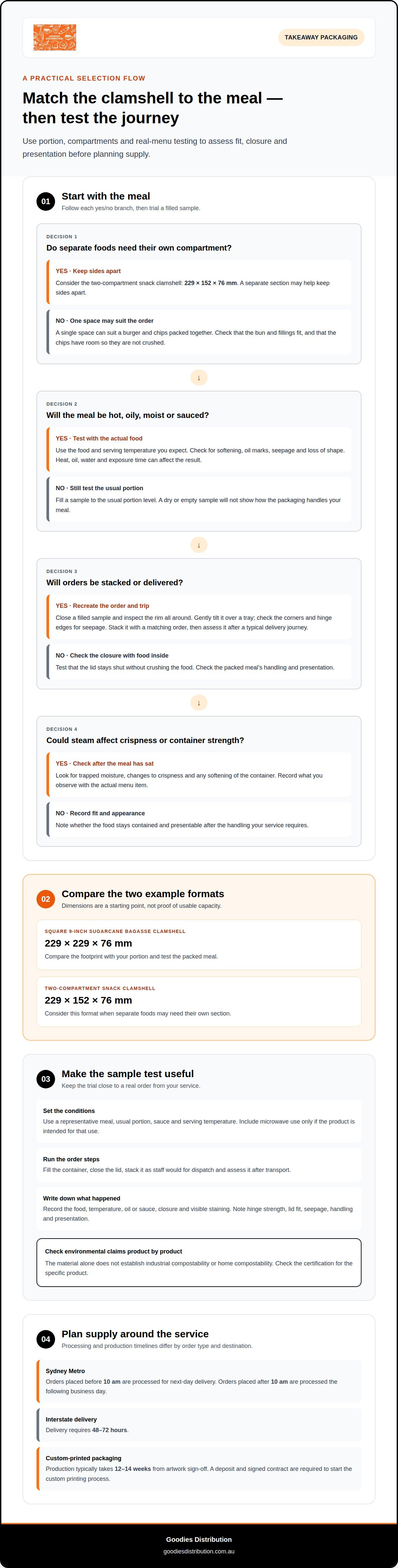
Two sugarcane bagasse formats illustrate how dimensions and compartments can suit different restaurant portions. A square 9-inch clamshell measures 229 × 229 × 76 mm; the related two-compartment snack clamshell measures 229 × 152 × 76 mm.
Measurements offer a useful starting point, but they do not establish usable capacity. Compare the internal space with the actual meal: a burger needs room for its bun and fillings, while a side dish needs enough area to avoid crushing. The molded shape and compartment layout also affect how hot food sits inside.
Australian wholesale reviews can help assess supplier reliability when they describe practical details, such as order consistency, communication and delivery handling. Look for feedback relevant to your operation, then consider whether the supplier provides clear product specifications and dependable supply processes.
For a restaurant menu, map each portion to a format before choosing a carton. A larger square footprint may suit a full meal, while a narrower snack format can separate foods in two compartments. Compare the intended portion, food shape and stacking needs, then test the fit with a representative serving.
Choose sugarcane bagasse packaging for the menu item it can hold and present well, rather than relying on size labels alone. A sample helps staff check portion fit and service handling before ordering. That practical comparison can guide a suitable choice for takeaway meals and catering.
Explore bagasse container options to compare formats for your menu.
Goodies Distribution: Bagasse containers, trays and bowls
Goodies Distribution offers bagasse containers, trays and bowls for food-service businesses choosing practical packaging for takeaway and catering. These formats can support different menu and serving needs, from a meal packed for one customer to food arranged for sharing. Bagasse bowls in the range are certified compostable; use product-specific certification information when communicating environmental claims.
Start with how your team serves each dish. A clamshell can suit a packed meal, a tray may work for catering presentation, and a bowl may suit foods served together. Consider portion shape, how the order will be carried and where packaging needs to stack in your kitchen. Matching formats to service helps keep packing routines clear and supports a consistent customer experience.
For a packaging brief that needs more than a standard format, Goodies Distribution offers custom branding and designed packaging. Share the intended menu use, serving context and operational requirements so the packaging can reflect both food presentation and day-to-day handling. Clear requirements help shape a solution around your business needs, without assuming every format suits every menu.
Custom Branding Services can bring your venue’s visual identity to its packaging. A considered design makes each takeaway order part of the customer experience, from the first look at the pack to carrying it away. Goodies Distribution can help bring your chosen formats and brand presentation together through custom packaging.
Choose packaging claims carefully: compostability depends on the specific product and its certification, not the material name alone. For packaging that combines menu fit, presentation and tailored branding, contact Goodies Distribution to discuss your requirements.
Plan packaging that grows with your menu
Packaging choices shape more than the handover at the counter. As your menu or service model changes, consider how each format works across preparation, presentation and the customer’s journey. A consistent visual identity can connect dine-in, takeaway and catering orders while keeping practical needs in view.
For Sydney food-service businesses considering bagasse clamshell containers wholesale, start by planning around real menu use and brand priorities. Goodies Distribution supplies takeaway containers and offers Custom Branding Services, helping businesses consider packaging formats alongside their visual identity. Choose each item for a clear role, then bring the look together through thoughtful branding.
Start a conversation when you’re ready to discuss packaging for your operation. Contact Goodies Distribution to explore a practical next step for your food-service packaging. With a considered plan, your packaging can support efficient service and a customer experience that feels true to your brand.
Frequently Asked Questions
What is the minimum order quantity for wholesale bagasse containers?
Standard-stock orders have a four-carton minimum. Cutlery, straws and napkins count as half a carton, while bagasse containers count as full cartons. Orders require a registered account, an Australian Business Number (ABN) and prepayment. For a café trial, plan the carton mix around storage space and expected menu use rather than assuming you can order a single carton.
Why choose bagasse over plastic?
Bagasse is a sugarcane-fibre option for food packaging. Choose a format that suits your food, and substantiate any compostability claim with certification for that exact product. The material name alone does not establish compostability. Consider product certification and appropriate disposal options alongside practical needs such as portion fit and how the container handles your menu during service.
Where can I find bagasse clamshell containers wholesale in Australia?
For bagasse clamshell containers wholesale in Australia, Sydney food-service businesses can source packaging through Goodies Distribution. The range includes takeaway containers and bagasse containers, trays and bowls, with custom branding also available. To plan an order, match the format to your menu and storage needs, then order through a registered account using an Australian Business Number.
What should I know about wholesale bagasse clamshell container prices per carton in Australia?
Wholesale purchasing is carton-based, with a four-carton minimum for standard stock. For procurement planning, compare the exact clamshell format and carton quantity with your menu volumes, storage capacity and ordering schedule. Custom-printed packaging has product-specific minimums, so plan it separately from stocked items. This keeps carton requirements clear when organising supply for your food-service operation.
What bagasse clamshell container sizes and capacities are available in Australia?
Clamshell formats differ in footprint and compartment layout, but external dimensions alone do not indicate usable food capacity. During a kitchen trial, compare the internal space with a real portion, including the height of stacked fillings or sides. Consider whether the compartments suit the meal, and assess the filled container in your service workflow rather than estimating capacity from outside measurements.
What are the minimum order quantities and bulk discounts for bagasse clamshells in Australia?
The standard-stock minimum is four cartons; cutlery, straws and napkins count as half a carton. Custom-print minimums vary by product, so plan those orders separately. Base bulk purchasing on the carton quantities and product requirements that apply to your order, rather than assuming a discount. Factor storage space and expected usage into your quantities.