


A plate labelled compostable may still be the wrong choice for your menu, service style or local disposal options. If you’re comparing compostable plates wholesale australia suppliers, look beyond the label. The material, portion size and performance with hot, wet or heavy foods all matter.
It’s understandable to want packaging that supports your environmental goals without compromising food presentation or the customer experience. Compostability claims also need checking against the exact product’s certification and disposal instructions. A compostable item isn’t automatically accepted in every collection system. Start with practical fit and verified end-of-life information.
This guide compares common plate materials and the service details to check before choosing a wholesale option for your Australian food business. You’ll also learn what to verify about certifications such as AS 4736 and AS 5810, and why local disposal access matters. Goodies Distribution is a wholesale packaging partner with a Sydney-local warehouse, and its directors bring a combined 40-plus years of hospitality experience. Compostable plates aren’t confirmed in its current range, so ask about availability or suitable bagasse packaging alternatives.
Key Takeaways
- Check the exact product details before choosing a plate. Material names alone don’t confirm performance or compostability.
- Match the plate format to your menu and service conditions, including heat, moisture, oil and how long food will sit before serving.
- Before choosing compostable plates wholesale australia options, verify the product’s certification, seedling logos and disposal instructions.
- Use a buying checklist to clarify menu needs, carton storage, ordering cadence and a practical disposal pathway.
- Ask Goodies Distribution to confirm plate availability or discuss suitable bagasse packaging alternatives for your food business.
Compostable Plates Wholesale Australia: What Food Businesses Need to Assess
A wholesale plate needs to keep pace with service, present food well and suit the disposal options available after use. For cafés, caterers and takeaway venues comparing compostable plates wholesale australia, that means weighing practical performance against what the environmental claim actually supports. A plate labelled “compostable” may not suit every dish or be accepted by every composting collection.
What does compostable mean for a wholesale plate buyer?
Buyer’s definition: A compostable plate is designed to break down under specified composting conditions, as set out in the product’s supporting evidence or certification. The claim alone doesn’t confirm those conditions, the timeframe or the disposal route for that particular plate.
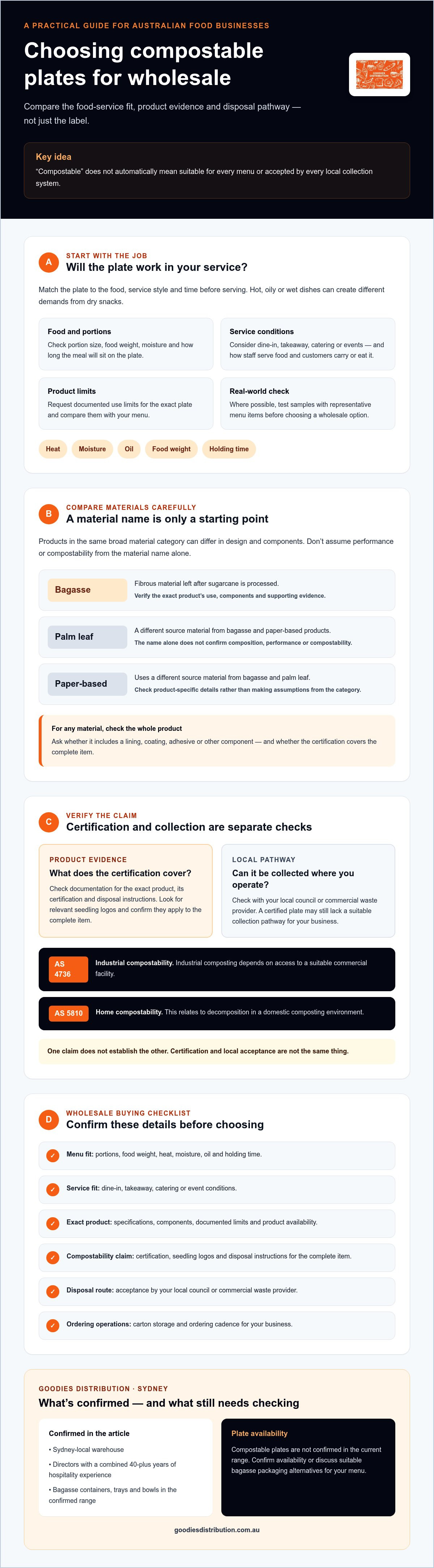
Check documentation for the exact product rather than relying on a supplier’s broad category description. In Australia, AS 4736 relates to industrial compostability, while AS 5810 relates to home compostability. Industrial composting depends on access to a suitable commercial facility; home compostability relates to decomposition in a domestic composting environment. One claim doesn’t establish the other. A general overview of biodegradable plastic can explain the wider material context, but it isn’t a substitute for product-specific evidence.
Check whether your local council or commercial waste provider accepts the product too. Certification and collection access are separate questions: a plate may meet a compostability standard but still have no suitable collection pathway where your business operates.
Why the plate must fit the food-service job
Start with the food and how it reaches the customer. Consider portion size, food weight, moisture and how long the meal will sit on the plate. Hot, oily or wet dishes can create different demands from dry snacks, so ask for documented product limits and compare them with your menu. Don’t assume a plate that works for quick counter service will also suit a catered meal or event.
Service style matters as well. Dine-in presentation may call for a different format from takeaway, while catering and events can involve longer holding times or busy serving conditions. Check the plate’s size and shape against your portions, how staff plate food at speed, and how customers carry or eat it. Where possible, test samples with representative menu items before choosing a wholesale option.
A plate affects the customer experience as well as the service workflow. The right choice should support appealing presentation and feel practical to use, while clear disposal instructions give staff and customers a next step. Before ordering, confirm availability and evidence for the exact plate. Goodies Distribution’s confirmed range includes bagasse containers, trays and bowls. Ask about plate availability or suitable alternatives rather than assuming plates are stocked.
Bagasse, Palm Leaf and Other Compostable Plate Materials Explained
Material names can help narrow the options, but they don’t establish how a particular plate will perform or what will happen to it after use. When comparing compostable plates wholesale australia, treat each material as a starting point for questions. Then check the exact product’s specifications, certification and disposal instructions.
How bagasse differs from palm leaf and paper-based options
Bagasse is the fibrous material left after sugarcane is processed. Palm leaf and paper-based products use different source materials, but the name alone doesn’t confirm a product’s composition, coatings, performance or compostability. Products in the same broad category can have different designs and components, so don’t rank materials without comparable specifications or independent evidence.
Ask whether the item includes a lining, coating, adhesive or other component, and whether the certification covers the complete product. APCO’s Sustainable Packaging Guidelines can also help businesses consider material choice and recovery as part of packaging decisions.
| Material category | Service considerations | Evidence to check | Disposal caveat |
|---|---|---|---|
| Bagasse | Confirm the specific product’s intended use and documented food-service limits. | Full composition, any coatings, product-specific certification and care or use instructions. | Don’t assume the item is accepted by local composting services. Check its disposal instructions and collection access. |
| Palm leaf | Check the product format and supplier guidance against your menu and service needs. | Material description, any added components, certification and supporting documents. | A natural-source description alone doesn’t confirm compostability or local acceptance. |
| Paper-based | Ask how the exact item is intended to be used, especially with wet or oily foods. | Fibre and coating details, food-use guidance and product-specific certification. | Coatings or other components may affect disposal. Follow the exact product instructions. |
Which plate format suits your menu and service?
Start by mapping the meal: how many components need space, how you want portions to look, and whether staff or customers serve the food. A round plate and a compartment format can suit different presentation needs, but don’t assume either is available in a particular material. Confirm the actual options with the supplier.
For hot, wet, oily or heavier foods, request product specifications and documented limits instead of relying on material labels. Goodies Distribution’s confirmed bagasse offering is containers, trays and bowls, not verified plates. Ask Goodies Distribution about bagasse packaging or enquire about plate availability before planning an order.
How to Compare Wholesale Compostable Plates for Real Service Conditions
A plate can look right on a product page and still be a poor fit for your kitchen. Compare options against your menu, service pace, customer experience and the disposal pathway you can actually use. For businesses searching compostable plates wholesale australia, this practical check matters as much as the material name.
What should a food business check before ordering?
Ask the supplier for documentation on the exact product, not just information about a general material category. Check details that affect service and environmental claims:
- Format: Confirm dimensions, shape and compartment layout against your portions and presentation.
- Food-use guidance: Ask for any stated food-contact or temperature guidance and the product’s documented limits.
- Composition: Check what the plate is made from, including any coating or other components.
- Certification: Verify which compostability certification applies to the exact product and what it covers.
- Other packaging: Ask whether lids, wraps or accompanying items have separate disposal instructions.
These details help you compare products fairly and avoid assuming that a certification or disposal claim for one item applies to every part of a meal’s packaging.
Will a compostable plate suit hot, wet or oily food?
Suitability depends on the product’s specifications, not its material name alone. Heat, moisture, oil and the time food sits on a plate can all affect performance. A plate used for quick service may face different demands from one holding a hot, wet meal during a longer event. Ask the supplier for documented limits that match your menu and service duration, rather than relying on a broad claim such as “suitable for food service”.
Before changing your full supply, arrange a practical trial with representative dishes and your usual serving process. Note whether the plate holds the portion as expected, how it looks at handover and whether staff can use it smoothly during service. Gather customer feedback as well. A small trial won’t guarantee every outcome, but it can reveal questions to resolve before a wider product change.
Credible compostability claims connect evidence for the exact product with a disposal pathway your business can access locally. Confirm both before ordering. A product’s certification doesn’t by itself establish that a local collection service will accept it.
A Wholesale Buying Checklist for Sydney Cafes, Caterers and Takeaway Venues
A clear enquiry helps you compare wholesale options without overlooking details that affect service, storage and disposal. Use this process when assessing compostable plates wholesale australia suppliers, and check each claim against the exact product you’re considering.
Questions to ask a wholesale packaging supplier
- Describe your menu and service. Note the dishes you’ll serve, typical portions, service pace and whether meals are eaten on-site, catered or taken away.
- Request exact product details. Ask for dimensions, format, material composition and any stated food-use or temperature guidance. Confirm current availability rather than planning around an unverified listing.
- Check certification evidence. Request documentation for the specific product and clarify what the certification covers. Ask for disposal instructions, including whether accompanying packaging components need separate handling.
- Discuss alternatives and logistics. If plates aren’t available, ask whether the supplier offers a suitable alternative. Confirm delivery coverage, dispatch arrangements and how stock availability is communicated, without assuming a particular delivery timeframe.
- Confirm the local disposal route. Check with your waste provider or relevant collection service whether it accepts the product. A compostability claim doesn’t confirm acceptance by every local service.
For Sydney operators, Goodies Distribution has a Sydney-local warehouse and offers Sydney-wide delivery. Its confirmed range includes bagasse containers, trays and bowls, but plate availability needs confirmation. Ask about current options or suitable confirmed alternatives before making plans.
How to plan plate stock for a busy venue
Start with your own usage records. Review consumption by service period and menu item, then consider busier periods and any catering or event work before estimating order quantities. This gives you a more useful planning basis than relying on a generic carton estimate.
Check where cartons will be stored and how staff will move them. Keep packaging in a suitable, dry storage area, and consider high humidity where relevant. Follow any storage guidance supplied for the product. Set a regular reorder check that balances service continuity with available space. A just-in-time inventory approach may help align replenishment with demand, but only if supplier availability and dispatch arrangements suit your operation. Confirm those details directly, and don’t assume minimum orders or lead times.
For a broader selection conversation, enquire about Goodies’ bagasse packaging options and ask whether compostable plates are currently available.
Find a Compostable Packaging Partner for Your Australian Food Business
The right wholesale choice needs to do three things: suit the food and service, be supported by evidence for the exact product, and have a practical disposal pathway for your business. Those checks matter when comparing compostable plates wholesale australia options, because a compostability claim alone doesn’t confirm service fit or local collection acceptance.
Goodies Distribution works with hospitality businesses as a wholesale packaging partner. Its directors bring a combined 40-plus years of hospitality industry experience, and its Sydney-local warehouse supports Sydney-wide delivery. Compostable plates aren’t listed among its confirmed offerings, so check availability before assuming they’re stocked.
When to enquire about plates or alternative packaging
Ask whether plates are currently available and request details for the exact product before deciding. If plates aren’t available or don’t suit your menu and service format, discuss confirmed bagasse containers, trays and bowls as possible alternatives. Compare each option against your portions, service style and the product’s documented specifications, certification and disposal instructions. A packaging partner can help clarify what to check, but your choice should rest on evidence that matches your requirements.
What to include in a wholesale enquiry
A focused enquiry makes it easier to decide whether an option is worth assessing. Include:
- Venue type: For example, café, restaurant, catering business or takeaway venue.
- Menu and portions: Describe the food you’ll serve and the presentation you’re aiming for.
- Service conditions: Explain whether meals are served dine-in, packed for takeaway or prepared for events. Note relevant heat, moisture, oil or holding-time needs.
- Packaging preferences: Share your preferred material or format, while staying open to a suitable alternative.
- Evidence and end-of-life: Request current product documentation, applicable certification details and clear disposal instructions. Check whether your local collection service accepts the item.
- Supply needs: Ask about current availability, delivery coverage and dispatch arrangements, then consider carton storage and ordering cadence for your venue.
Clear questions help you compare function, product evidence and disposal arrangements before committing to a packaging change. To discuss your requirements and ask about current plate availability or suitable confirmed alternatives, contact Goodies Distribution about wholesale packaging.
Choose Packaging That Works for Your Service
For your food business, a sound compostable packaging choice starts with fit: the plate must suit your menu and service conditions, its environmental claims must be backed by evidence for the exact product, and you need a practical disposal pathway. Comparing compostable plates wholesale australia options on those points helps you avoid relying on material names or broad claims alone.
Before ordering, confirm product specifications, relevant certification and disposal instructions, then check whether local collection can accept the item. Goodies Distribution offers quality eco-friendly items, but certification varies by product and should always be checked for the exact item. Compostable plate availability also needs confirmation. Its confirmed range includes bagasse containers, trays and bowls, which may be worth discussing if they suit your menu.
Goodies’ directors bring a combined 40-plus years of hospitality industry experience, supported by a Sydney-local warehouse and Sydney-wide delivery. Share your venue type, service needs and packaging questions to start a practical conversation.
Discuss your wholesale compostable packaging needs and take the next step towards packaging choices that suit your service and verified end-of-life options.
Frequently Asked Questions
Are compostable plates accepted in Sydney council food-waste or green-bin collections?
Not automatically. In NSW, compostable packaging is not accepted in FOGO bins under the NSW EPA restriction introduced in 2024, so don’t assume a plate can go in your food-waste or green bin. Collection rules can vary by council and waste provider, so check the current instructions for your address before disposing of a product. Follow its label and supplier guidance, and keep it out of a collection stream that doesn’t accept it.
What is the difference between home compostable and industrially compostable plates?
Home compostable plates are certified for composting in a domestic environment, while industrially compostable plates require the managed conditions of a commercial composting facility. In Australia, AS 5810 applies to home compostability and AS 4736 to industrial compostability. These are different claims, not interchangeable labels. Check the certification for the exact product, then confirm that you have access to a suitable composting pathway.
Can bagasse plates hold hot, wet or oily food?
It depends on the exact product, so the material name alone can’t confirm suitability. Ask the supplier for documented guidance on temperature, moisture, oil and how long food can sit on the item. If those details match your menu, trial it with representative dishes and your usual service process before making a wider change. Goodies Distribution’s confirmed bagasse range is containers, trays and bowls, not verified plates.
How do I check whether a compostable plate is certified?
Ask for current documentation for the exact plate, including the applicable standard and what the certification covers. In Australia, AS 4736 relates to industrial compostability and AS 5810 to home compostability. Check that the product description, certification and any seedling logos match, and request disposal instructions. A general claim or logo alone doesn’t confirm acceptance by your local council or waste provider.
How much plate capacity does my cafe or catering business need?
Estimate demand from your own service records rather than a generic allowance. Review plate use by menu item and service period, then account for expected busy periods, catering work and events. Check how many plates are used per order and whether different dishes require different formats. Before ordering, compare your estimate with carton quantities, available storage and a sensible reorder point to help maintain supply without crowding your venue.
What should I ask before placing a wholesale order for compostable plates?
For compostable plates wholesale australia, request the exact product’s dimensions, material composition, food-use guidance, certification documents and disposal instructions. Ask whether coatings or accompanying items need separate disposal, and confirm current availability, carton details, delivery arrangements and suitable alternatives. Match the product evidence to your menu and service conditions, then check whether your local collection provider accepts it before placing an order.
Does Goodies Distribution wholesale compostable plates in Sydney?
Compostable plates aren’t listed among Goodies Distribution’s confirmed offerings, so availability needs to be confirmed before planning an order. Goodies is a wholesale packaging supplier with a Sydney-local warehouse and Sydney-wide delivery. Its confirmed range includes bagasse containers, trays and bowls, which may be worth discussing if they suit your menu and service format. Ask for product-specific details and disposal guidance for any option you’re considering.