


What makes a good takeaway container? It protects the meal, suits your service and gives your brand room to stand out. For takeaway businesses seeking wholesale bagasse and paper containers in Western Sydney, the right choice balances material, function and presentation.
Packaging needs to do more than look environmentally responsible. It must work for the food you serve, fit your day-to-day operations and suit the disposal options available to your customers.
This guide explains how bagasse, paper and other plant-based options suit different takeaway needs, and what to consider when choosing containers, trays, bowls and bags. It also clarifies how industrial and home compostability certifications differ, so environmental claims match the packaging’s intended disposal conditions. You’ll see how wholesale supply and custom branding can help bring packaging choices together with a consistent customer experience.
Key Takeaways
- Match container shapes and materials to your menu, portioning and takeaway service needs.
- Understand how industrial and home compostability certifications relate to different disposal conditions.
- Choose cup styles and accessories that support practical service and a consistent customer experience.
- See how wholesale packaging and tailored branding can help bring your takeaway presentation together.
Takeaway Containers, Trays and Bowls
Choose containers for your menu and service format, then consider how their material and shape affect disposal.
Compostable, cardboard and bagasse styles
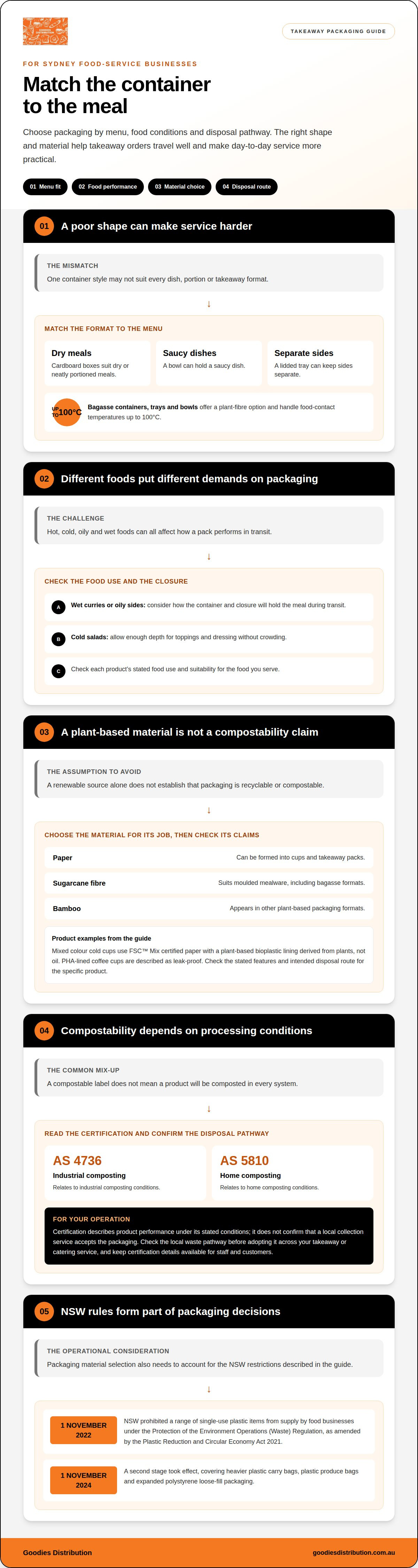
Cardboard boxes suit dry or neatly portioned meals, while bagasse containers, trays and bowls offer a plant-fibre option. Match shape and depth to the menu: a bowl can hold a saucy dish, while a lidded tray separates sides. Add cutlery where takeaway service calls for it. Bagasse handles food-contact temperatures up to 100°C.
Suitability for different foods
Hot, cold, oily and wet foods place different demands on packaging. Check the product’s stated food use and suitability for the food you serve. For wet curries or oily sides, consider how the container and closure will hold the meal during transit. Cold salads need enough depth for toppings and dressing without crowding.
NSW prohibited a range of single-use plastic items from supply by food businesses from 1 November 2022 under the Protection of the Environment Operations (Waste) Regulation, as amended by the Plastic Reduction and Circular Economy Act 2021. A second stage took effect 1 November 2024, covering heavier plastic carry bags, plastic produce bags and expanded polystyrene loose-fill packaging.
Compostable, recyclable and reusable packaging each has different purchasing and waste-handling requirements. The disposal route matters: a compostable label does not mean a product will be composted in every system. Choose products with a disposal pathway that fits your operation.
Packaging Materials and Compostability Certifications
Paper, sugarcane fibre and bamboo give Australian food-service businesses different packaging formats. Paper can be formed into cups and takeaway packs; sugarcane fibre suits moulded mealware, while bamboo appears in other plant-based formats. Choose by the job each item must do, then consider its material and disposal pathway. A renewable source alone doesn’t establish recyclability or compostability.
Plant-based bioplastic can be used as a lining for paper packaging, but claims should be checked for the specific product. Goodies Distribution’s mixed colour cold cups are made from FSC™ Mix certified paper and lined with plant-based bioplastic derived from plants, not oil. Its PHA-lined coffee cups are described as leak-proof. Consider the product’s stated features and intended disposal route rather than assuming every plant-based material is compostable.
Certification helps distinguish industrial compostability from home compostability. AS 4736 relates to industrial composting, while AS 5810 relates to home composting; the relevant label clarifies the intended processing conditions. Certification describes product performance under those conditions, not whether a local collection service accepts it. Keep certification details with product information to support clear staff and customer guidance.
A wholesale supplier can provide product certification information and explain its intended disposal pathway. This gives your business a basis for discussing whether local waste services accept the packaging before adopting it across takeaway or catering operations.
BioPak Compostable Cups and Accessories
For cafés and takeaway counters, choose cups around the drinks you serve and how customers carry them. Our range of compostable cups includes single-wall options for everyday service and double-wall formats for hot drinks. Special printed artwork series add vibrant presentation to cup displays, helping your packaging feel considered at the counter. These paper cups are FSC-certified, and the cups feature AS4736 industrial compostability certification through Goodies Distribution.
Keep the serving setup practical. Pair each cup with a compatible lid, then consider whether the drink needs a sipping opening or a straw. A flat straw-hole lid and a dome lid serve different drink styles, so align the lid shape with the beverage and cup size. Stirrers complete the setup for drinks that need mixing. Matching accessories across service formats can also help staff prepare takeaway orders consistently across Western Sydney.
Certification and material claims should relate to the specific cup, not simply the brand or artwork. The AS4736 certification relates to industrial composting, so it doesn't mean a cup belongs in a home compost system. Clear disposal information helps customers understand the intended pathway. For a business, the choice comes down to serving needs, cup presentation and the waste system available to receive the used packaging. Consider how the cup, lid and stirrer work together before standardising a setup across your café or takeaway service with wholesale eco friendly containers Western Sydney.
Carry Bags for Takeaway Businesses
A carry bag is the final part of a takeaway order’s packaging, so it needs to suit the containers inside. Paper bags offer a practical option for cafés, restaurants and takeaway venues. Choose a format around the meal: a compact bag may suit a single order, while a larger format can accommodate several packed containers. Consider how handles, bag opening and base shape affect staff packing and customer carrying.
Match the bag to your service routine and brand presentation. A well-sized bag can help keep containers upright and give customers a convenient way to carry an order. Consider which meals, cups and accessories commonly leave the counter together. Custom branding can connect your paper bags with the experience customers associate with your business.
NSW’s lightweight plastic carry bag ban applies to bags under 35 microns. NSW’s second stage of plastics bans took effect on 1 November 2024 and covered heavier plastic carry bags, plastic produce bags and expanded polystyrene loose-fill packaging. These rules make material selection a practical part of takeaway operations, not just a presentation choice. For Western Sydney businesses, selecting paper bags alongside suitable takeaway containers can help create a consistent pack-out. Consider bag size, order contents and customer carrying needs together, so staff can pack meals neatly and customers can transport them with ease.
Wholesale Supply and Bespoke Branding
Wholesale supply helps food-service businesses coordinate packaging formats, replenishment and brand presentation. For restaurants seeking wholesale containers made from specified materials in Western Sydney, it also brings product selection and supply planning into one decision.
Compostable, recyclable and reusable suppliers
Western Sydney businesses can source takeaway containers from wholesale suppliers offering compostable, recyclable or reusable options. For venues in Parramatta, Penrith, Blacktown, Liverpool and nearby suburbs, look for distributors with Sydney delivery coverage. Compare each material’s verified claims and intended disposal route; “biodegradable” alone doesn’t establish compostability. Matching packaging with available waste processing helps make an environmental choice more practical.
Choosing sizes, lids and quantities
A wholesale supplier can help match container capacity and shape to menu portions, then pair each format with a compatible lid. A shallow tray may suit meals with separate sides, while a deeper container can hold a saucy dish. Discuss your menu mix and service pattern to support packing, transport and storage.
Plan wholesale quantities around the packaging your business uses regularly, including takeaway containers, lids and bags. For businesses sourcing wholesale containers made from specified materials in Western Sydney, custom branding can also connect packaging with the customer experience. Share your artwork and packaging priorities with Goodies Distribution to start a design discussion, while keeping each format suited to its role.
Goodies Distribution
Goodies Distribution supplies Western Sydney cafés, restaurants and takeaway businesses with food-service packaging. Its range includes Takeaway Containers, Paper Bags, cutlery and bagasse containers, trays and bowls. Sydney-based supply supports local businesses planning wholesale packaging orders. Consider these options together so containers, bags and serving accessories fit the way your venue prepares and hands over orders.
Start with your menu and service pattern. A venue packing meals for delivery may prioritise containers suited to its portions and order format, while a café may also need bags for takeaway items. Bringing these requirements into one packaging plan keeps selection grounded in your workflow, not appearance alone.
Custom Branding Services can help connect packaging with your brand presentation. Goodies Distribution provides in-house custom branding, allowing artwork and packaging choices to be considered together. A clear brief about your visual identity and intended packaging use gives the design process a practical starting point. This can help create a consistent look across the items customers receive, while keeping the role of each package in focus.
If you’re reviewing your packaging or planning a brand refresh, discuss your menu, service needs and design priorities with Contact Goodies Distribution. A focused conversation can help you identify which packaging categories best fit your business and customer handover.
Frequently Asked Questions
Looking for Sustainable Food Packaging Solutions?
Map the items your business uses to the disposal pathway available to customers and staff. Keep product certification details accessible, and make disposal instructions clear at the point of service. This helps avoid treating compostable packaging as suitable for every bin or compost system and keeps environmental claims specific to each product.
Where can businesses buy wholesale bagasse and certified paper food containers in Western Sydney?
Businesses in Western Sydney can buy wholesale packaging from Goodies Distribution. Orders are placed through a registered account, and customers need an Australian Business Number (ABN). Purchases are prepaid. These requirements help commercial buyers plan account setup and payment before placing an order, whether they’re establishing a new packaging supply arrangement or organising stock for an existing food-service operation.
What container materials are available, such as bagasse, kraft paper, cardboard, and PLA?
Alongside bagasse, kraft paper and cardboard formats, specific product choices include FSC™ Mix certified paper cold cups lined with plant-based bioplastic. PHA-lined coffee cups are described as leak-proof and fossil-free. BioBoard Sushi Trays use FSC™ certified paper with an aqueous water-dispersion coating on both sides. These examples show why material and construction claims should be considered product by product.
What are the minimum order quantities for bagasse and paper containers in Western Sydney?
The minimum order for standard stock is four cartons. Cutlery, straws and napkins count as half a carton towards that minimum, so a business can combine packaging categories when planning an order. Products are sold by the carton, and custom-print minimum quantities vary by product. The order quantity depends on the formats your business needs.