

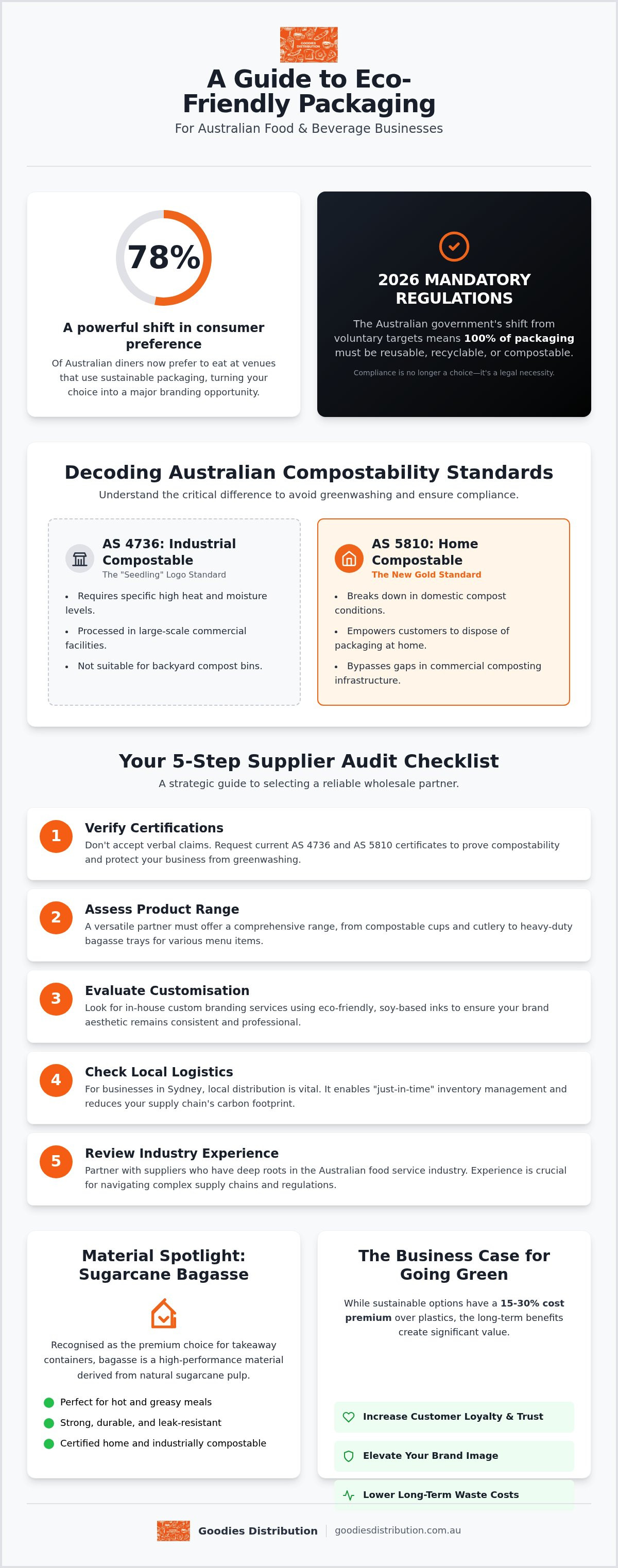
Did you know that 78% of Australian diners now prefer to eat at venues that use sustainable packaging? It's a powerful shift in consumer behaviour that turns your choice of takeaway containers into a major branding opportunity. Finding the right eco friendly food packaging suppliers isn't just about ticking a box for the planet; it's about building lasting trust with a community that values integrity and quality.
We understand the frustration of trying to spot genuine innovation amidst a sea of greenwashing and confusing technical jargon. You want packaging that reflects your commitment to the environment without the fear of containers leaking or becoming soggy during a busy delivery run. As 2026 brings stricter mandatory regulations across every Australian state, the need for reliable, certified solutions has never been more urgent for your bottom line.
This guide offers a comprehensive checklist to help you vet wholesale partners and understand the critical differences between home and industrial compostability. We will explore how to choose high-performance materials like bagasse and BioPak to ensure your business stays compliant, professional, and ahead of the curve. From navigating the latest South Australian labelling mandates to securing a reliable partner in Sydney, you'll find the clarity needed to make a positive impact.
Key Takeaways
- Understand the 2026 shift from voluntary targets to mandatory packaging regulations and how to navigate the evolving single-use plastic bans across Australian states.
- Learn how to rigorously verify essential certifications like AS 4736 and AS 5810 to ensure your business is protected from the risks of greenwashing.
- Discover why sugarcane bagasse is the premium choice for hot or greasy meals and how to match specific compostable materials to your menu's requirements.
- Identify the qualities of reliable eco friendly food packaging suppliers in Sydney to secure a local partnership that supports just-in-time inventory and custom branding.
- Master the design constraints of customising compostable surfaces with soy-based inks to elevate your brand image and build deeper customer loyalty.
Navigating the Australian Eco-Friendly Packaging Landscape
In 2026, the Australian government transitioned from voluntary industry pledges to an enforced regulatory framework. This landmark shift means 100% of packaging must now be reusable, recyclable, or compostable. Choosing reliable eco friendly food packaging suppliers is no longer just a moral choice; it is a legal necessity to meet the mandatory National Packaging Targets. For local business owners, this regulatory environment provides a clear roadmap toward a more sustainable future.
For years, "biodegradable" was the industry buzzword. Today, it's often viewed with suspicion. Without specific certifications, the term "biodegradable" can simply describe plastic that breaks into smaller, harmful microplastics. Moving toward certified compostable materials ensures your takeaway containers actually return to the earth. Australians are savvy diners. Research indicates that 78% of local consumers prefer restaurants that use Sustainable packaging. This preference is a fundamental shift in how people choose where to spend their money, turning your choice of disposables into a powerful brand asset.
Understanding Australian Standards AS4736 and AS5810
Industrial composting certification (AS4736) requires specific heat and moisture levels found in commercial facilities. While this is a step forward, AS5810 (Home Compostable) is the new gold standard for Sydney takeaway businesses. It allows your customers to dispose of their packaging in their own backyard bins, bypassing infrastructure gaps. From 1 March 2026, South Australian laws require these certifications to be clearly labelled on every individual container. When vetting eco friendly food packaging suppliers, always look for the "seedling" or "home compostable" logos on your wholesale supplies to verify compliance and protect your business from greenwashing claims.
The Business Case for Sustainable Disposables
Investing in high-quality disposables like bagasse trays or BioPak cups reduces your brand's carbon footprint while increasing customer loyalty. While eco-friendly options typically carry a 15-30% cost premium over conventional plastics, they often lead to lower long-term waste management costs. When you make the switch, tell your story. Use your social media or in-store signage to explain why you've chosen home-compostable products or biodegradable cutlery. It turns a functional item into a conversation about shared values, helping your café or deli stand out in a competitive market. We see this transition as a partnership between your commercial success and the health of our local environment.
The Ultimate Supplier Audit: A 5-Step Checklist
Selecting a wholesale partner is a strategic decision that goes well beyond comparing price lists. It requires a thorough investigation into the operational DNA of your potential partner to ensure they can meet the rigorous demands of the 2026 regulatory landscape. To help you navigate this, we've developed a precise audit process designed to align your business with the Australian Sustainable Packaging Guidelines.
- Verify Certification: Don't settle for verbal promises. Ask your eco friendly food packaging suppliers for current AS4736 or AS5810 certificates to prove their products are truly compostable.
- Assess Product Breadth: A versatile partner should offer a comprehensive range. This includes everything from BioPak compostable cups to heavy-duty bagasse trays and bowls.
- Evaluate Customisation: Look for in-house custom branding services. This ensures your brand aesthetic remains consistent across all sustainable materials.
- Check Local Logistics: For businesses in Sydney, local distribution is vital for maintaining "just-in-time" inventory and reducing your overall carbon footprint.
- Review Industry Experience: Seek out partners with deep roots in the Australian food service industry. Experience counts when you're navigating complex supply chains.
Vetting the Supplier’s Environmental Integrity
When reviewing technical data sheets (TDS) for compostable liners or containers, pay close attention to the fine print. Genuine environmental integrity means avoiding suppliers who still use misleading terms like "oxo-degradable," which typically describes banned plastic additives. Instead, look for partnerships that prioritise carbon-neutral manufacturing or hold B Corp status. This level of transparency confirms that your wholesale partner is truly committed to a circular economy and isn't just following a trend.
Operational Reliability and Wholesale Support
Operational success depends on how well a supplier integrates with your daily workflow. For many small Sydney businesses, high minimum order quantities (MOQs) can create storage headaches. Ask how they handle smaller, frequent deliveries versus large-scale wholesale orders to keep your space organised. A dedicated account manager is also essential when you're managing complex custom branding projects. They act as a knowledgeable guide, ensuring your vision for bespoke, sustainable packaging is realised without technical hiccups. This level of support allows your business to scale confidently as consumer demand for greener solutions continues to grow.
Material Selection: Matching Food Types to Sustainable Solutions
Selecting the right material is where the practical success of your business meets your environmental goals. It's about matching the physical properties of the packaging to the unique needs of your menu. To align with the Sustainable Packaging Guidelines (SPGs), you need to look beyond the surface level. Finding the right eco friendly food packaging suppliers means looking for a partner who understands these material nuances, ensuring your fish and chips stay crisp and your lattes stay hot.
Modern sustainable materials have evolved to handle almost any culinary challenge. Bagasse, made from sugarcane pulp, is a miracle for hot, greasy, or saucy meals. It breathes naturally, which prevents steam from turning a burger bun into a sponge. For cold items like salads or smoothies where visibility is key, PLA (Polylactic Acid) offers a plant-based plastic alternative that's clear and sturdy. Meanwhile, FSC-certified paper remains the go-to for dry goods and double-wall coffee cups. The most exciting innovation in 2026 is the rise of aqueous coatings, a water-based lining that makes paper cups completely home compostable without the need for traditional plastic films.
Hot Food and Delivery Performance
Bagasse containers, trays & bowls are significantly more durable than traditional paper. They don't lose structural integrity when hit with steam or oil, making them the gold standard for Australian takeaway. Preventing "soggy bottom" syndrome isn't just about food quality; it's about protecting your brand's reputation in the high-stakes world of home delivery. Because bagasse has natural insulating properties, it retains heat better than recycled cardboard. This ensures your customers enjoy their meal at the intended temperature, even after a twenty-minute scooter ride through Sydney traffic.
Beverage Service and Lid Compatibility
Whether you're serving a standard 8oz flat white or a large 12oz takeaway latte, BioPak compostable cups provide the premium feel your customers expect. The drinking experience is often defined by the lid, and the necessity of a spill-proof fit can't be overstated. You'll need to choose between PLA lids or the newer aqueous-lined options to ensure a secure seal. While PLA offers a smooth, familiar feel, aqueous coatings provide a natural texture that many modern diners find more authentic. Your choice of material affects the drinking experience just as much as the roast of your beans, so it's worth testing how different textures feel to your customers.
Custom Branding: Personalising Your Sustainable Packaging
In a city as competitive as Sydney, every takeaway bag walking down the street serves as a powerful touchpoint for your business. Custom branding transforms functional items into sophisticated marketing tools that tell your story to every passerby. When you partner with established eco friendly food packaging suppliers, you gain access to printing techniques specifically designed for plant-based materials. This isn't just about sticking a logo on a box; it's about creating a cohesive visual identity that resonates with an audience that values authenticity. Strategic logo placement on coffee cups, paper bags, and even greaseproof paper turns a simple bowl into a mobile billboard for your brand.
Working with compostable surfaces requires a thoughtful approach to design and chemistry. Unlike traditional plastics, these natural materials are often more porous and require soy-based or water-based inks to maintain their environmental integrity. These inks ensure that your final product remains fully compostable while delivering the professional, high-quality results your customers expect. It's a delicate balance between commercial aesthetics and ecological responsibility; a balance that defines modern Australian hospitality.
Maximising Brand Impact on Eco-Materials
Bagasse has a beautiful, organic texture that lends itself perfectly to minimalist design. Using clean lines and bold logo placements allows the natural origin of the material to shine through, which reinforces your commitment to sustainability. For delis and bakeries, custom greaseproof paper is an underutilised asset that adds a touch of bespoke quality to every sandwich or pastry. This attention to detail builds deeper customer loyalty by showing that your brand values extend to every layer of the dining experience. You can explore more strategies for this in our guide on Custom Branded Packaging: Growing Your Sydney Brand.
The Custom Design Process
The journey from an initial concept to a finished wholesale order typically takes several weeks to ensure the highest quality. Choosing the right eco friendly food packaging suppliers ensures that your custom designs are executed with technical precision on challenging surfaces. It's important to understand that sustainable printing involves specific colour limitations and one-off plate costs that differ from digital or plastic printing. In-house design expertise is vital for brand consistency because it ensures your artwork is technically optimised for the unique absorption rates of compostable fibres. Once these technical hurdles are managed, your custom order can be scaled to meet your growing business needs.
Ready to elevate your presentation? Contact us today to learn how our custom branding services can help your Sydney business stand out.
Logistics and Local Partnership: The Sydney Advantage
Efficiency in the hospitality sector often comes down to the speed and reliability of your supply chain. When you work with local eco friendly food packaging suppliers, you're not just buying boxes; you're securing a vital lifeline for your daily operations. Sydney's fast-paced dining scene requires a "just-in-time" inventory approach to keep kitchens running smoothly without cluttering valuable floor space with excessive stock. Sourcing from an Australian-owned and operated partner also significantly reduces "food miles," ensuring your sustainability claims extend from the material of the bowl to the carbon footprint of its delivery journey.
A local partnership offers the agility needed for troubleshooting and rapid re-orders during unexpected busy periods. If you run out of biodegradable cutlery on a Friday afternoon, a Sydney-based warehouse is far more capable of saving your weekend service than a distant interstate distributor. This proximity creates a sense of security, allowing you to focus on your food while we handle the complexities of your disposables. It's a collaborative way of doing business that prioritises your practical success alongside the health of our local environment.
Inventory Management for Busy Eateries
Calculating your weekly usage for 8oz versus 12oz cups is a foundational step in maintaining a lean and profitable business. While it's tempting to over-order to avoid shortages, compostable stocks require careful management to prevent environmental degradation before they even reach the customer. Plant-based materials like PLA are sensitive to high humidity and temperature fluctuations, which can affect the fit of lids or the structural integrity of the containers. Storing wholesale paper cups in tight café spaces requires a methodical approach. We recommend using vertical shelving and keeping stock in a cool, dry area away from steam-heavy equipment like dishwashers. For a deeper dive into selecting the right volumes, see our guide on Wholesale Coffee Cup Sizes Australia: A Guide to Choosing 200ml vs 250ml.
Choosing Goodies Distribution as Your Sydney Partner
We believe that a true wholesale relationship is built on reliability and shared expertise. With over 40 years of industry experience, our directors understand the unique pressures of the Sydney market and the specific needs of local food businesses. We provide direct access to the full BioPak range, combined with local expertise that helps you navigate the 2026 regulatory changes with confidence. Whether you need a bespoke packaging audit or a reliable supply of bagasse trays, our team is here to act as your visionary mentor. Start your transition today by reviewing our Eco-Friendly Packaging: 2026 Australian Wholesale Guide. Our Sydney-based team is ready to help you find better solutions for your brand and the planet.
Future-Proofing Your Business for a Sustainable Australia
The shift toward mandatory packaging targets in 2026 marks a defining moment for the Australian hospitality industry. By prioritising certified compostable materials like bagasse and BioPak, your business does more than just meet legal requirements; it builds a brand founded on integrity and modern values. Choosing the right eco friendly food packaging suppliers is about finding a partner who understands the technical nuances of AS5810 standards and the logistical demands of a busy Sydney kitchen.
As a Sydney-owned and operated specialist with over 40 years of industry experience, we are proud to be an official BioPak wholesale partner. We invite you to request a wholesale quote for your Sydney business today to begin your transition toward a waste-free future. Our team is ready to provide the commercial-grade solutions and custom branding expertise needed to elevate your menu while protecting our local environment. It's a journey we're excited to take together, ensuring your business thrives in a greener, more sustainable world.
Frequently Asked Questions
What is the difference between compostable and biodegradable packaging?
Compostable packaging is designed to break down within a specific timeframe under certain conditions, leaving behind nutrient-rich organic matter. In contrast, "biodegradable" is a broad term that lacks strict timeframes or safety standards, often leading to products that simply fragment into microplastics. When evaluating eco friendly food packaging suppliers, always prioritise certified compostable options to ensure your disposables truly return to the earth without harming the local Sydney ecosystem.
Are BioPak products home compostable or industrially compostable?
BioPak offers a diverse range that includes both home and industrially compostable items. Most of their bagasse containers, trays, and bowls are certified for home composting under AS5810, meaning they break down in backyard bins. However, some items like PLA-lined coffee cups require the higher temperatures of industrial facilities (AS4736). We help our Sydney clients distinguish between these labels to ensure their customers receive clear disposal instructions that match local infrastructure.
Can I custom brand my compostable takeaway containers?
Yes, you can certainly personalise your sustainable disposables through our professional custom branding services. We work with soy-based and water-based inks that maintain the compostability of the underlying materials like bagasse or FSC-certified paper. This process allows your Sydney café or restaurant to turn every takeaway order into a mobile billboard, building brand loyalty while showcasing your commitment to the environment without compromising on aesthetic quality or professional finish.
What are the current plastic bans in NSW for 2026?
By 2026, New South Wales has fully enacted bans on single-use plastic straws, stirrers, cutlery, and expanded polystyrene food service items. Additionally, the National Packaging Targets are now mandatory, requiring all packaging to be 100% reusable, recyclable, or compostable. These regulations mean Sydney businesses must transition away from traditional plastics to avoid compliance issues. We stay updated on these legislative shifts to ensure our wholesale partners remain ahead of every regulatory change.
Is bagasse better than paper for hot food delivery?
Bagasse is generally superior to paper for hot, greasy, or saucy meals because it offers higher structural integrity and natural breathability. While paper can become soggy as steam accumulates, bagasse containers, trays, and bowls allow moisture to escape slightly, keeping food crisp and hot. This makes it the ideal choice for Sydney delivery runs where maintaining food quality over a twenty-minute journey is essential for customer satisfaction and your brand's reputation.
How much does custom branded eco-packaging cost compared to plain?
Custom branded eco-packaging typically involves a higher initial investment than plain stock due to plate costs and specialised printing processes. However, many Sydney businesses find that the marketing value and increased customer loyalty provide a significant return on this investment. Costs vary based on order volume and design complexity. We recommend discussing your specific needs with our team to find a solution that balances your marketing goals with your commercial budget.
Do you offer free delivery for wholesale orders in Sydney?
We provide efficient local distribution throughout the Sydney metropolitan area to support your "just-in-time" inventory needs. Delivery terms for wholesale orders can vary based on your location and the size of your order. Our Sydney-based team focuses on providing reliable, rapid re-orders to ensure your café or restaurant never runs short. Contact us directly to discuss the most cost-effective shipping options for your specific business requirements and delivery schedule.
What certifications should I look for in an eco-friendly supplier?
When vetting eco friendly food packaging suppliers, you should look for the Australian Standards AS4736 for industrial compostability and AS5810 for home compostability. These certifications are the only way to verify that a product has been rigorously tested and proven to break down safely in Australian conditions. Look for the "seedling" or "home compostable" logos on technical data sheets to ensure your Sydney business meets the latest 2026 environmental regulations and consumer expectations.