

Custom takeaway boxes in Australia can carry your colours, logo and message beyond the counter, helping food businesses build brand recognition. For Sydney cafés, restaurants and takeaway operators, the right packaging also protects food and makes orders easier to carry. Choose a format and material to suit the food, how it will be packed and how customers will use it.
Distinctive packaging should work smoothly behind the counter as well as look good. This guide covers how to plan a design that reflects your brand, choose materials with performance and environmental considerations in mind, and understand the factors that affect production, delivery and order quantities. It also explains how custom branding can fit into the process.
Key Takeaways
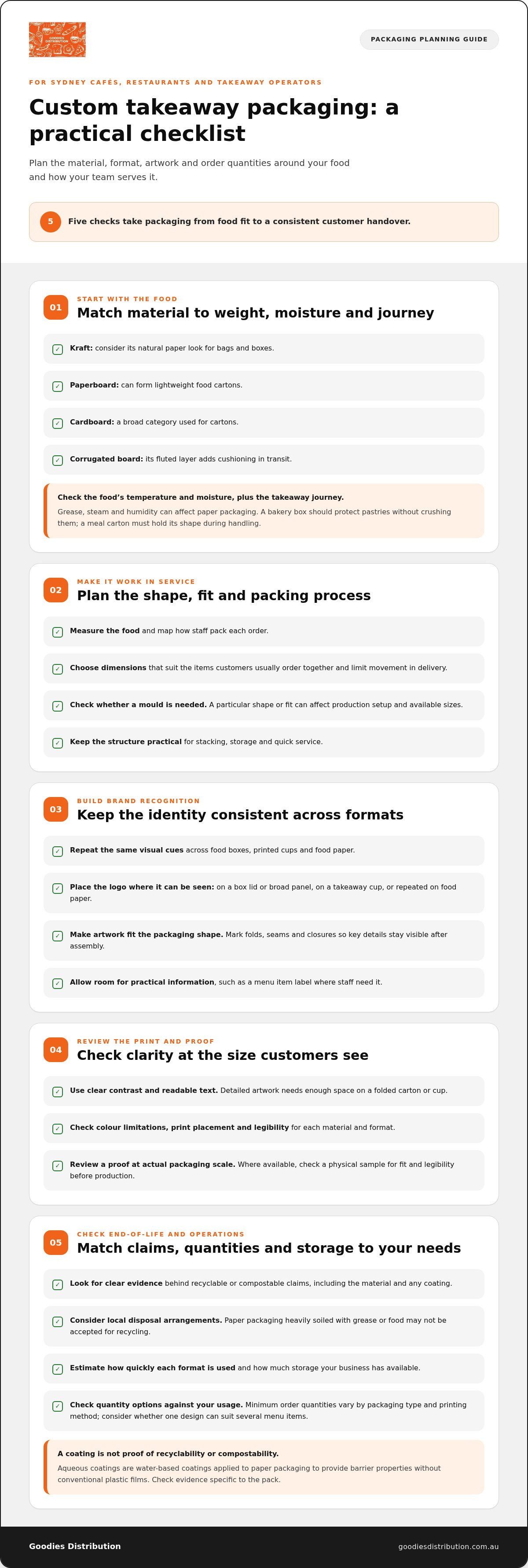
- Match kraft, cardboard, corrugated board or paperboard to the food’s weight, moisture and takeaway journey.
- Use consistent branding across food boxes, printed cups and food paper to make each customer handover more recognisable.
- Prepare artwork around your packaging dimensions and food-service needs, then consider how design, production and delivery fit your schedule.
- Order quantities depend on the packaging format and print requirements, so align them with expected use and available storage.
- Custom branding services and practical packaging choices can help create a more cohesive takeaway experience.
Where can I buy custom food packaging in Australia?
Australian hospitality businesses can source custom food packaging from wholesale suppliers serving cafés, restaurants, takeaway venues and food manufacturers. Compare how materials suit your menu, the print quality, evidence behind sustainability claims, minimum quantities and delivery arrangements.
Food Packaging Materials
Kraft, cardboard, corrugated board and paperboard suit different packaging needs. Kraft offers a natural paper look for bags and boxes, while paperboard can form lightweight food cartons. Cardboard is a broad category used for cartons, and corrugated board adds a fluted layer for cushioning in transit. Match the material to the food’s weight, moisture and journey.
A bakery box needs to protect pastries without crushing them, while a meal carton must hold its shape during takeaway handling. Grease, steam and humidity can affect paper packaging, so consider the food’s temperature and moisture before choosing a format. A well-fitted box can also limit movement during delivery.
Custom Designs and Packaging Moulds
Custom packaging brings together the box shape, dimensions and printed artwork. Start by measuring the food and mapping how staff pack orders. A mould may be needed for a particular shape or fit, and its design can affect production setup and the sizes available. Keep the structure practical for stacking, storage and quick service.
Prepare artwork to fit the finished packaging. Place your logo and key brand colours where customers can see them, and keep folds and closures clear. Check that the box still opens easily when graphics cover its panels. Where available, review a physical sample or proof for fit and legibility before production.
Supplier Price, Print and Sustainability Comparisons
Compare suppliers using the same box size, material, print coverage and order quantity. Custom food packaging costs depend on the product, size, quantity and print coverage, so compare equivalent specifications. Review colour consistency, text clarity and artwork placement across the box. These details show how the packaging will look at the counter and in customers’ hands.
For sustainability, consider the material and any coating, and look for clear evidence behind recyclable or compostable claims. Paper packaging heavily soiled with grease or food may not be accepted for recycling. Disposal options depend on local arrangements, so Sydney businesses should consider how customers can dispose of the packaging after use.
Custom Printed Box Costs
There is no single standard cost for custom printed takeaway boxes in Australia. Price depends on the product, size, quantity and print coverage, so compare like-for-like specifications rather than headline quotes. A larger order can change the per-unit calculation, and a bespoke shape may need a different setup from a standard box.
Minimum order quantities vary by packaging type and printing method. Before ordering, estimate how quickly your business uses each format, how much storage it has and whether one design can suit several menu items. Compare those needs with the available quantity options to avoid storing packaging that no longer fits your service.
How Can Food Packaging Boxes Be Used To Boost Brand Recognition And Sales?
Consistent packaging makes each takeaway order a familiar brand touchpoint. Food boxes, printed cups and food paper can carry the same visual cues from counter to customer.
Printed Food and Bakery Packaging
Choose formats that suit both the food and its presentation. A bakery box can feature your logo on the lid, while printed cups keep your café identity visible during takeaway. Food paper can carry a repeated pattern or small logo on wrapped sandwiches and pastries. Together, these details help customers recognise your brand across different orders.
Keep key details legible at the size customers will see them. Place your business name where it remains visible when a box is stacked or held. Use the same logo, colour palette and type style across boxes, cups and paper so customers connect each item with your business.
Printing Methods and Finishes
Printing methods and finishes affect how artwork looks on different materials. A simple logo with a limited colour palette can suit the natural look of kraft paper. Detailed artwork needs clear contrast and enough space to remain readable on a folded carton or cup. Review a proof at actual packaging scale before approving the design.
Coatings and lamination change a package’s surface and finish. Aqueous coatings are water-based coatings applied to paper packaging to provide barrier properties without conventional plastic films. Consider the food’s grease and moisture, then weigh the functional need against end-of-life options. Don’t assume a coating makes packaging recyclable or compostable; look for evidence specific to that pack.
Logo Printing and Design Support
Design logo artwork around the packaging shape, not just a flat image. Mark folds, seams and closures so important details remain visible after assembly. For a takeaway carton, place the main logo on a broad, visible panel. Leave space for practical information, such as a menu item label, where staff need it.
Design support can help carry one identity across different formats. Prepare artwork suited to a box, cup and food paper rather than stretching the same file across every surface. Check colour limitations, print placement and legibility in each proof. This keeps the look consistent while accounting for each material and shape.
Custom Bags, Pouches and Boxes
Printed bags, pouches and boxes extend branding beyond the food container. A paper bag carries an order from a café counter to a workplace, while a pouch can make a snack easier to handle. Choose dimensions for the items customers usually order together. A good fit keeps logos visible and reduces gaps or shifting items.
Short-run custom printing can suit a new menu, seasonal design or business trial. Before ordering, define the purpose, artwork and formats you need. Compare setup, proofing and minimum quantities, which can vary by format. A focused design across a few useful items can establish a recognisable look without adding unnecessary packaging.
Design, prototyping, manufacturing and delivery
A successful packaging project starts with operating needs, not artwork alone. Map how the pack will move through your kitchen, service counter and customer handover.
Brief and concept design
Build the brief around what your team needs the packaging to do. Note which menu items it must hold, how staff assemble orders and where packs are stored during busy service. For a mixed takeaway order, consider whether components need to stay upright or separate. These details help shape packaging that suits both the food and your workflow.
Set the design direction by identifying the brand elements that matter most. Choose the logo version, colour palette and tone of any messaging before reviewing concepts. If several menu ranges share packaging, decide which details stay consistent and which change. This gives designers a practical framework while keeping the brand in view.
Artwork setup and prototyping
Approve one artwork version before moving forward. Keep the final file and feedback together so your team can distinguish current artwork from earlier drafts. If several staff members review the design, nominate one person to consolidate comments. This clarifies decisions and reduces conflicting changes.
Use a prototype review to test more than appearance. Check how the pack feels to handle, whether the closure works smoothly and how it fits into order packing. Have a team member run a sample handover and note any awkward steps. Record the changes needed and use that feedback to refine the design before manufacturing.
Manufacturing and dispatch planning
Before manufacturing, match the approved design to the final production specification. Record the format, material, dimensions and artwork version in one reference. This helps staff and suppliers work from the same details, particularly when a business uses several packaging formats. Keep the approved version accessible to the person responsible for future orders.
Plan dispatch around your venue’s receiving arrangements and stock levels. Decide who will accept the cartons, where they will be stored and how the team will distinguish new stock from existing supplies. For example, a restaurant preparing for a menu change can set aside space before the new packaging arrives. Clear planning helps the transition fit around service.
For a Sydney business coordinating a launch, connect the packaging plan with staff training and menu preparation. Decide when the team will start using the new pack and how to handle remaining stock. If several venues are involved, allocate stock to each location before dispatch. This keeps the change organised from arrival through service.
Local production, turnaround, and delivery
Production and freight both affect when food packaging reaches your venue. Plan artwork approval, manufacturing and delivery as separate stages.
Production Turnaround
Start with the date the packaging needs to be ready for service. Work backwards through artwork approval, production and dispatch, allowing time for each stage. Bespoke designs can involve different production steps from standard formats. Confirm the approved artwork and packaging specification before production to reduce avoidable revisions.
Australian manufacturing and overseas production can have different schedules and freight journeys. Ask suppliers where an order is made and which stages affect turnaround. For a Sydney café launching a menu, align the packaging order with menu testing and opening plans. A production estimate should separate manufacturing time from transit.
Build a simple schedule around key milestones: final artwork, production approval, dispatch and delivery. Assign one staff member to manage approvals, especially when several people review logos or menu details. Changes after artwork approval may affect production planning. Clear decisions help the team track progress and distinguish dispatch from completion.
Production planning depends on the packaging format and order specification. A printed box, for example, may need a different setup from an unprinted standard pack. Confirm the material, dimensions, print coverage and quantity together. A shared specification gives the production team a consistent reference and helps your business plan stock around actual needs.
Delivery Across Australia
Freight planning should account for the delivery address, consignment size and receiving arrangements. Metro deliveries in Victoria, New South Wales, the Australian Capital Territory and South Australia typically arrive the next business day after dispatch. This is transit time after dispatch, not the time needed for artwork approval or production.
For delivery beyond metro areas, consider the distance to your venue and how the order will be received. A regional restaurant may need to coordinate delivery with staff availability and storage space. Keep receiving instructions clear and tell the nominated contact when stock is due. These details make deliveries easier to manage.
Shipping across Australia involves varied routes and locations, so don’t assume every destination follows the same schedule. Where practical, group orders by venue and plan how cartons will be stored at each site. A Sydney operator supplying another location should allocate stock before dispatch so each venue receives packaging suited to its service.
Before ordering, record the required arrival date, delivery address and receiving contact. Match these details to the production plan, then track approval and dispatch milestones. For a seasonal menu or event, build a buffer into internal planning rather than relying on transit time alone. This keeps packaging logistics visible alongside food preparation and service.
Takeaway box minimum order quantities
Minimum order quantities depend on the packaging format, print method and whether the design is bespoke. Compare the order quantity with your actual usage and storage capacity before approving production.
To request a sample or quote, prepare a short specification. Include the box dimensions, material, artwork, print coverage and estimated order quantity so the options can be assessed against the same requirements.
Printed boxes may have different minimums from standard, unprinted takeaway containers. A bespoke design can involve setup for its shape and artwork, while a stocked format follows an existing specification. Ask how the minimum applies to each format and whether changing colours or sizes requires a separate order.
Minimums can vary across packaging categories, too. A restaurant might need meal boxes, paper bags for combined orders and cups for drinks. Estimate weekly use for each item, then account for menu changes, seasonal demand and storage space. Planning quantities by format can help avoid excess stock of one item while another runs low.
Use recent purchasing records to estimate demand instead of relying on one busy week. A café, for example, can compare weekday lunch use with weekend trade before choosing a quantity. If the menu changes often, a smaller commitment to a printed design may reduce leftover packaging. If the same design suits regular orders, plan replenishment around its usage pattern.
Stock planning matters for sustainable packaging choices, too. Choose quantities that suit your service and storage rather than ordering more just to reach a preferred unit rate. Keep cartons dry and organised, and rotate older stock forward. A simple inventory sheet recording format, quantity received and quantity used can help the team decide when to reorder.
For a quote, explain how the packaging will be used. State whether the food is hot, moist or greasy, and how orders are packed and transported. These details help suppliers assess whether the material and box structure suit the job. Include any compostability or sourcing requirements, and request evidence for the environmental claims that matter to your business.
Customer support is most useful when it clarifies the order specification, artwork approval and quantity basis. Before proceeding, review the sample or proof against the food, logo placement and closure. Record the approved design and quantity for repeat orders. Explore custom packaging options for takeaway operations.
Goodies Distribution: Custom Branding Services
Goodies Distribution helps food businesses bring their visual identity to takeaway packaging with Custom Branding Services. This is a natural next step once you’ve chosen a packaging format and want branding applied consistently across customer orders.
Pair branded Takeaway Containers with Paper Bags for a coordinated handover, or include Biodegradable Cutlery where it suits your service. A café, for example, can align its container and bag designs so customers see a consistent identity from collection to dining.
Share your packaging needs, preferred formats and artwork direction to get started. Goodies Distribution can help you consider branding alongside the practical demands of food service. Contact Goodies Distribution to discuss custom branding for your takeaway packaging.
Make your next packaging choice count
Start your next packaging decision with one clear priority: make every order easier to recognise and handle. Choose the food-service use that matters most, then shape the design around how customers collect, carry and enjoy their order. For Sydney food businesses planning custom takeaway boxes in Australia, this keeps brand presentation connected to everyday service.
Goodies Distribution offers Custom Branding Services alongside Takeaway Containers and compostable cups, bringing branded packaging options together for food businesses. Consider which formats belong in the same customer handover and how your visual identity can carry across them.
Ready to plan packaging around your brand and operation? Contact Goodies Distribution to discuss a considered next step for your food business.
Frequently Asked Questions
Is your food packaging safe for direct food contact?
Some packaging is designed for direct food contact, but suitability depends on the specific product and how you use it. Match the item to the food’s temperature, moisture and fat content, and follow its product information. Packaging suited to a dry bakery item, for example, may not suit a hot, oily meal. Compostability or paper sourcing claims alone do not establish food-contact suitability.
Which Australian suppliers offer custom takeaway boxes?
Goodies Distribution is a wholesale supplier for Australian hospitality and food-service businesses, including Sydney operators. It offers custom branding alongside food packaging, and purchases require an Australian Business Number (ABN). When comparing suppliers, consider whether a wholesale model suits your business, how ordering works and whether the packaging formats and branding options fit your needs.
What types and sizes of custom takeaway boxes are available in Australia?
Australian options include paperboard cartons, square containers and bagasse formats, with dimensions varying by product and supplier. Goodies Distribution lists BioBoard square takeaway containers in various sizes, as well as rectangle containers in 750 ml and 1000 ml formats. To choose, measure a typical serving and consider whether it includes side dishes or sauces. Check that the filled container fits your delivery bag or service setup.
What are the minimum order quantities for custom takeaway boxes in Australia?
Minimum quantities differ by product and print requirements, so no single quantity applies to every custom box. Goodies Distribution sells wholesale, with order units depending on the item. Before committing, estimate how quickly your business uses the packaging and how much stock it can store. This helps align the order with trading patterns and reduces the risk of surplus designs after a menu change.
What are the typical production and delivery times for custom takeaway boxes in Australia?
Timing varies with the product, customisation and order schedule. A custom-printed run involves artwork approval and production before dispatch, while an existing packaging format follows a different ordering process. For a Sydney venue planning a launch, set the intended in-service date first, then allow time for each stage and receiving arrangements. Ask for the expected dispatch window as well as estimated transit time.
What Australian food-contact safety and packaging regulations apply to takeaway boxes?
Australian food businesses need packaging suited to its intended use and appropriate for food safety. Relevant considerations depend on the material, any lining or coating, and the food’s temperature and composition. Compostability and fibre-sourcing claims are separate from food-contact suitability. Keep product information with your packaging records, especially when changing materials or using a new format for hot or oily foods.
What artwork and file requirements do Australian packaging printers have?
File requirements vary between printers and print processes. Before preparing artwork, ask which file formats, colour settings, image resolution and bleed specifications are required. Keep an editable master file alongside the production file so later menu or branding changes are easier to manage. If another designer prepares the artwork, share the printer’s requirements before work starts to avoid unnecessary file conversion or rework.