

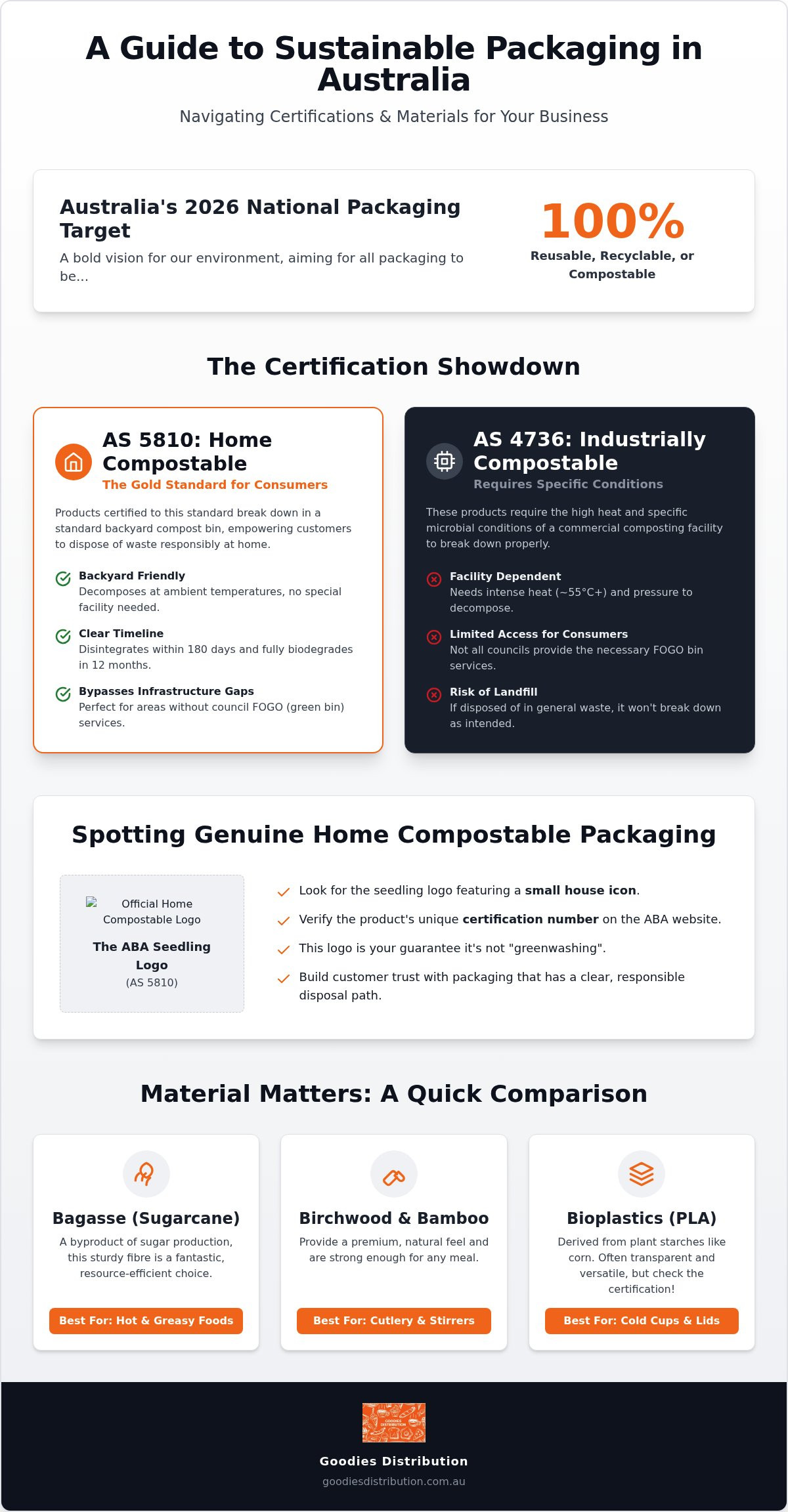
Did you know that by the end of 2026, Australia's National Packaging Targets aim for 100% of all packaging to be reusable, recyclable, or compostable? It's a bold vision for our environment, yet for many Sydney business owners, it often feels like a maze of confusing certifications and state-based plastic bans. You've likely felt the frustration of trying to find genuine home compostable packaging australia that doesn't just look good on paper but actually performs under the heat of a fresh laksa or a hot flat white.
We understand that you want to protect the Australian coastlines we all love without compromising the quality of your service. It's perfectly normal to worry about products breaking or vague eco-claims that don't hold up under scrutiny. This guide is designed to help you master the shift to sustainable food service by choosing certified solutions that delight your customers and simplify their disposal process. We'll explore the latest 2026 mandates, the technical differences between AS 5810 and AS 4736 standards, and how to select durable bagasse and BioPak products that keep your brand reputation as solid as your coffee.
Key Takeaways
- Identify the AS 5810 certification to guarantee your packaging returns to the earth in a backyard bin, not just a commercial facility.
- Understand why home compostable packaging australia is the gold standard for empowering customers who don't have access to council FOGO services.
- Compare the durability of bagasse, birchwood, and bamboo to find the perfect match for your hot, greasy, or cold signature dishes.
- Gain practical insights into matching straw diameters and cutlery weights to your menu to ensure every takeaway meal feels premium.
- Discover how bespoke branding on certified compostable products can turn your packaging into a powerful statement of your Sydney business's values.
Understanding Home Compostable Packaging Standards in Australia
Choosing the right takeaway gear involves more than just picking a sturdy box. In the current market, home compostable packaging australia represents the peak of environmental responsibility. To be truly home compostable, a product must be able to break down in a standard backyard compost bin at ambient temperatures. This is a significant step up from items labelled simply as "biodegradable," a term that has unfortunately become a magnet for greenwashing. While almost everything eventually biodegrades over decades or centuries, true compostable items leave no toxic residue and enrich the soil within a specific timeframe.
The Australasian Bioplastics Association (ABA) acts as the gatekeeper for these claims in our region. They manage the certification process that ensures products meet rigorous scientific benchmarks. Many of these items are crafted from bioplastic materials derived from renewable plants like corn or sugarcane. By looking for official ABA certification, you can be confident that your packaging won't just sit in a landfill forever. It's about moving away from vague promises toward verified results.
AS 5810 vs. AS 4736: What Businesses Need to Know
It's easy to get tangled in the technical codes, but the difference is vital for your customers' experience. AS 4736 is the Australian Standard for industrial compostability. These products require the intense heat and pressure of a commercial facility to break down. If your customer tosses an AS 4736 cup into their home garden, it likely won't budge. In contrast, AS 5810 is the dedicated home composting standard. These products must disintegrate within 180 days and completely biodegrade within 12 months in a home environment. Prioritising AS 5810 builds immense trust because it gives your customers a clear, easy disposal path right in their own backyard.
Identifying the Home Compostable Logo
Spotting genuine home compostable packaging australia is straightforward once you know what to look for. You should search for the "Home Compostable" seedling logo, which features a small house icon nestled next to the sprout. This logo is often accompanied by a unique certification number. Verifying this number on the ABA website is a quick way to ensure your supplier is compliant with 2026 regulations. Sydney cafes are increasingly moving toward these certified options because they eliminate the "disposal barrier." When your packaging is easy to get rid of responsibly, your brand becomes a partner in your customer's sustainable lifestyle.
Home vs. Industrial Compostable: Why the Distinction Matters
While industrial composting is a fantastic step forward, it relies on a system that isn't yet universal across our suburbs. In 2026, home compostability is the ultimate goal for the circular economy because it decentralises waste management, allowing every household to turn potential litter into nutrient-rich soil. This distinction is the difference between a product that actually returns to the earth and one that sits in a landfill for decades because the right bin wasn't available. Understanding the nuances of home compostable packaging australia ensures your business stays ahead of both regulations and customer expectations.
Many businesses worry that home compostable packaging australia might be less durable than its industrial counterparts. This is a common misconception. Modern bagasse and plant-based materials are engineered to withstand heat and moisture during use, only beginning their breakdown process once they hit the specific microbial environment of a compost heap. For Sydney customers, the convenience of tossing a container into their own backyard bin is a massive drawcard, especially since many local councils are still catching up with FOGO (Food Organics and Garden Organics) infrastructure.
The Reality of Australian Waste Infrastructure
The truth is that industrial composting facilities require precise heat and pressure to work effectively. Without a dedicated green bin service, an industrially certified cup is likely to end up in general waste. By choosing home compostable options, you reduce the risk of your packaging contributing to the growing landfill problem. It's a proactive way to bypass infrastructure gaps. Educating your customers is key; a simple sign or a stamp on your sustainable cutlery can guide them on how to dispose of their items correctly.
Brand Reputation and Environmental Impact
Offering "guilt-free" takeaway isn't just good for the planet; it's a powerful marketing tool that fosters deep community trust. When you align your business with Australian compostable standards, you're telling your community that you value integrity over mere convenience. Sydney locals are famously loyal to brands that share their environmental values, and providing a solution that doesn't rely on council infrastructure is a massive win. We've seen local cafes transform their customer base simply by switching to home compostable ranges. This shift significantly reduces your business's reliance on fossil-fuel-based plastics and builds a narrative of genuine responsibility that resonates deeply with modern, eco-conscious diners.
Comparing Materials: Bagasse, Wood, and Plant-Based Plastics
Selecting the right material is where your environmental vision meets your customer's reality. While the standards provide the framework, the physical material dictates how a meal is enjoyed. In the world of home compostable packaging australia, we've moved far beyond flimsy paper plates. Today's options offer a sophisticated blend of performance and planet-friendly disposal, ensuring your takeaway service feels like a premium extension of your dine-in experience.
The mouthfeel and durability of your packaging can make or break a customer's loyalty. A soggy container or a straw that collapses mid-drink sends the wrong message about your brand's quality. By understanding the unique strengths of different plant-based materials, you can choose solutions that stand up to the heat of a Sydney summer or the weight of a hearty winter laksa.
Bagasse: The Sustainable Powerhouse
Bagasse is the fibrous residue left after sugarcane is crushed for juice. It's essentially a waste product turned into a high-performance resource. Unlike traditional cardboard, which can become soggy under the pressure of steam and oils, bagasse containers, trays & bowls maintain their structural integrity even with hot, greasy meals. It's an incredibly cost-effective choice for heavy-duty catering because it provides a thermal barrier that keeps food warm without the container melting or warping.
This material aligns perfectly with the National Compostable Packaging Strategy by utilising agricultural byproducts rather than virgin timber. It's naturally home compostable and offers a neutral mouthfeel that doesn't interfere with the flavour of your signature dishes. For businesses serving wet or oily foods, bagasse is often the most reliable choice on the market.
Wooden and Bamboo Alternatives
For cafes looking to elevate their takeaway aesthetic, birchwood and bamboo offer a premium, organic feel. Birchwood cutlery is sleek and sturdy, providing a much better experience than the snapping plastic forks of the past. It's essential to ensure these items are FSC-certified to guarantee the wood comes from responsibly managed forests. This adds another layer of integrity to your sustainability claims.
When it comes to sippable treats, bamboo straws are a massive improvement over paper versions. While paper straws are famous for collapsing mid-drink, bamboo remains rigid for hours. You can find a range of these sustainable cutlery and straw options that match your drink's diameter, from fine cocktails to thick smoothies. Finally, plant-based plastics like PLA (Polylactic Acid) are ideal when you need transparency for cold salads or iced coffees. Just remember to verify that the specific PLA item is certified for the home, as some varieties still require industrial heat to break down. Mixing these materials thoughtfully ensures your home compostable packaging australia setup is as functional as it is beautiful.
Buying Guide: Selecting Sustainable Cutlery and Straws
Your choice of "smalls" is where the customer's physical interaction with your brand is most intense. When sourcing home compostable packaging australia, it's vital to consider the specific demands of your menu. A flimsy stirrer won't survive a thick porridge, just as a heavy-duty fork might be overkill for a light salad. It's about finding that sweet spot where functionality meets environmental integrity, ensuring every bite is as enjoyable as the last.
Straw selection requires a similar level of precision. A standard diameter is perfect for a soda, but a thick shake or a fruit-filled smoothie demands a jumbo straw to prevent customer frustration. In 2026, matching the right tool to the task is a hallmark of a professional, eco-conscious venue. It shows your customers that you've thought about their experience from the first sip to the final swallow.
Storage is often the hidden challenge for Sydney's smaller cafes and bars where space is at a premium. While bulk wholesale orders are more cost-effective, you must ensure your back-of-house can accommodate the footprint. We recommend a cost-per-unit analysis that factors in the 10-40% typical price difference for certified home compostable packaging australia options. This isn't just an expense; it's an investment in your brand's future and a direct response to the growing national preference for plastic-free dining.
Standout Products for Your Business
BioPak compostable cutlery sets are a fantastic way to maintain hygiene while showcasing your commitment to the planet. These sets are often pre-wrapped, making them ideal for busy takeaway windows where speed is of the essence. For those serving thick shakes, jumbo paper straws provide the necessary suction without the sogginess. Wooden stirrers remain a staple for coffee stations, offering a natural look that complements a rustic Sydney aesthetic. You can explore a wide range of cutlery and straws designed to meet these diverse needs.
Common Mistakes to Avoid When Buying Wholesale
One of the biggest pitfalls is ordering "eco-friendly" items that lack official Australian certification. Without the AS 5810 mark, you risk misleading your customers and falling foul of ACCC greenwashing guidelines. Another common slip-up is underestimating the stock levels required for the peak Sydney summer trade, when iced drinks and outdoor dining are at their height. Finally, always test how your cutlery fits inside your takeaway containers. There is nothing more awkward for a customer than a fork that's too long to allow the lid to close properly, leading to spills and a poor experience.
Ready to upgrade your service? View our complete wholesale cutlery collection to ensure your business is fully compliant and customer-ready.
Customisation and Implementation in Your Sydney Café
Transitioning your service to a more sustainable model is an inspiring step for any local business. It's about more than just swapping a plastic fork for a wooden one. By integrating home compostable packaging australia into your daily operations, you're telling a story of care and responsibility that resonates with every Sydney local who walks through your doors. This final stage of the journey is where your brand identity truly shines, turning every takeaway order into a walking advertisement for your values.
Partnering with a local supplier who understands the unique rhythm of the Sydney hospitality scene makes this shift much smoother. Reliable delivery and professional support mean you can focus on your craft while we handle the logistics of your sustainable transition. It's a partnership built on shared goals and a commitment to protecting our beautiful coastlines and parks for the next generation.
Elevating Your Brand with Custom Designs
Custom Branding Services allow you to transform plain containers into bespoke pieces of art that capture your café's unique personality. When a customer carries your branded sleeve or opens a bag lined with custom greaseproof paper, they're engaging in a premium unboxing experience. In 2026, consumers are increasingly looking for brands that align with their personal ethics. A logo printed on a certified home compostable surface proves that you haven't just chosen the easy path; you've chosen the right one. At Goodies Distribution, we use our 40 years of industry experience to help you navigate the technical side of printing on plant-based materials, ensuring your logo looks sharp and professional every time.
Making the Switch: A 5-Step Implementation Plan
Organising your front-of-house for easy sustainable disposal is the key to closing the loop and ensuring your packaging doesn't end up in a landfill. Here is how you can get started today:
- Audit your current usage: Review your inventory to identify the easiest plastic swaps, starting with high-volume items like cups and lids.
- Train your team: Educate your staff so they can confidently explain the benefits of home compostable packaging australia to curious patrons.
- Update your signage: Use clear, friendly instructions near your bins to encourage customers to compost their items at home.
- Select your supplier: Choose a local partner who offers professional industry experience and a wide range of BioPak and bagasse-based solutions.
- Commit to the change: Place your first bulk order for sustainable cutlery and straws to start the transition and show your community you're serious about the planet.
By taking these intentional steps, you're not just buying packaging; you're building a more resilient and respected Sydney business that leads by example.
Lead the Way in Sustainable Takeaway
Embracing the shift toward home compostable packaging australia isn't just about meeting 2026 regulations; it's about building a brand that Sydney locals trust and respect. By choosing certified AS 5810 materials like bagasse and FSC-certified wood, you're removing the disposal barrier for your customers and ensuring your packaging leaves a positive legacy. Whether you're matching straw diameters to thick shakes or auditing your current plastic usage, every small swap contributes to a healthier Australian environment.
As a Sydney-based specialist with over 40 years of industry expertise, we're here to be your partner in this transition. As an official BioPak wholesale distributor, we offer a range of durable solutions alongside custom branding services to help your business stand out. It's time to turn your environmental vision into a practical reality that delights your diners. Shop our range of home compostable cutlery and straws to start your journey today. We're excited to help you organise a more sustainable future for your café.
Frequently Asked Questions
What exactly does 'home compostable' mean in Australia?
Home compostable refers to products that break down in a standard backyard compost heap without needing industrial heat or pressure. In our local context, this means the item meets the AS 5810 Australian Standard. Unlike industrial options, these products are designed to disintegrate at ambient temperatures alongside your vegetable scraps. Choosing genuine home compostable packaging australia ensures your customers can dispose of their takeaway waste responsibly without relying on council-run green bin facilities.
Is home compostable packaging more expensive for my business?
While certified sustainable options typically carry a slightly higher unit cost than traditional plastic, they offer significant long-term value for your brand. This investment helps your Sydney business comply with strict state-based plastic bans and avoids the risk of ACCC penalties for misleading claims. Many local café owners find that the boost in brand loyalty from eco-conscious diners far outweighs the small increase in price. It's a strategic choice for businesses focused on a plastic-free future.
Can I put home compostable cutlery in my council's green bin?
Not necessarily. While many Sydney councils are expanding their Food Organics and Garden Organics (FOGO) services, some facilities still only accept food scraps and garden waste. It's always best to check with your specific local council first. The beauty of AS 5810 certified items is that they're guaranteed to break down in a home bin, giving your customers a reliable disposal path even if their local green bin doesn't accept packaging yet.
How long does it take for home compostable packaging to break down?
Under the AS 5810 standard, products must disintegrate within 180 days and completely biodegrade within 12 months in a home composting environment. The actual speed can vary depending on the health of the compost heap and local Sydney weather conditions. A well-maintained pile with plenty of moisture and air will typically see these items disappear much faster. This timeframe ensures the material returns to the earth without leaving behind any microplastics or toxic residues.
Does home compostable cutlery work for hot takeaway food?
Absolutely. High-quality home compostable cutlery, particularly our birchwood and bamboo ranges, is designed to remain sturdy even when used with steaming hot meals. Unlike some older plant-based plastics that might soften, wooden utensils and bagasse-based containers maintain their structural integrity throughout the meal. They won't melt or warp under the heat of a fresh laksa or a hot roast, providing a reliable and premium experience for your takeaway customers every single time.
Are paper straws actually home compostable?
Most high-quality paper straws are home compostable, but you must ensure they don't contain hidden plastic linings or non-compostable glues. To be certain, look for the FSC-certification for the paper and the AS 5810 mark for the finished product. We recommend using jumbo paper straws for thicker drinks to ensure they stay rigid. If they're certified, they'll break down safely in a backyard bin, making them a much better choice than traditional single-use plastic.
Why should I choose a Sydney-based supplier like Goodies Distribution?
Choosing Goodies Distribution means you're partnering with a Sydney-based team that has over 40 years of industry experience. We aren't just a warehouse; we're a dedicated partner that offers professional custom branding and local support. Being an official BioPak wholesale distributor allows us to provide the highest quality home compostable packaging australia with reliable, fast delivery across the city. We understand the unique pressures of the Sydney hospitality scene and provide the expertise to help you succeed.