


The safest takeaway soup bowl isn’t chosen by its compostable label alone. For Sydney food-service businesses, compostable soup containers need to suit the soup, hold up during service and travel securely with a well-fitting lid. Leak performance depends on the specific container, lid and use conditions. The right size matters too: it affects portioning, carrying and how the meal arrives with your customer.
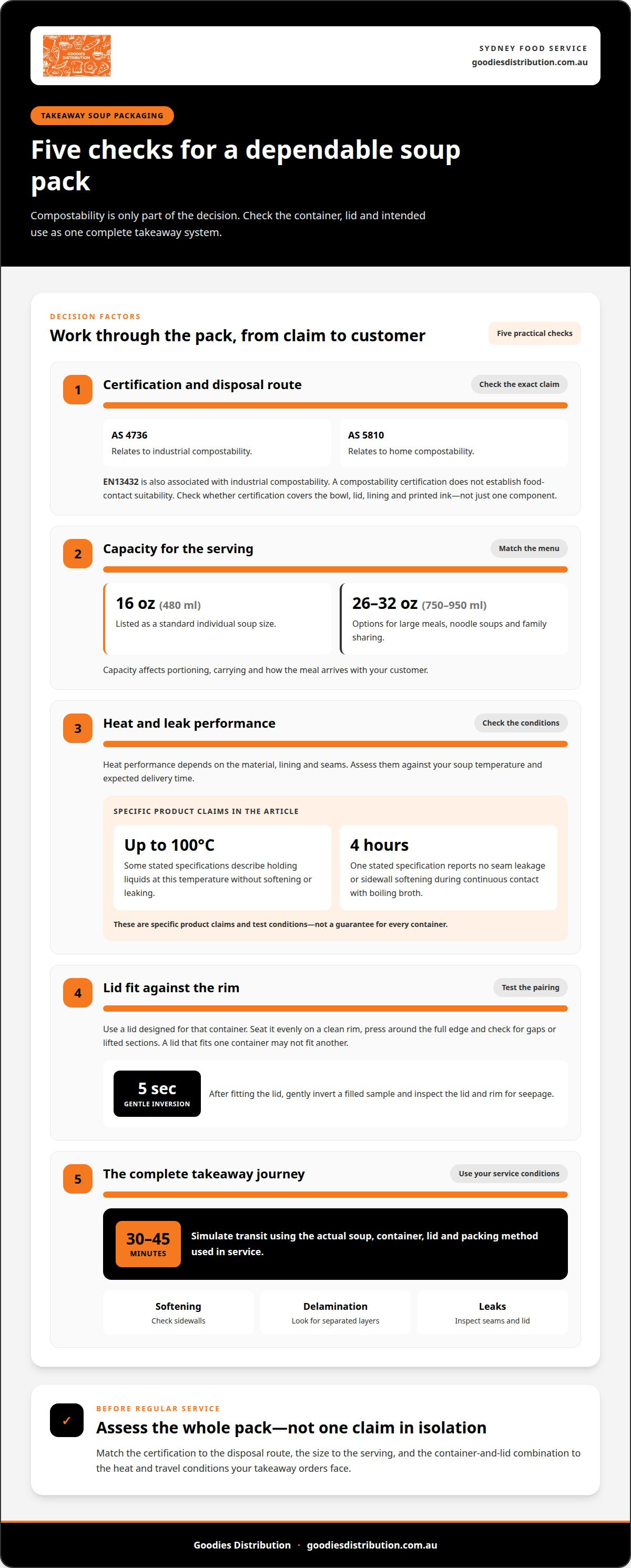
It’s understandable to focus first on the material, especially when you’re working towards more responsible packaging. But a bowl’s compostability, heat and leak resistance, lid fit and capacity all shape whether it’s practical for your menu. A 16 oz (480 ml) container is listed as a standard individual soup size, while 26-32 oz (750-950 ml) options suit large meals, noodle soups and family sharing.
Read on to weigh these factors for takeaway service, understand what certification labels can tell you and match container size to the serving. You’ll also see why checking the complete container-and-lid combination matters, so your packaging supports a dependable delivery experience and clearer environmental choices.
Key Takeaways
- Choose packaging with compostability certification suited to its intended composting environment, and consider whether the certification covers the container, lid and ink.
- Assess heat and leak resistance with the soup you serve and the conditions of takeaway travel in mind.
- Use a lid designed to fit the container’s rim, then test the pairing as a complete system before relying on it for delivery.
- Match capacity to the serving: individual portions, hearty meals and shared soups each call for a different container size.
Compostability and certification
Compostability needs a defined end-of-life route, not just a plant-based description. In Australia, AS 4736 relates to industrial compostability, while AS 5810 relates to home compostability. These standards refer to different composting settings. A container certified for industrial composting should not be described as home compostable unless that separate claim is supported.
Compostability certifications help distinguish products designed for different disposal environments. Read the exact wording on the packaging: “industrially compostable” and “home compostable” do not mean the same thing. AS 4736 and EN13432 are associated with industrial compostability, while AS 5810 relates to home compostability. The relevant certification should match the product and the composting facilities available to your customers.
Do compostable soup containers meet Australian food-contact safety requirements? Compostability certification alone does not establish food-contact suitability. It addresses compostability, not whether a container is suitable for hot soup. Treat food-contact suitability as a separate requirement and look for documentation covering the product’s intended use.
What Australian rules and standards apply to compostable food packaging and compostability claims? For compostability, the named standards include AS 4736 for industrial compostability and AS 5810 for home compostability. These standards address compostability; they do not, by themselves, establish food-contact suitability. Describe the disposal conditions accurately rather than implying that every certified item breaks down in every composting system.
Certification scope matters for a complete takeaway pack. A bowl, lid, lining and printed ink may use different materials, so one component’s certification does not automatically cover the others. Check whether certification applies to the assembled packaging or just a particular part. For example, a certified bowl paired with an uncertified lid may not support a claim about the whole pack.
For a practical assessment, identify the exact container and lid, then match their certification details to your intended claim. Look for seedling logos and the standard named on the packaging or supporting documentation. Finally, consider the disposal route customers can actually use. A clear label naming industrial or home compostability helps Sydney venues set accurate expectations and avoid presenting certification as a general environmental guarantee.
Heat resistance and leak resistance
Heat performance depends on the container material, lining and seams. Assess these against the soup temperature and expected delivery time.
Boiling-liquid resistance
Boiling soup puts the lining, sidewalls and seams under sustained heat. Some stated compostable soup-cup specifications describe holding liquids up to 100 degrees Celsius without softening or leaking. Another reports no seam leakage or sidewall softening after four hours of continuous contact with boiling broth. Treat these as specific product claims, not a guarantee for every container. For your menu, focus on the stated maximum temperature and the test conditions.
Leak resistance and lid venting
A secure seal helps prevent soup escaping at the rim, while a vent can release steam. A vent that is too open may allow liquid to escape if the container tips; a tightly closed lid may trap hot vapour. Check that the lid suits the container and intended use. Test a filled, lidded sample by gently inverting it at 45° for 5 seconds, then inspect the rim and lid for seepage.
Hot-soup holding performance
How long can compostable containers safely hold hot soup without leaking or softening? One stated specification reports four hours without seam leakage or sidewall softening under continuous boiling-broth contact, but that result applies to its described test, not every container. For takeaway service, test the actual soup and pack through a 30-45 minute transit simulation. Look for softening, delamination and leaks before choosing a container for regular use.
Heat damage and transport spills
Heat can weaken a wall or seam, while movement can dislodge a poorly fitted lid. These risks can make leaks or container damage more likely during delivery. Check for softened sidewalls, separated layers and wet seams after transit. For microwave reheating, some guidance recommends warming fibre bowls for 1-2 minutes with the lid ajar. Follow the specific container’s instructions, and avoid reheating a sealed pack.
Lid fit and spill prevention during delivery
A secure lid is useful only when it matches the container rim. Test the complete pack under hot-fill and delivery conditions.
Secure-fitting lid performance
Some cups use precision-formed rolled rims to create a tight seal with matching plant-fibre lids. The fit depends on using the intended lid, seating it evenly and keeping the rim clean. A lid that appears secure on one container may not fit another. Before service, fill a sample, press around the full rim and check for gaps or lifted edges.
For a hot-fill check, fill the container at 90-95°C, fit the lid and hold it for 30 minutes at room temperature. Then gently invert the lidded container for 5 seconds. Watch the rim and lid for seepage. This simple sequence helps reveal an uneven seal before takeaway orders leave the kitchen.
Spill prevention during delivery
A tight seal still needs to cope with movement. Simulate a 30-45 minute hot-fill delivery using the container, lid and packing method used in service. Look for liquid around the seam, a loosened lid or damage where the wall meets the base. These checks make performance easier to assess under conditions closer to a customer’s journey.
Add a gentle shake test: use three 10-second shakes, followed by a 30-second ride. Keep the container upright during the ride, then inspect the outside and lid. Check that the lid remains seated and the container hasn’t softened or leaked. Repeat with the soups your venue serves, since liquid level and soup texture affect how contents move.
Record the container and lid pairing that passed each test. This gives staff a clear packing routine and helps prevent substitutions that affect the fit. Test again if the container, lid or delivery setup changes. A seal that performs on the bench still needs to remain secure during handover and transit.
Container sizes and soup-use cases
Capacity affects portion control, carrying comfort and how soup arrives. Listed options range from 8-12 oz (240-360 ml) through to 26-32 oz (750-950 ml). Choose for the serving, not simply the largest available volume.
The 8-12 oz (240-360 ml) range suits smaller servings or soup offered alongside another dish. For a Sydney café, this size may fit a light lunch menu better than a container designed for a full meal. Consider the finished portion, including noodles, vegetables or toppings, before settling on capacity.
A 16 oz (480 ml) container is listed as a standard individual soup size. It can suit a single-serve lunch, but the recipe still matters. A dense lentil soup and a broth with noodles may occupy the same volume differently. Match the container to the actual portion you serve.
For larger meals, noodle soups and family sharing, listed capacities span 26-32 oz (750-950 ml). More room can accommodate substantial servings, but a larger container may be less convenient to carry. Consider how customers will transport it, and how the filled pack fits within your takeaway bag.
Test your chosen capacity with a representative menu item. Fill it to the serving level used in service, then assess headroom, lid fit and ease of handling. A container filled close to the rim leaves less room for toppings and movement. A smaller size may help control portions but can feel cramped for chunky soup.
Keep a simple size-to-menu guide for staff: record the dish, serving volume and matching container. For example, list a single-serve broth separately from a family noodle soup. This reduces packing errors during busy service and supports consistent presentation. Explore takeaway container options for packaging choices suited to your menu.
Goodies Distribution
Goodies Distribution supplies packaging to Sydney food-service businesses. When considering containers for takeaway soup, weigh practical factors such as portion size, secure lid fit, heat performance and the compostability claim you want to make.
Takeaway Containers can support your packaging requirements, while Custom Branding Services can align presentation with your business identity. Paper Bags and Biodegradable Cutlery may also be part of a considered takeaway setup. The right combination depends on your menu, how customers carry orders and the packaging details you need to communicate clearly.
Share your serving and delivery requirements with Goodies Distribution to help guide your packaging decisions. Contact the team to discuss packaging for your takeaway service.
Make your next packaging choice with confidence
Your next packaging decision can support smooth service and a considered customer experience. Choose an approach that fits how your team prepares, packs and presents each order. Clear, accurate compostability messaging can also help customers understand the packaging’s intended disposal route.
Choosing leak-proof compostable soup containers is one part of creating a practical takeaway setup. Goodies Distribution supplies Takeaway Containers for food-service businesses, alongside eco-friendly compostable cups and Custom Branding Services. These offerings help you consider packaging and brand presentation together while keeping your menu and day-to-day operations in view.
Bring your soup menu and packaging priorities into the next conversation. Contact Goodies Distribution about soup containers to discuss options for your takeaway service. Thoughtful packaging choices can help your business serve customers with care while making sustainability claims responsibly.
Frequently Asked Questions
What is the Safest Material for Takeaway Soup Bowls?
No material is safest by name alone. Select a bowl with food-contact information covering its intended use, including hot soup and any reheating. A paper bowl with a lining, for example, has a different construction from a moulded bagasse bowl. Choose packaging to suit the recipe, serving method and kitchen handling, using product documentation rather than a broad material label to guide your decision.
Which compostable soup containers are leak-proof for hot liquids?
Assess leak-proof compostable soup containers as a container-and-lid pairing, not by material claims alone. The product’s stated hot-liquid performance and the lid’s fit both matter. Test the pairing with the soup you serve, including broth and thicker recipes, and note whether movement or a high fill level affects the seal. Don’t treat “compostable” as evidence of leak resistance.
What materials are compostable soup containers made from, such as bagasse, PLA, or paper?
Compostable soup packaging can be made from bagasse fibre, paper, PLA or combinations of these materials. Bagasse is moulded plant fibre, while paper containers may include a barrier layer to manage liquid. PLA is a plant-based bioplastic used in some packaging components. Since the bowl and lid may use different materials, consider each part when reviewing the product’s material description.
What sizes and lid types are available for compostable soup containers in Australia?
Listed capacities include 8-12 oz (240-360 ml), 16 oz (480 ml), and 26-32 oz (750-950 ml). Lid designs depend on the container’s rim and intended use; a vented lid, for example, may suit a different service need from a fully closed lid. Match the lid to the exact container, then assess the filled pack for handling and presentation.
Can compostable soup containers be disposed of in Australian home compost, council organics bins, or commercial composting?
Disposal depends on the product’s certification and the collection route available. A container intended for industrial composting is not automatically suitable for home composting. Council organics services may also set their own acceptance rules. Give staff the product’s disposal instructions and use customer-facing labels that accurately describe the certified route, rather than putting every compostable item in the same bin.
How do compostable soup containers compare with recyclable paper and reusable options?
Compostable and recyclable paper packaging follow different end-of-life routes, and coatings or food residue can affect practical handling. Reusable containers can reduce reliance on single-use packs when customers can return them and the business can wash and manage them. Compare the packaging’s intended use, cleaning or collection arrangements, and the waste pathways available to your Sydney venue before selecting a format.