

A burger box is part of the takeaway experience, not just a wrapper. For Sydney food businesses, choosing sustainable burger boxes wholesale means balancing material, fit and compostability with the need to keep orders secure and presentable. Bagasse, a fibre left after sugarcane processing, is one renewable material option; the right size also helps limit movement in transit.
Look beyond a green-looking finish: environmental claims should match the packaging’s materials, certification and disposal pathway. Compostability depends on the product’s certification and the facilities available to customers, so clear product information matters.
This guide explains how materials affect burger-box performance, what to consider when choosing a size and how to assess compostability for your business. It also covers practical packaging choices that can support tidy takeaway presentation and a considered customer experience.
Key Takeaways
- Match the box’s footprint and depth to your burger so it stays presentable without excess movement during takeaway and delivery.
- Choose materials with your menu in mind: grease, heat and moisture can affect how packaging performs.
- Distinguish industrial compostability from home compostability, and use certification details to guide disposal advice.
- Consider how custom branding and coordinated takeaway packaging can make the customer experience feel more consistent.
Why Opt for Biodegradable Packaging for Your Burgers?
For Australian cafés, burger outlets and food trucks, biodegradable packaging can reduce reliance on conventional plastic while giving takeaway orders a considered presentation. Choose boxes documented as suitable for food contact, and keep compostability or plastic-free labelling accurate to the product and its disposal conditions. A fibre box is not automatically plastic-free or suitable for every composting system.
Bagasse, the fibre left after sugarcane processing, gives burger boxes a renewable material base. Sugarcane and bamboo packaging typically takes 6 months to a year to biodegrade, depending on the composting environment. That variation matters: the material alone doesn’t tell customers how or where to dispose of a box. Check the product’s certification and communicate its intended disposal pathway clearly.
Match the packaging to your service. A food truck at an outdoor event may need a sturdy box for takeaway, while a café might prioritise neat stacking behind a compact counter. For a busy burger outlet, using a consistent format can simplify packing during a rush. Test the packaging with your menu’s grease and moisture before making it a regular choice.
Take care with claims such as “compostable” and “plastic-free.” Fibre packaging may include a coating or lining, so a natural-looking surface does not prove that the whole box is plastic-free. When sourcing sustainable burger boxes wholesale, review the product details and certification before describing the packaging to customers. Clear wording sets realistic expectations about disposal.
- Request a sample and test it with a hot burger, sauce and chips.
- Use a design template to check logo placement, readability and available print areas before approving artwork.
Trial a sample to assess fit, stacking and presentation before adopting a format. A clear design brief can also help food trucks and takeaway venues create consistent branding while keeping essential packaging information readable.
Burger box sizes and delivery performance
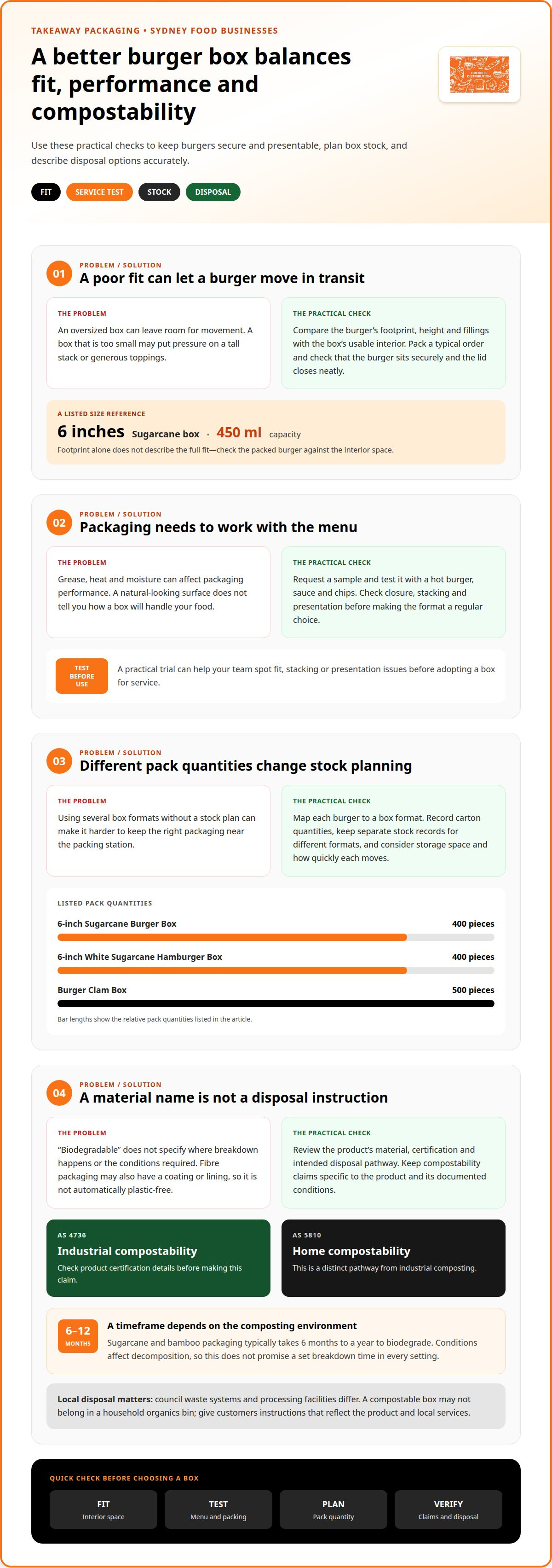
The right fit helps keep burgers steady during takeaway and delivery. A listed sugarcane box measures 6 inches and holds 450 ml, offering a useful reference when assessing portions and internal space.
Box Sizes and Custom Dimensions
Start with the burger’s footprint, height and fillings. A tall stack or generous toppings may need more clearance than a compact café burger, while an oversized box can let food shift during delivery. Compare the packed burger with the box’s usable interior, not just its external measurements.
Custom dimensions are a design consideration, not a standard size assumption. Record the burger’s width and height, then account for wrapping or inserts if your service uses them. A 6-inch format may suit some menus, but its 450 ml capacity shows why footprint alone doesn’t describe the full fit. A simple fit test can help your team spot pressure on toppings or wasted space.
Product Sizes and Carton Quantities
Pack quantities affect storage space and how often your team replenishes the pass. The listed 6-inch Sugarcane Burger Box comes in cartons of 400 pieces. The 6-inch White Sugarcane Hamburger Box is also packed in cartons of 400, while a Burger Clam Box is sold in a pack of 500 pieces.
If your restaurant serves several burger sizes, map each menu item to a box in your stock plan. Record the carton quantity for each format and consider how quickly it moves during service. This helps staff keep the right packaging near the packing station and plan storage without mixing formats.
Bulk Pack Sizes and Stock Planning
Bulk packs suit different ordering rhythms. A 400-piece carton and a 500-piece pack create different replenishment intervals, so match each quantity to menu demand and available storage. Keep separate stock records when distinct box formats serve different burgers. This makes it easier to spot which sizes need replenishing before a busy service.
Delivery performance also depends on closure and packing practice. Pack a typical order and check that the lid closes neatly, the burger sits securely, and the box stacks with other takeaway orders. For a considered look, explore packaging options that suit your service and presentation needs.
Compostability and biodegradability
“Biodegradable” describes material breakdown but does not specify where it happens or the conditions required. Compostable burger boxes are designed to break down through composting under defined conditions. For cafés and takeaway venues, check whether the product is intended for industrial composting, home composting or neither of the disposal pathways available to customers.
Yes, some compostable packaging products are certified to Australian standards, including AS 4736 and AS 5810. AS 4736 relates to industrial compostability, while AS 5810 covers home compostability; check the product’s certification details before using either claim.
Australian food-service packaging wholesalers sell sustainable burger boxes wholesale, including compostable and recyclable options. Authorised Goodies Distribution stockists are one route to packaging with compostability certifications; compare product information to identify its material, certification and intended disposal pathway.
There is no single answer for every Australian council waste system. Acceptance depends on local collection services and processing facilities, so a compostable box may not belong in a household organics bin. Recycling also depends on the box material and local collection rules. Give customers disposal instructions that reflect the packaging and the services available in their area.
Sugarcane and bamboo packaging typically takes 6 months to a year to biodegrade, depending on the composting environment. This range shows why “biodegradable” doesn’t promise a set breakdown time in every setting. Temperature, moisture and processing conditions affect decomposition, while durable construction still needs to protect food during service.
For practical convenience, assess each box in three steps:
- Identify whether the material is fibre, coated paper or a mix.
- Match its certification to industrial composting or home compostability.
- Use disposal wording that reflects the product’s certification and local collection options.
These checks connect environmental claims with what happens to the box after use. Clear labels and accurate staff guidance help customers understand the intended disposal route instead of assuming every compostable package belongs in the same bin.
Burger box materials, including cardboard, corrugated board and kraft
Material affects how burger packaging handles heat, grease and movement during takeaway. Cardboard, corrugated board, kraft paper and plant-fibre options have different structures. Consider the burger’s weight, moisture and journey before choosing a format.
Cardboard provides a formed surface for a box, while kraft describes paper commonly recognised by its natural brown appearance. Corrugated board has a fluted layer between flat sheets, adding stiffness. Its performance with hot food depends on the specific box and the food packed inside.
Bagasse is fibre left after sugarcane processing, offering a different material choice from paperboard. Sugarcane burger boxes may be described as leak-resistant, grease-proof and durable for burgers, wraps and sandwiches, but performance depends on the product. Test a box with your menu’s sauces and fillings before relying on it in service.
Bamboo pulp is another plant fibre used in packaging. Sugarcane and bamboo are distinct material descriptions, not interchangeable labels. Check the product’s material details, construction and disposal information rather than assuming one plant-based box performs or breaks down like another.
Bagasse, recycled paperboard and compostable PLA boxes differ in material and end-of-life route. Bagasse uses sugarcane fibre; recycled paperboard uses recovered paper fibres; PLA is a plant-based bioplastic commonly made from renewable starch sources such as corn or sugarcane. Compostability depends on the finished product’s certification and suitable processing conditions, not the material name alone.
For a practical comparison, pack the same burger in each candidate box. Check whether the base holds its shape, whether grease seeps through, and whether the lid stays closed during a typical delivery. Then match any environmental claim to the box’s actual material and certification details.
Explore bagasse packaging options when assessing fibre-based formats for your takeaway menu.
Goodies Distribution
Goodies Distribution helps food businesses bring packaging choices and brand presentation together. When reviewing burger packaging for takeaway, consider how Takeaway Containers work alongside Paper Bags and Biodegradable Cutlery. Custom Branding Services can help create a consistent look across your packaging.
Goodies Distribution supplies Takeaway Containers for food-service businesses. When choosing packaging, consider menu fit, handling and presentation, then use clear material and compostability information to communicate disposal expectations accurately.
For Sydney cafés, restaurants and takeaway operators planning a packaging refresh, share your requirements and priorities with Goodies Distribution. Contact the sales team to discuss packaging options and custom branding.
Shape Your Next Packaging Choice
Let your next packaging decision reflect the experience you want customers to have, from opening their order to recognising your brand. A clear brief for sustainable burger boxes wholesale can bring your service priorities and environmental aims into focus.
Consider what matters most for your menu and day-to-day operations, then use those priorities to guide your packaging choice. A measured approach helps you move forward with purpose without overlooking the practical details of ordering.
Ready to take the next step? Contact Goodies Distribution to discuss your packaging needs and shape a solution that feels right for your business.
Frequently Asked Questions
Why Are Burger Boxes Important?
Burger boxes give takeaway orders a defined unit that staff can close, label and group with the correct order. When a venue handles several menu variations, a clear packing routine can help distinguish standard and modified orders. Treat packaging selection as part of order management: align the box format with how your team identifies and hands over each order.
What sustainable burger box materials are available from Australian wholesalers?
Australian wholesalers may offer burger boxes made from paperboard, kraft, corrugated board or bagasse, with some packaging using PLA. The specific range varies between suppliers. For Sydney food businesses, product documentation can help you understand the materials in the finished box and support accurate purchasing records. This is useful when your venue needs to communicate packaging details consistently across staff and customer-facing information.
What minimum order quantities apply to sustainable burger boxes in Australia?
Goodies Distribution’s standard minimum order is four cartons. Orders require a registered account and an Australian Business Number, and all purchases are prepaid. Include the carton quantity in your stock planning. Custom-printed packaging has product-specific minimum quantities, which may differ from standard stock orders.
What sizes and designs of wholesale burger boxes are available for single, double and takeaway burgers?
Wholesale ranges can include different formats and finishes, but a product name does not always show whether a box suits a single or double burger. Match the selected design to the menu item and packing process, including any inserts or wrapping your team uses. Request a sample through Goodies Distribution’s sales team so staff can review the format before incorporating it into routine ordering.
Can Australian suppliers print custom branding on eco-friendly burger boxes?
Goodies Distribution offers custom printing for a range of packaging products. The minimum order quantity varies by product, and the typical production lead time is 12-14 weeks from artwork sign-off. A deposit and signed contract are required to start the process. Allow time for artwork preparation and approval when planning a packaging refresh for a Sydney restaurant or takeaway venue.
What delivery timeframes and regional delivery options are available for wholesale burger boxes in Australia?
Goodies Distribution delivers within Australia. Sydney Metro orders placed before 10 am are processed for next-day delivery; orders placed after 10 am are processed the following business day. Interstate deliveries require 48-72 hours. Shipping is available to locations across Australia, making the service relevant to Sydney businesses as well as hospitality operators in other regions.