

What if packaging that looks like the sustainable choice is the wrong fit for your menu? Choosing wholesale food packaging supplies means balancing how food travels, how your team serves it and what customers experience when they open it. Your packaging needs to support your environmental goals without compromising function or presentation.
This guide helps Sydney food businesses match packaging to their menu and service style, understand what compostability certifications such as AS 4736 and AS 5810 mean, and plan supply for busy hospitality operations. Certification applies to specific products, so check the claim for the item you’re considering.
We’ll cover practical options including paper coffee cups, bagasse containers, trays and bowls, and paper bags, then look at how custom branding can bring your packaging in line with your business identity. You’ll also find guidance on choosing a wholesale partner like Goodies Distribution with Sydney-local support. The aim is a packaging plan that works behind the counter and feels right in your customers’ hands.
Key Takeaways
- Map each menu item to its serving or takeaway format so packaging supports food quality and a smooth service flow.
- Compare wholesale food packaging supplies by function, material, product-level certification evidence, branding options and supply support.
- Check what a compostability claim means for the specific item. Certification marks and product information help distinguish industrial from home compostability.
- Audit your menu and expected usage, then group regular-use packaging by station or service task to make ordering more consistent.
- Goodies Distribution is an authorised BioPak wholesale distributor with a Sydney-local warehouse, Sydney-wide delivery and in-house custom branding.
Why wholesale food packaging supplies matter to Sydney food businesses
Packaging is part of every service, from the cup handed across a café counter to the container packed for a delivery order. It helps protect food, supports practical handling and shapes the customer’s first impression. For Sydney cafés, restaurants, takeaway venues, caterers and food manufacturers, the right choice needs to suit both the food and how it reaches the customer.
Packaging choice affects service behind the counter and the impression customers take away. Plan around four considerations: functional fit, evidence behind environmental claims, brand presentation and the support needed to keep everyday operations supplied. Don’t let one factor stand in for another. A material claim doesn’t tell you whether a format suits your menu, just as attractive branding doesn’t guarantee easy handling.
Packaging has a broader role in protecting and presenting food, as outlined in the importance of food packaging. For a hospitality business, that role translates into practical decisions made throughout each service.
What should food packaging do during service?
Start with the order journey. Counter service may call for packaging that’s easy to fill and pass to a customer, while takeaway and delivery need a format that can be carried and handled beyond the venue. Catering adds another consideration: the packaging should suit how food is arranged, transported and presented to a group.
Fit, closure and handling all affect the result. A container that’s awkward to fill can slow staff during a busy period; a poor fit for the food can affect its appearance by the time it reaches the customer. Consider portion shape, moisture and whether components need to stay separate. Cups, takeaway containers, trays and bowls serve different purposes, so choose a format for each menu item rather than applying one packaging choice to everything.
Why buy food packaging wholesale?
Planned wholesale purchasing can help a venue keep regular packaging formats consistent across shifts and replenishment cycles. Staff are more likely to know which item suits each order when formats are organised around familiar menu items and service tasks. It also gives managers a clearer basis for estimating usage and planning storage, rather than treating each order as an isolated decision.
Just-in-time inventory means arranging replenishment close to when stock is needed. As a planning approach, it can help businesses consider typical usage, storage space and ordering routines. It doesn’t guarantee that stock will always arrive exactly when required, so build a realistic buffer around busy periods and the items your service relies on most.
Wholesale food packaging supplies are most useful when your purchasing plan reflects day-to-day demand, not just a broad product catalogue. Keep regular formats clear for staff, review usage as the menu or service mix changes, and assess supply support separately from product performance. This helps packaging support both a smoother operation and a considered customer experience.
Match wholesale food packaging supplies to your menu and service format
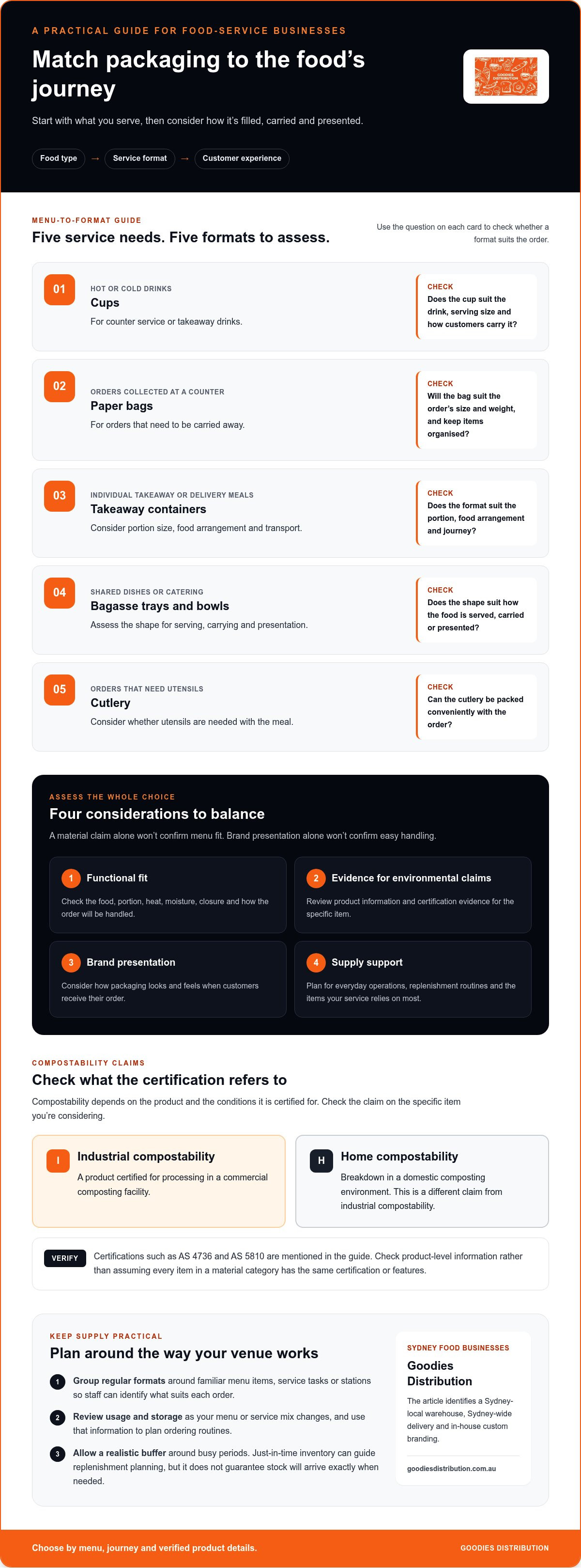
Start with the journey each order takes: from the pass to a table, across a takeaway counter, into a delivery bag or onto a catering spread. Heat, moisture, portion size and transport all influence which format to assess. Use the guide below to turn broad packaging categories into menu-specific questions.
| Food or service need | Packaging format to assess | Selection question |
|---|---|---|
| Hot or cold drinks for counter service or takeaway | Cups | Does the cup format suit the drink, serving size and way customers carry it? |
| Orders collected at a counter | Paper bags | Will the bag suit the order’s size and weight, and keep items organised? |
| Individual meals for takeaway or delivery | Takeaway containers | Does the format suit the portion, food arrangement and transport journey? |
| Shared dishes or catering presentation | Bagasse trays and bowls | Does the shape suit how the food is served, carried or presented? |
| Orders that need utensils | Cutlery | Does the order need cutlery, and can it be packed conveniently with the meal? |
Choose packaging by food type and service journey
Dine-in service, takeaway and delivery place different demands on packaging. A dish served immediately has a shorter journey than one carried across Sydney, so consider how heat and moisture may affect the food’s appearance and the packaging during transit. For paper formats, moisture can soften the material or contribute to soggy bottom syndrome, the loss of crispness or structural strength as moisture builds up. Consider portion size, food arrangement and handling together, rather than selecting by category alone.
Bagasse containers, trays and bowls are options to assess for suitable menu items. Match the format to the serving task, then review the item’s stated specifications for your intended use. Don’t assume that every product in a material category has the same features or performs in the same way.
Check materials, certifications and disposal claims
Industrial compostability means a product is certified for processing in a commercial composting facility; home compostability refers to breakdown in a domestic composting environment. These are different claims and depend on product-specific certification. Seedling logos identify products certified to specified compostability requirements, so check the mark and supporting product information before describing an item as compostable. A general label alone doesn’t establish which certification applies.
FSC certification and compostability describe separate attributes. FSC relates to responsible forest sourcing for applicable materials, while compostability concerns how a product breaks down in the relevant composting environment. One claim doesn’t automatically prove the other. As you compare wholesale food packaging supplies, assess menu fit, material and evidence independently. Explore packaging options for your food service with these questions in mind.
How to compare wholesale food packaging supplies without relying on vague green claims
Compare each option against the job it needs to do, then assess its material and environmental evidence separately. A label such as “eco-friendly” doesn’t explain how an item performs or what happens to it after use. Check environmental claims against the specific product, rather than assuming them from its material or brand. This helps you make a sound choice for your Sydney venue and explain it clearly to customers.
| Factor | What to compare | Useful question |
|---|---|---|
| Function | Format, intended food use and handling needs | Does it suit the food and service journey? |
| Material | The material stated for the particular item | Does it meet your practical requirements? |
| Certification evidence | Product-specific mark and supporting certification information | Which standard or claim applies to this item? |
| Branding | Available custom branding options | Can the design reflect your visual identity? |
| Supply support | Wholesale arrangements and local support | Does the arrangement suit your regular ordering needs? |
Use the table to compare like with like. A compostability claim won’t tell you whether a container suits your food, and a material description alone doesn’t show how the item is certified.
What do compostability certifications tell a buyer?
“Biodegradable” and “compostable” aren’t interchangeable proof points. Biodegradable doesn’t specify the conditions or timeframe for breakdown; a compostability claim should identify the relevant environment and be supported by product-specific evidence. AS 4736 relates to industrial compostability, while AS 5810 relates to home compostability. EN 13432 may also appear as a stated certification. Check the documentation and mark for the individual product before using these claims.
A seedling logo can help identify certified compostable products, but don’t extend one item’s certification to other products in the range. Standards describe particular claims, not a blanket attribute of a supplier’s full catalogue.
How do FSC claims differ from compostability claims?
FSC certification relates to the source of paper materials. Compostability, by contrast, concerns whether a specific product is certified to break down in a defined composting environment. These claims answer different questions: one is about material sourcing, the other about end of life. FSC certification doesn’t, on its own, establish that packaging is compostable, and a compostability claim doesn’t establish its paper source.
Keep each claim precise in product descriptions, menus and customer communications. To explore packaging options alongside these checks, view Goodies Distribution’s packaging range, including BioPak products with product-specific certification information.
Build a practical wholesale packaging plan for your Sydney venue
A clear packaging plan helps your team make routine choices consistently and gives you a better picture of what needs replenishing. Build it from actual menu requirements and your own order records, rather than generic usage estimates. Review the plan whenever your menu or service mix changes.
- List your menu items. Group them by how they’re served, such as hot drinks, takeaway meals, shared dishes or catering orders. Note items that need separate components or cutlery.
- Map each service format. Record whether orders are served at the counter, collected for takeaway, sent for delivery or prepared for catering. One menu item may need different packaging depending on its journey.
- Assign packaging categories. Match relevant items to cups, paper bags, takeaway containers, bagasse trays or bowls, and cutlery. Link each format to the food and task so staff can select it easily.
- Estimate expected usage. Use order history, stock records and internal usage notes to understand which items are used regularly and which are occasional. Separate everyday needs from seasonal or catering requirements.
- Set a review routine. Compare recorded usage with remaining stock and adjust your ordering plan as demand, menu items or service patterns shift.
Map packaging to menu and service volume
Start with the menu, then follow each order from preparation to handover. A drink sold at the counter, for example, may have different accompanying packaging needs from a meal packed for delivery. Identify the item, service stage and packaging category together. Keep everyday formats distinct from catering or seasonal requirements, and use your own records to refine expected usage rather than applying industry averages that may not reflect your venue.
Plan storage, replenishment and branding together
Before setting order routines, consider where cartons will be stored and how much space is practical for regular-use packaging. Store paper packaging appropriately, keeping high humidity in mind. Group items by station or service task, such as cups and bags near the drinks area and takeaway containers and cutlery where meals are packed. This makes stock checks easier to repeat.
Mark which items need custom branding to create a consistent customer experience, and distinguish them from standard formats in your records. A just-in-time inventory approach can help organise replenishment around actual usage and available storage, but it doesn’t guarantee product availability. Goodies Distribution’s Sydney-local warehouse and Sydney-wide delivery support your planning for replenishing wholesale food packaging supplies.
Keep the plan flexible. A menu change, a shift towards more takeaway orders or new customer expectations may alter which formats you use and how often you reorder. Review your records, update station groupings and adjust your stock plan to match. To put your plan into action, explore wholesale packaging options from Goodies Distribution.
Source wholesale food packaging supplies with Goodies Distribution
For Sydney hospitality businesses, a wholesale partner should make it easier to connect packaging choices with the realities of service. Goodies Distribution is an authorised BioPak wholesale distributor serving Sydney, with a Sydney-local warehouse and Sydney-wide delivery. Its wholesale range supports food-service businesses planning packaging around everyday menu needs, from takeaway orders to catering requirements.
The directors bring over 40 years of combined hospitality industry experience. That background informs a practical understanding of how packaging fits into food-service routines, from selecting formats for a café’s takeaway orders to considering how a restaurant presents packaged meals. Start with the job each item must do, then weigh its material, product-specific evidence and fit with your business.
Explore a wholesale range for food-service businesses
The range includes BioPak cups, takeaway containers, paper bags, biodegradable cutlery, and bagasse trays and bowls. Home compostable products are also available as a specific product category. Each item has its own intended use and material details, so treat product descriptions as specific to that item rather than assuming every format has the same features or environmental credentials.
FSC-certified paper cups speak to paper sourcing, while compostability certifications apply to particular products. BioPak products include items with AS 4736 and AS 5810 certifications, but these claims aren’t automatically shared across the range. Check the stated certification for the product you’re considering and keep any environmental description aligned with that evidence.
Bring sustainable packaging and brand presentation together
Packaging is part of the experience customers take away from your venue. Consistent colours, design and presentation can help cups, bags and meal packaging feel like a considered extension of your business identity. Goodies Distribution provides in-house custom branding services and tailored branding consultation, helping businesses align packaging design with their visual identity while keeping packaging choices connected to their practical role.
For a useful decision, bring three questions together: does the format suit your food and service, what product-level evidence supports its environmental claim, and how should it represent your brand? This keeps sustainability messaging grounded, helps staff work with clear packaging choices and gives customers a more consistent experience. Custom branding works best as part of that plan, not as a substitute for function or substantiated claims.
Goodies Distribution combines BioPak wholesale access with hospitality experience and custom branding. Whether you’re reviewing everyday cups and takeaway packaging or considering branded paper bags for your venue, choose by product need and evidence rather than a broad environmental label. Shop wholesale food packaging supplies for your Sydney business.
Make your next packaging decision count
Your packaging plan can evolve alongside your menu, service style and customer expectations. Use each review to ask whether your choices still suit the way your business serves customers, and where a small adjustment could make day-to-day ordering or presentation clearer.
Choosing wholesale food packaging supplies is an ongoing part of running a food business. Keep your next step practical: identify one packaging decision to review, then choose an option that fits your venue’s needs and the experience you want customers to have.
Ready to take that step? Shop wholesale food packaging supplies with Goodies Distribution and find options for your business. Thoughtful choices can help your packaging feel like a natural part of the service you’re proud to offer.
Frequently Asked Questions
Can compostable food packaging go in a Sydney kerbside organics bin?
Not automatically. Acceptance depends on your council’s current collection rules and the specific packaging item. A product certified for composting may still be unsuitable for a particular kerbside service. Before setting up a sorting station at your Sydney venue, check your council’s guidance and the product’s disposal instructions. If local acceptance isn’t clear, don’t direct customers or staff to place it in the organics bin based on certification alone.
What does AS 4736 certification mean for food packaging?
AS 4736 relates to requirements for industrially compostable products, but it doesn’t guarantee acceptance at every composting facility. Check the certification information for the exact item you’re buying, including supporting product documentation and disposal directions. Keep that information accessible to staff who answer customer questions. Certification claims should stay attached to the relevant product, rather than being applied to every item from the same supplier or brand.
Is FSC certification the same as compostable packaging?
No. FSC certification relates to the responsible sourcing of paper materials; compostability concerns how a specific product is intended to break down after use. One claim doesn’t prove the other. Check both separately in the product information, especially if you’re writing packaging or menu copy. Goodies Distribution offers FSC-certified paper cups, but that sourcing claim alone shouldn’t be used to describe a cup as compostable.
Can compostable packaging be placed in paper recycling?
Not based on appearance alone. Compostable and recyclable describe different end-of-life claims, and the correct route depends on the item’s material and your local recycling guidance. A paper-looking package may include other materials, so don’t assume it belongs in the same stream as plain paper. For your venue’s bin signs, follow council instructions and the product’s disposal information, and avoid directing customers to paper recycling without a sound basis.
Are all paper cups compostable?
No. Paper cups can have different linings or coatings, so the word “paper” doesn’t establish a compostable end-of-life option. Check the exact cup’s certification and disposal information before making a claim. Look for relevant seedling logos or home compostable logos, and make sure they apply to that item. This helps cafés avoid describing every cup in a supplier’s range as compostable when product claims may differ.
What is the difference between home compostability and industrial compostability?
Home compostability refers to decomposition in a domestic or backyard composting environment, while industrial compostability relates to managed commercial conditions. A claim for one doesn’t prove the other. Before choosing a disposal message for customers, check the product’s specific certification and instructions, then compare them with local disposal options. This distinction matters if your venue’s customers are likely to assume that a compostable item can go into a home compost bin.
How can a food business communicate compostable packaging claims to customers?
Use wording that identifies the specific product and gives customers a clear disposal direction supported by product information and local guidance. Avoid calling an entire range compostable unless the claim applies to every relevant item. Where appropriate, refer to the item’s verified certification mark and put simple instructions near the bin or collection point. For wholesale food packaging supplies, keep staff guidance consistent with the claim shown on each product.